What you were saying about Anne being interested in sex before she was the age of consent, and that being part of her motivation in writing sexual stuff with underage characters. It makes a lot of sense to me. I have some.. interesting emotional baggage from being interested in sex when I was a minor. A lot of wounds that tumblr likes to stick it’s fingers in and that I dare not react to for fear of how aggressive this site can be (and also because I don’t want to hurt people who were abused)

(2) 

[continued] But it rubs at emotional raw points when the agency of a character who is a minor has their agency completely written off. Mostly because it reminds me of the kind of things that were said to keep me repressed. So what I’m saying is’ yeah I can see how someone who has been there would write that’ not that I would, mostly because I live in fear that my weirdness will hurt others.

[Anon refers to this post]

Hello Anon, thank you for sending me this message. Responding to these kinds of questions is intellectually stimulating for me, and sometimes the research and crowd-sourcing with trusted advisers changes my mind on things I thought I knew! It’s a learning process.

Reminder: This is a fandom blog for a fictional series, for entertainment only.  

^Not shouting at you or anyone, Anon. I’m just reminding people that I recognize that I am out of my depth on certain topics, and trying to express myself without hurting anyone, too. I tried to answer that ask as sensitively as possible, as I, too, don’t want to hurt people who were abused, or anyone else. I’m addressing your message because I feel like you were hurt just for your interest in these things, which I feel is unfair.

TL;DR: Anon, I’m sorry that people trampled you to the point that you felt like your interests were harmful to others. Thoughtcrime is not crime.

Being interested in learning about sex, as a minor or as an adult, is not a crime. I don’t know if you create/consume dark fiction, or even specifically the kind of sex you were intrigued about as a minor, but human beings (for the most part) are sexual beings and are interested in it.  In Non-fiction:

  • Books/essays/TED Talks/etc. are written on it, 
  • There are people who devote their careers to it as a scientific study, see Sexology.
  • There’s at least one Museum for it! The Museum of Sex in NYC, which I still need to check out one of these days.
  • More than just for the mechanics, there’s the psychological aspect, the power dynamics, the intimacy with another person/people. It’s a unique experience and one that is defined differently by many people. Some relationships involve people who can’t (or don’t want) penetrative sex, but are intimate just the same. 

“But it rubs at emotional raw points when the agency of a character who is a minor has their agency completely written off. Mostly because it reminds me of the kind of things that were said to keep me repressed.”

Right. Did Amadeo have agency in his relationship with Marius? That is up to the individual reader to decide. When people trample others, insisting their opinion is fact, and that you must be completely dense or willfully ignorant (or both!) to even suggest otherwise!!! please keep in mind that they are just a person, no matter how strongly they state their opinion, and you have every right to your own opinion and can disagree privately or publicly. 

Repression of interest/education/participation/etc. as it relates to sex has long been used as a means of controlling people, and is too big a topic for this blog post. But I absolutely agree that repression is used to control people, for better and for worse.

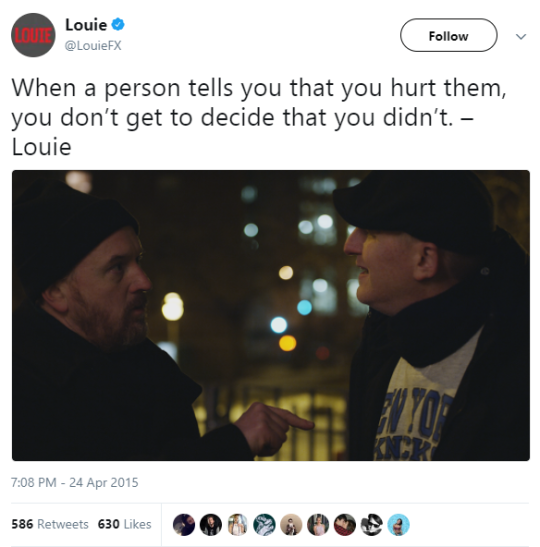
Before we move on, re: the concept of hurting people: I’ve been thinking about this quote, (which I thought it was a McElroy quote, but I see that it might actually a Louis C.K. quote? I don’t know who said it originally) Here’s the tweet:
image

“When someone opens up and reveals that they have been hurt by you, they are being vulnerable. It’s not always easy to admit that you’ve been hurt, and if someone tells you that you’ve hurt them, the least you owe them is your respect and acknowledgment of their pain. The worst thing that you can do is make them feel bad for opening up to you, make them feel like they’re the one who did something wrong, or tell them that you didn’t actually hurt them. You don’t know their feelings. If they’re telling you that you hurt them, then you hurt them. Accept this and apologize.” [6 Lessons We Can All Learn from Louis C.K.]

^It’s easy enough to apologize when you’ve physically stepped on someone’s toes because you weren’t looking. I’m grateful when someone tells me that I did that, rather than bottling up their frustration and thinking I’m a clumsy person. It’s easy to apologize in that situation.

It’s much harder to apologize when you wrote/said something that you thought was socially acceptable, in private or in public, and someone tells you that it was hurtful. A sincere apology is still necessary, but harder to do.

I struggle with wanting to be able to speak my mind on these very sensitive topics, like about Anne Rice being interested in sex before the age of consent and how that affected her writing, inspiring socially taboo situations in her works. To even suggest that there is nuance and something worth exploring in dark fiction, that could be taken (even unintentionally on the part of the person creating/consuming/discussing dark fiction) as hurtful to abuse survivors or anyone else. When I create/consume dark fiction, it’s an exploration, not promotion. I am not intending to belittle the experience of survivors of abuse or hurt anyone else. I can’t speak for Anne Rice or any other content creator/consumer, but I can keep saying that in my opinion, creating/consuming/discussing dark fiction is not a crime. Dark thoughts are not a crime. 

When someone is hurt by this exploration, it is partly their responsibility to avoid it. If X person tells me that my discussion of dark fiction (specifically incestuous/pedophilic undertones) hurt them, Louie C.K. is correct, I do not get to decide that I didn’t hurt X person. AND I apologize sincerely. I might also change my opinion of something based on this interaction. 

But I also remind X person that this is only my blog, with my own unauthorized opinions. Every blog is an opt-in experience, you choose to read it. If discussing these things = endorsement to X person, then I would ask them, respectfully, to Unfollow/Block me and not read my blog. In a social network like this, it may be difficult to avoid a blogger that upsets you, especially when it’s one of the fandom’s more popular blogs like mine is, but that’s why we tag things. I’m tagging this post with #pedophilia mention tw and #incest mention tw for those who don’t want to see even mentions of it. 

I hope that helped, Anon, and to anyone else reading this, it was not my intention to hurt anyone for expressing my opinions about learning about sex or about dark fiction. 


Hit the jump for more, cut for length.


To get back to your question…

Anon asked:

“What you were saying about Anne being interested in sex before she was the age of consent, and that being part of her motivation in writing sexual stuff with underage characters. It makes a lot of sense to me. I have some.. interesting emotional baggage from being interested in sex when I was a minor.”

*nods* I think many people are interested in sex before the age of consent, if not the psychological implications, then just the mechanics of it. It’s like anything you learn to do, like anything else, there’s a first time, it takes some practice and there’s awkwardness, so of course we’re curious about it!

I was curious about it as a child, my parents never tried to sell me on anything fictional like the stork bringing babies to expectant adults. 

The fact that the age of consent varies by country and even states in the US shows that different societies have different ideas about when a person can consent to physical intimacy, and it’s not universally 12:00 am on your 18th birthday. 

Anecdote: My ex-roommate lost her virginity to her boyfriend at age 15. She told me she had no regrets about it. Maybe she did and never told me, or never admitted it to herself, but I am sure that there are those who had similar experiences and were not necessarily abused.

“A lot of wounds that tumblr likes to stick it’s fingers in and that I dare not react to for fear of how aggressive this site can be”

You’re absolutely right about that. I have seen people dogpiled for all kinds of reasons. Generally, it’s thrilling to feel righteous. It feels good to be part of a group attacking a common enemy. There are all kinds of reasons for it and you are absolutely not obligated to expose yourself to people who are looking to pick a fight and bully someone off the site. As someone accurately described it to me, some people are predisposed to disagreement, and you do not have to engage in fruitless, unwinnable arguments. They’ll even move the goal posts so if you think you’ve made a valid response to their point, supported by reasons, they’ll say that wasn’t the point in the first place *eyeroll.* For some people it’s more about just winning your submission.

{{ BTW, I don’t think we often address when X person claims that they were hurt in ways (or for reasons) that are hurtful to the one they claim has hurt them, but that absolutely happens. X person might say this is tone-policing or victim-blaming, but I’m sure that some of them are aware that they wield their argument more as a sword than anything else. Both sides can be hurt by call-out posts, for example, which are less about teaching and more about mob mentality and shouting into the void, but I don’t want to delve further into that. }} 
Do you think it’s too much to ask that for the tv series they don’t..dive too much into the incestuous/pedophilic undertones that the books had at times? (Ex. Implying drinking blood could be a very erotic experience, then having adult vampires feed on children) I loved the books, still do! But as a survivor some parts were a lot to handle. Why do you think Anne Rice would go route in particular? I feel like if said things were taken out completely not much would drastically change in the books

Hello Anon, I’m sorry that it took me almost a month to answer this. It’s an extremely sensitive topic, as I’m sure you know, and these are very loaded questions. I took time to reach out to my trusted advisers, talked to them for hours, and considered their responses very carefully. 

I’m very sorry to hear that you are a survivor of this kind of trauma in real life. The fact that you are still able to love the Vampire Chronicles despite the fact that they contain parts that are difficult for you to handle means that there must be something good in them for you, and I hope you don’t lose your love for them. Could you come back and tell me some of the things/characters you love about them? Or how you first got into them? I love those kinds of stories!

This has become a very long post, much to my chagrin. I wish that I could simply agree with you and move on, but I can’t do that. The issues you bring up are very nuanced to the point that a blog post on tumblr can’t truly cover it all, but I will do my best to keep this blog post concise and to the point. I have also placed the cut only after most of my response as I have been accused of hiding things under cuts on past controversial topics, so it’s all out, clogging your dash. Sorry.

Before we go any further: My stance on dark fiction (in this case, incest/pedophilia) is that I do not endorse or condone it in REAL LIFE. Period.

TL;DR: No, I don’t think the VC tv series will “dive too much into the incestuous/pedophilic undertones that the books had at times.” Standards & Practices won’t allow it. I’m going to use the term “dark fiction” because I don’t necessarily agree with you that every instance of fictional adult vampires feeding on fictional children is definitely a very erotic experience for the vampire, and therefore carrying incestuous/pedophilic undertones, but it is definitely harm against fictional minors. Harm against minors and incestuous/pedophilic undertones all fall under dark fiction, however.

I’m not asking you to like dark fiction, Anon. There is some that I can’t stomach, either. I’m not saying people who like dark fiction are in any way superior to those who don’t. I’m advocating that some of us do want some dark fiction, and that consuming/creating dark fiction is not necessarily endorsement, whether you are a best-selling author, a fanfic writer, a filmmaker, a fanartist, a popular metal musician, or a cosplayer, or a consumer of the media made by any of these.

(1) The Rices have said that they will try to adapt the books as close to canon-compliance as possible. Whether that means including incestuous/pedophilic undertones and/or harm against fictional minors, the show will very likely have to follow it’s network’s Standards & Practices Dept.:

In the United States, Standards and Practices (also referred to as Broadcast Standards and Practices) is the name traditionally given to the department at a television network which is responsible for the moral, ethical, and legal implications of the program that network airs. [Wiki]

Further:

…the essential responsibilities of the editors [are]… assuring that the programming is acceptable to the bulk of the mass audience. This involves serving as guardians of taste with respect to language, sexual and other materials inappropriate for children,… [More about S&P from the Museum of Broadcast Communications.]

^These are the people who are paid to point out when dark fiction has crossed the line, and together with the showrunners, they decide whether something in a given episode should be revised or must be “taken out completely,” (which is censorship, defined as “the suppression or prohibition of any parts of books, films, news, etc. that are considered obscene, politically unacceptable, or a threat to security.”).

When we talk about censorship, the easy way to deal with dark fiction would be to just “take it out completely.” After all, why do we even need dark fiction? Not everyone wants it. Hannibal is a good example of why those of us who are fascinated by psychology want dark fiction. I found this great essay by Warren Ellis. Here’s a quote from it:

“… Fiction is how we both study and de-fang our monsters. To lock violent fiction away, or to close our eyes to it, is to give our monsters and our fears undeserved power and richer hunting grounds.”

“Fiction, like any other form of art, is there to consider aspects of the real world in the ways that simple objective views can’t — from the inside. We cannot Other characters when we are seeing the world from the inside of their skulls. This is the great success of Thomas Harris’s Hannibal Lecter, both in print and as so richly embodied by Mads Mikkelsen in the Hannibal television series: For every three scary, strange things we discover about him, there is one thing that we can relate to. The Other is revealed as a damaged or alienated human, and we learn something about the roots of violence and the traps of horror.”

(2) For movie!IWTV, I don’t know what the writing or editing process was like, but I would assume that there was a S&P Dept. of some kind (or at least similar considerations were taken into account) because there ARE instances of the vampires feeding on children that were changed from how they were presented in the book!!, there’s a few examples that come to mind, and in each instance, and I think it was revised to make it less incestuous/pedophilic. I have examples under the cut so you can avoid them if you need to.

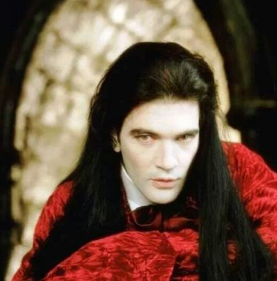
(3) One example of the filmmakers choosing to remove something (almost) entirely from canon: Armand being a teenager around 15 or 16 years old in canon, and he was aged up to the very not-teenage Antonio Banderas, who was 34 yrs old at the time. 

image

^There are still fans today who believe that that change drastically changed the story, and he’s still the butt of jokes about it. Personally, I would say that this change did not drastically change much in IWTV. I don’t think he was described as being that young in book!IWTV, and I don’t think his appearing to be a teenager would have, for example, had enormous impact on Louis’s feelings towards him at that time; that he felt like Armand could be the teacher/mentor Lestat couldn’t be. That’s just my unpopular opinion on that. I have more thoughts on

Antonio!Armand

in my #Defending Antonio tag. 

So yes, I think if some things like that were taken out completely that were not absolutely necessary to their given place in canon, not much would drastically change, but talk to anyone who really dislikes/disliked Antonio!Armand, and you’ll probably get a very different answer. 

SO… where does that leave us?

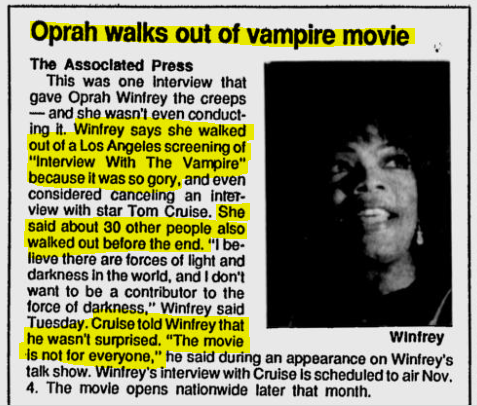
(4) In Fiction, we can explore these things from a place of safety, we can always close the book, or change the channel, or walk out of a movie theatre, as Oprah did during a screening of movie!IWTV in 1994 (my highlights added):

image

^She walked out because of the gore, which is understandable, there’s alot of blood. That, and the “force of darkness,” which isn’t all that specific. When Tom says, “The movie is not for everyone,” it’s not to say that anyone is lesser for not being able to handle it. I think he was intrigued by the darker aspects, and I think it might be the first truly antagonist/villain role he had taken up until that point. He wanted to explore that. 

I don’t believe in just cutting out all the dark fiction, each instance should be considered and handled with nuance. Revision is one option, and total removal might be the better choice in some instances.

I think that’s part of what made movie!IWTV so successful, the enormous amount of care and sensitive handling of dark and light fiction, what they chose to keep, remove, and alter.


(5) The other thing you asked was “Why do you think Anne Rice would go [that] route in particular?”

The question has been raised, many times, whether Anne Rice is, and has been, writing (essentially) propaganda for her own view regarding sexuality, especially as it applies to minors in sexual situations/relationships with adults. Whether Anne Rice endorses sex between minors and adults, it seems pretty clear that she does, as this has been an element of her writing in other series, as well. To my knowledge, she has committed no crimes against minors in real life, and therefore I do not hold her as a criminal of thoughtcrimes. That is definitely an unpopular opinion to other fans, and again, it is why I will not engage in an ultimately fruitless discussion about a crazy lady who writes the books she wants to read. Thoughtcrime is not crime.

Since you asked, I’ll answer why I think AR would pursue that line of thought, under the cut, in case it is upsetting.

I hope that answered your questions in the limited space of a blog post, Anon, and I hope you weren’t offended at any of my response, I tried to be as careful as possible and share my thoughts as respectfully as possible. If any harm was caused, it was not intentional on my part.


Hit the jump for things I said I’d put under a cut.


(2) Instances of the vampires feeding on children that were changed from how they were presented in the book!!:

  • Louis feeding on Denis (Armand’s mortal “pet”) under the Theatre. In the novel, Louis feels the boy getting a hard-on against his leg. In the movie, their only point of contact is the part of the boy’s hand Louis is biting. Seems to have taken some of the sexuality out of it, and I don’t think it drastically changed that moment.
  • Movie!Denis himself seemed to be a “peace pipe,” with all those other bites on his hand, and Louis has to feed on him in view of the theatre vampires, making it more about Louis’ discomfort about being watched while feeding which we know from canon he really does not like DUE TO THE INTIMACY of the experience. This, however, is not really clarified in the movie, and it seemed to me to be more about a trust exercise, that he was given this little sip and had to trust that they had not poisoned the blood he was taking. This change worked for me, because the fear of being poisoned was very real in light of how Claudia had poisoned Lestat so easily. 
  •  Claudia feeds on Denis in the book, I think she’s even curled up in bed with him. She doesn’t feed on him at all in the movie. I don’t think it drastically changed that moment.
  • When Lestat turns Claudia in the book, he has Louis drain Claudia a second time, implying that it’s to actually finish her off. This doesn’t happen in the movie, and I was kind of grateful, because it’s more upsetting in the book, when Lestat tears her away from Louis and starts turning her without any discussion about it with Louis first. I’d say that this was a change for the better.
  • When Claudia offers those boys as a peace offering to Lestat, in the book, he has his hands all in one of their shirts, and as the poison takes effect, his arms are tangled around the dead boy’s body, it’s kind of scarier, this dead body clinging to him and binding him. I would say that this worked for me either way. It’s already a tense and scary moment.

(5) “Why do you think Anne Rice would go [that] route in particular?”

From what I understand, she was interested in sex before she was the age of consent, and was frustrated that she was being prevented from pursuing sexual relationships. When she writes these scenes involving underage characters, I think she’s placing herself in the role of the minor, and in some cases, trying to empower that minor with some amount of agency (Amadeo axing Marius’ door down in TVA), but it’s up to each individual reader to interpret the story for themselves and decide for themselves whether that minor was capable of any agency at all or was under duress, or whatever else they might headcanon about that relationship.

Again, I do not think she has committed any actual crimes. Thoughtcrimes are not crimes.

Hi! I was just hoping to clear things up. I follow Anne on FB and today I saw a post about Lestat. And one of the replies were something along the lines of Lestat was evil, a pedophile and incestuous. This wasn’t an accusation and the person didn’t post it in attempt to call out Lestat, it was like causally stating facts, I just wanted to know how true is this? I just finished IWTV and I LOVED Lestat, but pedophilia/incest are really 2 themes in lit that make a book difficult to enjoy for me.

I’m sorry that you may have to stop reading the series. 

Whether there is pedophilia/incest in the novels depends on your definition of those things, and also your headcanons about the characters. 

Low-level spoiling here as a kind of trigger warning:

Incest: Technically, almost every vampire is made by a vampire to be their companion. Makers and fledglings have a parent-child relationship because of the nature of the Dark Gift. So every relationship that continues from that point is technically incestuous. Louis is Lestat’s child in this way.

The person who commented in that thread was probably referring more specifically to Lestat’s relationship with his mother, Gabrielle. While they do not have penetrative sex, they are far more intimate than a mother and son should be. I won’t spoil it further for you. You have to read TVL.

Pedophilia: There are several underage fictional characters throughout the series and they are sometimes spoken of in a sexualized manner (Claudia, for example), and/or have non-consensual, dubiously consensual, and consensual sex (well, a child cannot truly give consent, you would have to read The Vampire Armand to better understand the consent from the underage characters) with adult fictional characters. 

If those topics make it difficult for you to enjoy the books, then I think you might consider not reading them further.

I found this great essay by Warren Ellis. It might help you. Here’s a taste, with my emphasis added in bold:

“… Fiction is how we both study and de-fang our monsters. To lock violent fiction away, or to close our eyes to it, is to give our monsters and our fears undeserved power and richer hunting grounds.“

“I don’t understand.” How many times have you read that in conjunction with a violent act?

“I don’t understand why he did it.” Or “I don’t understand why this happened.” Sammy Yatim, shot dead and then tasered by police on a Toronto streetcar, and even the chair of the Police Services Board asks, “How could this happen?”

….Here in Britain, our weakling government is attempting to launch a web filter that would somehow erase “violent material” from Internet provision — placing it, by association, in the same category as child pornography. Every week seems to bring a new attempt to ban something or other because it’s uncomfortably or scary or perhaps even indefensibly disgusting.

….we generally demonize violent acts and violent work. We make them Other, and we just distance ourselves. They are Other, and they didn’t come from us, and we’re just going to stand over there and shake our heads sadly. And, moreover, anyone who gets closer to it in order to experience or understand it must be a freak.

…The function of fiction is being lost in the conversation on violence. My book editor, Sean McDonald, thinks of it as “radical empathy.” Fiction, like any other form of art, is there to consider aspects of the real world in the ways that simple objective views can’t — from the inside. We cannot Other characters when we are seeing the world from the inside of their skulls. This is the great success of Thomas Harris’s Hannibal Lecter, both in print and as so richly embodied by Mads Mikkelsen in the Hannibal television series: For every three scary, strange things we discover about him, there is one thing that we can relate to. The Other is revealed as a damaged or alienated human, and we learn something about the roots of violence and the traps of horror.

… Fiction is how we both study and de-fang our monsters. To lock violent fiction away, or to close our eyes to it, is to give our monsters and our fears undeserved power and richer hunting grounds.”