I had to think about this one for awhile, bc my immediate reaction was to defend Louis and say: “Oh no, our sweet bb Louis wouldn’t kill a child! Nor a preteen or teens! He may not choose guilty from innocent but surely a teen and under would be safe from him??!”
But he’s NOT a sweet bb. He’s a vampire.
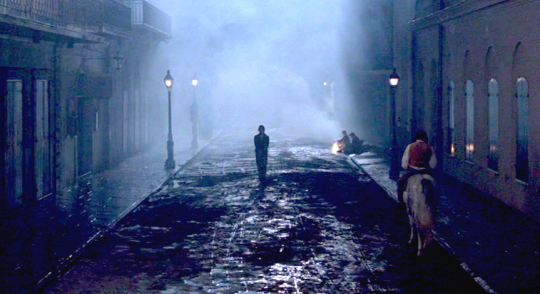
Louis killed Claudia, or attempted to do so. More on that in a bit. The only further explicit reference we have re: his killing methods in canon is in QOTD, when Akasha states that he kills “without regard for age or sex or will to live.“ and since she can read his mind and Louis does not correct her on that statement, I would assume that she’s pinned him accurately.**
(**Note 1: in the scene at the end of book!IWTV (which we still don’t know if it actually happened or not, bc unreliable narrators), Louis takes a baby that a young vampire brings to feed to Lestat, and returns it to its home: “I returned to the small house from which the vampire had taken the child, and left it there in its crib.” So maybe BABIES are safe from Louis!)
(**Note 2: Louis accepts the offer of taking a bite of Denis, Armand’s mortal preteen/teen pet at the Theatre des Vampires, not knowing if Armand intended him to kill this offering or not, but in the book, Louis takes it without any resistance and Armand takes Denis back before Louis can finish him BC HE MIGHT HAVE.)

TL;DR #1: Yes, I do think Louis would kill a lost child/preteen/teen, and I think that the circumstances of such a choice could be worth exploring in fiction.
TL;DR #2: I think it would be unlikely for Louis, on his own, to kill one member of a group of ppl of any age, for the practical difficulty of killing one of them w/o the others noticing and causing a scene. I think this would make his kill more difficult than necessary, as Louis kills perfunctorily, only exerting the amount of time and effort required to satisfy the need:
“I would let the first hours of the evening accumulate in quiet, as hunger accumulated in me, till the drive grew almost too strong, so that I might give myself to it all the more completely, blindly.
“…I lingered only a short while, long enough to take what I must have, soothed in my great melancholy that the town gave me an endless train of magnificent strangers.
“For that was it. I fed on strangers. I drew only close enough to see the pulsing beauty, the unique expression, the new and passionate voice, then killed before those feelings of revulsion could be aroused in me, that fear, that sorrow.” (IWTV)
^If his killing style had changed since then, I think he would have mentioned it to Daniel during the interview.
It also begs the question whether he would kill the elderly, people with disabilities (mental, physical, etc.), and other types of people whose defenses are lowered to some degree, and I think “indiscriminate” applies to all of those categories. Yes to all, Louis kills indiscriminately.
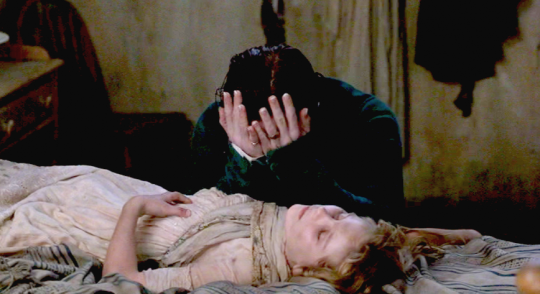
TL;DR #3: Claudia is a child Louis kills (well, attempts to kill) in canon, and her similarity to Anne Rice’s daughter (who died at the age Claudia was turned) was very likely the reason for Anne writing IWTV in the first place. Through the characters in IWTV, I think Anne asked the questions to get the answers to exorcise her demons regarding that loss. Fiction is a safe ground from which we can examine and lance the pain we have experienced in real life and release it, and in sharing the story, we might give others a catharsis, too. I think this novel’s rich exploration of these difficult issues is part of what has made it so beloved by her readers, we can relate deeply with her story in our own ways and feel a catharsis from her explorations.
There are parents who outlive their children bc of these early-childhood diseases (and other reasons) and they have to find a way to go on living, and even trying to be happy again. I’m sure Anne will always experience pain from this loss, but through fiction, she may have been able to achieve enough closure to go on living her life.
I think Anne’s answer for herself at the end of writing IWTV was, “Neither you nor your daughter, nor anyone else, were being punished. Michele was in the wrong place at the wrong time.”
Hit the jump for more, cut for length.
1. “So if a lost child happens to cross his path would he kill them?”
A) I think that Louis feels like he, personally, shouldn’t judge who should die, and that therefore ppl who cross his path of any age are fair game. Louis was very Savage Garden about it before he was aware of the concept. In the Savage Garden, tigers can’t really be held responsible for killing the young, infirm, or elderly of their prey. Vampires are not human, even though they were once human, and some seem very human still… some of them hold themselves to human laws and morality about killing, but some of them do not.
B) If a child is lost at night without a parent or guardian, if the child was as abandoned as Claudia was, I think Louis would probably still kill them. It could be considered a case of the child being in the wrong place at the wrong time.
After all, it would fall under the Savage Garden concept, they’re at risk of more than just being Louis’ dinner. Louis is just another risk out there, maybe scarier because you might be able to reason with him where you can’t with, for example, a virus or a tiger.
C) is for CLAUDIA: While it’s true that Claudia didn’t exactly “cross his path,”
Louis was drawn to her cries and she was a lost child, abandoned by her parents. Her father had left, her mother was dead, and she was defenseless. Claudia might have already been sick with the plague, or might have died from starvation.
One could argue that Louis killing her was more merciful than the slow death she might have suffered if no one had found her ;A; There are situations where death is more preferable to suffering. We don’t know whether she could have been saved from death if brought to the hospital in time; even a hospital and the best medical care is not a guarantee that a life will be saved.
Louis was filled with guilt and shame when Lestat found him with Claudia, and I do think that Lestat turned Claudia to take that guilt from Louis. At that time, this was Louis’ first human kill in years, and Louis might have committed suicide for the guilt of having killed an innocent child if Lestat hadn’t “given her another life.”
2) So if a bunch of punk preteens or teens
happen to cross his path
would he kill them?
As far as “a bunch of punk preteens or teens,” Louis still would not judge them, even though society tends to think less of “punks” for disrupting the peace, vandalizing property, or otherwise purposely causing trouble. So I don’t think they would be targets for Louis specifically because of their “punk” label.
Louis would
probably not be interested in a group of any type or age (even a group of violent middle-aged bikers would be safe!); as it would be difficult to kill one of them in the presence of the others without creating trouble. He goes for people who are out on their own. I don’t think he’d want to go to the effort of coercing one away from the pack.
It’s not canon but I would think Louis can share kills with other vampires now, and he would be able to do so more stealthily with another vampire or two with him, if they wanted to take down more than one victim together, any age.
3) Re: Claudia being Michele Rice: I think that Louis’ attempted killing of Claudia is the major impetus behind IWTV being written in the first place. Anne Rice lost her own daughter at the age Claudia is turned, and Anne was going through the pain of that loss, asking why it happened to her daughter. Had Anne been an irresponsible mother? Was it God’s punishment for Anne (and/or her family) failing to be a devout enough Christian? Was her daughter being punished for some crime?
Was it Satan?? Was it a case of a bad thing happening to a good person?
To my mind, IWTV’s real cornerstone, on which the rest of the story was built around, Anne Rice created muses through which she could ask these questions and try to get the answers.
Anne said she modeled Louis after herself, but he also represented Death. Anne wanted these answers:
- Why did Claudia die?! Bc Louis killed her.
- Who’s this Louis monster and why did he have to kill her?! Well, he’s a vampire, that’s what they do.
- Ok… But why did Louis have to kill an innocent child specifically? Bc he was a vampire who had been sustaining himself on animal blood for years. and he was in a state of malnutrition and extreme desperation, and this child was nearby and defenseless. She had done nothing wrong.
- Also, Louis felt terrible for this, even though he admits to Daniel that the act itself (as all blood drinking is to vampires) was pleasurable. Louis does not bring it up to Claudia herself until she began to rebel and demand answers.
So I think Louis battling with his religious upbringing, whether he was from the Devil, and having so much guilt about killing all victims (especially Claudia!) was a release for Anne, bc she could empathize with the entity she created who killed her child.
If the murderer himself felt guilt over it, that may have helped Anne achieve some measure of peace.
 I-want-my-IWTV