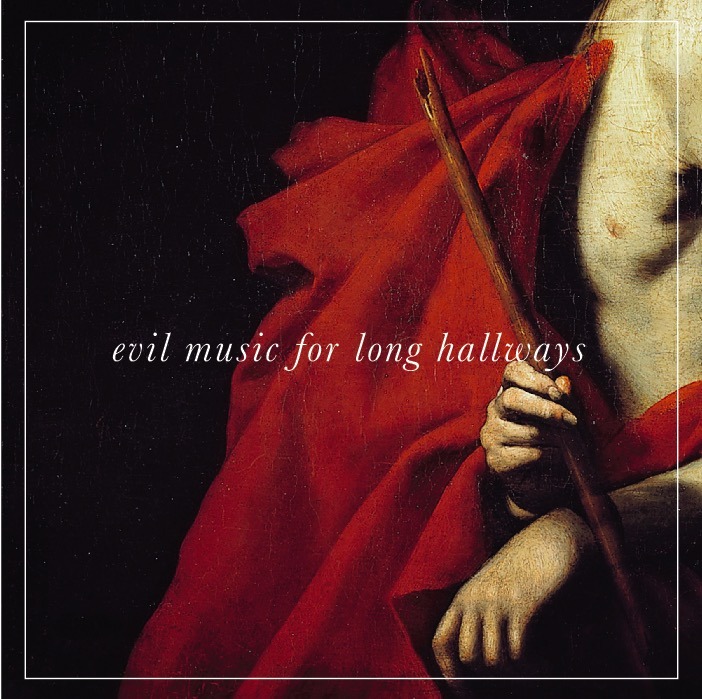
Evil Music for Long Hallways – a playlist for those days when you just need a little push to prove that you are of darkness inherent, even if the world around you does not point to it.
Perhaps I’m feeling macabre, but tonight I’m digging out my favorite spooky classical pieces and listening to them. So I thought putting together a top ten list of these would be fun while I drink my scotch. Note: These are not really in any particular order. I love them all.
1. Beethoven: Piano Trio in D major, op. 70 no. 1, “Ghost” – 2nd movement. Rattling of chains, shrieking of spirits; the nickname of this trio fits it well. The first and third movements are good as well, but only the second movement is really spooky. 2. Schubert: Der Leiermann (from Winterreise). A heartbroken young man sings about the hurdy-gurdy, an outcast who sits just outside the village and plays his instrument while dogs snarl at him and people ignore him.
Particularly chilling is that this is the last song of an hour-long cycle, and it drones on without clear resolution, ending with the line: “Strange old man, should I go with you? Will you accompany my songs on your hurdy-gurdy?” 3. Mussorgsky: Night On Bald Mountain. You may know this one from Disney’s Fantasia, which is featured during the Witches’ Sabbath sequence. 4. Schubert: Der Erlkönig. Based on a poem by Goethe, this song tells the chilling story of a father and his ailing child riding through the woods on horseback, while a malicious spirit tries to lure the boy away, unseen and unheard by the father. 5. Saint-Saens: Danse Macabre. Death plays his fiddle in the cemetery, rousing all the skeletons from their graves and dancing with them until they have to slink back at the first light of dawn. 6. Brahms: Ballade in D minor, op. 10 no. 1, “Edward.” Based on a Scottish ballade, the story is of a mother who knows that her son has murdered his father – she just wants to hear him say it himself. 7. Shostakovich: Viola Sonata. Shostakovich composed during the height of Soviet censorship, and his music almost always has a hunted, almost panicked feel to it. He composed this viola sonata just a month before his death. 8. Shostakovich: String Quartet no. 8 in C minor, op. 110. Between the frenzy of the second movement and the insistent “knocking on the door” of the fourth, this quartet can really put you on edge. What makes this music even freakier is Shostakovich’s musical signature (D E-flat C B) throughout the work. 9. Mussorgsky: The Hut of Baba Yaga the Witch (from Pictures at an Exhibition). This one always sounds like Baba Yaga’s “Hut On Chicken’s Legs” is chasing me through the woods, but that might just be my wild imagination. 10. Scriabin: Piano Sonata no. 9, “Black Mass.” Some of the directions that Scriabin writes in the score are “mysteriously murmuring”, and “with a sweetness that becomes increasingly poisonous,” which is a pretty apt description for much of this work. It begins mysteriously, then builds in tension until it all explodes in some kind of orgiastic climax. It ends just as enigmatically as it begins.
bc sometimes you just want a little mood music for re-reading the handbook and plotting galactic domination (or for writing a darkfic or battle-scene).
Schnittke: Seid nuchtern und wachet (Faust Cantata); VII. Es geschah (It came to pass) IT’S AN EVIL TANGO. ABOUT FAUST. BEING DRAGGED. INTO THE UNDERWORLD. Come on.
I’d love to have a more in-depth discussion of this sometime, but here’s a few facts off the top of my head
Mozart used to stay out all night partying and getting laid and then he’d sleep until noon and his long-suffering jerk of a father had to drag him out of bed to practice
He also wrote the overture for the opera Don Giovanni the morning it premiered, while extremely hungover
The interval between a perfect 4th and a perfect 5th (a tritone) was called “the devil’s interval”, and for centuries composers avoided it at all costs because it was believed to cause madness, violence, and sexual desire
Franz Liszt played so intensely that he physically destroyed pianos and they had to invent a stronger one (which is the model still used today)
Another thing about Liszt: women used to throw their underwear at him while he was performing. He was the first one-man boy band.
At the premiere of The Rite of Spring the audience was so alarmed by the dissonance and non-traditional style that they left their seats to storm out or beat each other up in the aisles
Many symphonies use non-traditional percussion like canons or massive wooden mallets, modern classical composers like John Cage like to stick things in piano strings
Shostakovich was the most hardcore composer (though I’m biased because he’s my fave). He barely escaped being exiled or killed by Stalin while continuing to write music containing forbidden folk melodies or thunderous movements depicting the dictator himself.
Paganini had no teeth and apparently looked like the devil
If folks have other facts I’d love to hear them!
J.S. Bach straight up lost one of his first jobs because he got in a sword fight with one of his students. He was 20. His student was 23. Apparently he called the student a “nanny-goat bassoonist”.
There is an opera about a magical ring that gives the wearer the power to rule the world. Through all the carnage for ownership of the ring, ALL the gods die, and Valhalla is destroyed. The opera is known as “The Ring Cycle” by Richard Wagner, and it is 15 hours long.
Oh and another thing about Liszt, he used to wear gloves and then throw them dramatically into the audience (of what I can only imagine as screaming teenage girls) before he performed.
Mozart wrote a piece called “"Leck mich im Arsch“, or “Lick Me in the Arse.”
Before batons was used for conducting, they used “pointed staffs” that would beat the tempo against the ground. Jean-Baptiste Lully stabbed himself through the foot with it, and therefore died from gangrene from the wound.
There is an aria in Lucia di Lammermoor in which the soprano has gone completely mad and has stabbed her husband to death. She sings with an accompanying flute (a bird that she’s hearing in her head), while in her wedding dress – covered in blood.
In Berlioz’s Symphony Fantastique, movement IV – “The March to the Scaffold”, the music depicts a young man’s march to the guillotine. You can hear the moment his head is cut off and bounces down the stairs.
I could probably go on forever. Classical music is fascinating!
THE DEVIL’S TRILL / 20 pieces of classical music for halloween
01. Swan Lake Suite, Op. 20: Scene – Tchaikovsky 02. Organ Fugue in G Minor – J. S. Bach 03. Concerto in D Minor “L’Estro Armonico #11” i. Allegro – Vivaldi 04. Pictures at an Exhibition: Catacombs, Roman Sepulchre – Mussorgsky 05. Violin Sonata in G Minor “Devil’s Trill” – Tartini 06. Sonata No. 12 in A-Flat Major, Op. 26 iii. Funeral March for a Dead Hero – Beethoven 07. Impromptu #4 in C Sharp Minor, Op. 66 – Chopin 08. Quartet No. 3 v. Moderato – Shostakovich 09. Subito – Lutoslawski 10. Danse Macabre – Saint-Saens 11. Sonate pour alto seul, Chaconne chromatique – Ligeti 12. Scottish Fantasy for Violin & Orchestra, i. Einleitung – Bruch 13. El Amor Brujo: Ritual Fire Dance – de Falla 14. Sonata in G Minor for Cello & Piano, Op. 19 ii. Allegro Scherzando – Rachmaninoff 15. Otello: Preludio – Verdi 16. La Muerte del Angel (tango) – Piazzolla 17. Concert Suite in G Minor for Violin & Orchestra, Op. 28 v. Tarantella: Presto – Taneyev 18. The Firebird Suite: Infernal Dance – Stravinsky 19. Le Mandarin merveilleux, Op. 19 – Bartok 20. Symphonie Fantastique, Op. 14 v. Dreams of a Witches’ Sabbath – Berlioz

 I-want-my-IWTV