you know when you read a piece of writing so effortless, so graceful and unpretentious that you are both a) thrilled to the point that you have to put it down and walk in a quick circle to make it last longer but also b) PHYSICALLY INCAPACITATED with snarling jealousy and rage
That’s true, art is different than writing in terms of the immediate engagement of seeing it. And yet, in galleries/museums, I can only remember a handful of times I’ve ever seen warnings for art that could be potentially upsetting in the context we’re using. With paintings like Judith Slaying Holofernes by Artemisia Gentileschi, you round a corner, and !!! someone’s getting brutally beheaded in vividly gorey detail. However, to attempt to discuss [fanworks] vs. [museum (or gallery)-displayed artwork and published fiction], that’s a potentially long and difficult discussion, and your blog is about fanfiction specifically, so I won’t go there.
But I do think we have to drag published fiction into the discussion as that’s what the fanworks are based on. As you wrote:
My concern is always that a tag like that is going to change how people interpret my work into something I didn’t intend. Like, I’ve been asked to tag things as abuse before that I really didn’t agree WERE abuse, just regular conflict in a relationship. I can appreciate that that might be upsetting someone, and would like to give them a way to avoid it, but I don’t want to label something as abuse if it’s not, either.
I agree with you on this. As “beauty is in the eye of the beholder,” so is “abuse is in the eye of any given reader,” whether or not the author intends it to be a depiction of abuse. Our fandom is based on works that contain plenty of problematic elements (including abuse) that the author most likely does not consider problematic, even when many of the fans are in agreement that they are problematic. Still, “many” is not “all,” and I choose not to trample on fans/fanficwriters/fanartists who ship A/B by tagging every depiction of
A/B
with {#abuse}, even when other fans condemn A/B as being a problematic and specifically abusive ship.
When fanartists and fanwriters take these same problematic elements from canon and extrapolate, they’re handling the same “tainted” material, whether or not they depict A/B as abusive, and therefore bear the brunt of the demands for tagging their works with {#abuse}.
So I don’t know what the answer is bc as I said above, I would not want to needlessly upset someone, but I also see it from the shipper/fanficwriter/fanartist/creator’s POV.
If we can’t agree on what should be tagged as {#abuse}, I feel like Dead Dove: Do Not Eat should apply:
I guess that writing is a little different, since it’s unlikely people are going to just glance at the work and be upset by something there. They sort of have to engage with it.
My concern is always that a tag like that is going to change how people interpret my work into something I didn’t intend. Like, I’ve been asked to tag things as abuse before that I really didn’t agree WERE abuse, just regular conflict in a relationship. I can appreciate that that might be upsetting someone, and would like to give them a way to avoid it, but I don’t want to label something as abuse if it’s not, either.
Dead Dove: Do Not Eat is a warning or tag used to indicate that a fanwork contains tropes or elements that may be deemed “problematic” without explicitly condemning the problematic aspects.
The “Dead Dove: Do Not Eat” tag would essentially be a “what it says on the tin” metatag, indicating “you see the tropes and concepts tagged here? they are going to appear in this fic. exactly as said. there will not necessarily be any subversion, authorial commentary condemning problematic aspects, or meditation on potential harm. this fic contains dead dove. if you proceed, you should expect to encounter it.”
I don’t feel that a
(published or fanfic)
writer is required to condemn abuse in the narrative, especially when, as you point out, they may perceive the abuse in question as regular conflict in a relationship. “Regular” is also up for debate, of course. As a fandom’s lifeblood is its fanworks, my feeling is to try to find some compromise between allowing the shipper/fanficwriter/fanartist/creators to create the fanworks they want to create, and for that to be done in a way that offers the most protection possible for people who might be upset by those fanworks.
well, i believe every artist out there has struggled (and still struggles) with the same issues as you, lovely person, so don’t worry that much about it. imo i think an art style is developed rather than ‘found’ if you know what i mean.
i can understand why people want to find the thing that’s theirs and all, but that shouldn’t be the main reason for drawing. an art style is something people grow after they finally enjoy what they’re doing and only after they know art is something that makes them feel things.
an art style is like a kid, right? like, your own child— your personal creation.
So, so many works I’ve read could be vastly improved with tightening and shaving of superfluous words. Wordiness is an easy stumbling block, as we’re used to how we talk. We’re used to how others (long ago) wrote. But times change, my friend, and so do expectations of the writer. We don’t get paid by the word in fiction. So show your smarts and say as much as you can with as much power as you can in as few words as possible.
Here are a few things you can cut without reserve to help shorten your story right now. And as you catch yourself using these words in your next draft, hit that backspace before you finish the sentence! It’s okay if you already have. You can go delete them now. No one will ever know.
Moment/Second/Minute
It’s so tempting. I am guilty of using this word like fertilizer in my first drafts. But most of the time, these words aren’t needed at all. They add nothing.
He sat down for a moment, sipping his coffee. vs. He sat down and sipped at his coffee.
But he only did it for a moment, you say!
He sat down for a moment, sipping his coffee. When the door opened a second later, he shot to his feet. vs. He sat down and sipped his coffee. The door opened, and before he could swallow his first sip, he shot to his feet.
I know, this is about making your writing more concise and my “right” example has more words than the first example. But what’s the difference? The words used in the second sentence are more tangible. They give a visual that “a second later” and “for a moment” don’t. And you could leave that part out, of course, if you’re really going for trimming word count. It doesn’t paint quite the same image, but “The door opened and he shot to his feet.” is a perfectly good sentence.
Suddenly/All of a sudden
You’ve heard this one, before, surely. These words are used…when? When you’re trying to portray suddenness. Surprise, perhaps. So why are you adding in extra words to slow down the pace?
She flipped on the TV and reclined in her chair. All of sudden, the TV flashed a bright light and the power went out. vs. She flipped on the TV and reclined in her chair. The TV flashed once before the lights went dark. The power was out.
That sense of immediacy is felt when stuff just happens. So let it happen. If it’s rhythm you’re worried about, then find more useful words to create the rhythm. Notice that I didn’t just cut “All of a sudden” out of the sentence and leave it. I reworded it a bit to make it stronger.
Finally
It can be a useful word, but more often than not, it’s just taking up space.
“Substitute ’[fucking]’ every time you’re inclined to write ‘very;’ your editor will delete it and the writing will be just as it should be.”
But seriously, if you’re saying, “She was breathing very hard.” You could just cut the “very” and say, “She was breathing hard.” Or, even better, “She was panting.” Or, EVEN BETTER: “She panted.”
Himself/herself/myself/themselves
Reflexive nouns have a specific purpose, though they can still often be avoided. They fall into the category of “use only when it’s confusing otherwise.”
Correct: He looked at himself in the mirror. Better: He looked in the mirror.
Incorrect: She gave them to Andrew and myself before leaving. Correct: She gave them to Andrew and me before leaving.
Technically correct I guess: I haven’t eaten lunch myself. (Intensive pronoun; aka waste of words) Better: I haven’t eaten lunch.
Intensive pronouns add emphasis, but that emphasis is negligible and often negated by the power of tightening your narrative.
That
You can likely cut 60% of your “that"s and your story will be unaffected. Sometimes, you do need to add a “that” here and there for clarification, but not always. And sometimes it’s just plain incorrect.
The jacket was the coolest one that he’d ever owned. vs. The jacket was the coolest one he’d ever owned.
In other cases, you might do well to substitute “that” with “which.” Though, if you’re doing this, make sure you do it properly. That change can often alter the meaning of your sentence. That can be for the better, though.
The vandalism that read “Bad Wolf” made Rose nervous. vs. The vandalism, which read “Bad Wolf,” made Rose nervous.
Do you see the difference? In the first sentence, the words are what make Rose nervous. In the second, the vandalism itself makes Rose nervous, and it happens to say “Bad Wolf.” In this case, if you’ve watched Doctor Who, then you know the first example is the correct one.
So when you’re sharing details using “that” or “which,” contemplate how important they are to meaning of the sentence to determine which type of clause you need to use.
Then
Or worse, “And then.”
It makes your writing sound a bit juvenile. Either cut it entirely, or substitute “and.”
She jumped into the pool, then hit her head on the bottom. vs. She jumped into the pool and hit her head on the bottom.
And then, after all that time, she fell asleep. vs. After all that time, she fell asleep.
Even
Sometime “even” can help emphasize a situation or behavior, but when it’s used in narrative improperly, it sounds childish and silly.
He couldn’t even breathe. vs. He couldn’t breathe.
Even with the new hair gel, his hair was terrible. (This one is fine, though you could still cut that “even” if you really wanted to…)
Just
Just…Delete it.
Breathe/breath/exhale/inhale/sigh/nod/shrug
Another one I’m so guilty of. In my first drafts, I tend to talk about how a character is breathing, or when they’re sighing like nobody’s business. I know a lot of writers who are guilty of this, too. It’s a great tool to use scarcely. In intense moments, you can let your character take a final deep breath to calm themselves. When a character almost drowns, those first few sweet breaths are important. But you readers know that people breath all the time. And just because you need a beat in your dialogue doesn’t mean you need to remind your reader that the character is still breathing or moving.
Rather/quite/somewhat
She was rather tall. She was tall. He was quite idiotic. He was idiotic. They were somewhat snazzy. They were snazzy. Why do you need those words? Kill ‘em.
Start/begin
This is a great example of fluff.
She started to run toward the shop. vs. She ran toward the shop.
He began scolding them for their performance. vs. He scolded them for their performance.
There are obviously uses for this word, like anything. He started the car. Begin your tests! But when you’re using it to slow the action and the pace of your narrative, then consider heavily if you need it. You probably don’t.
In order to/in an attempt to
Phrases that add unneeded complications, cumbersome wording…kill ‘em!
She bit down in an attempt to stop herself from screaming. vs. She bit down to stop herself from screaming.
Was able to
He was able to call. vs. He could call. OR He called.
This is one that isn’t inherently bad, but it can easily be overused and cutting it will help simplify your narrative.
Due to
Ugh. Are you trying to sound proper and stuffy? Because that’s a reason, I guess, to use this phrase…and yet it sounds like doodoo. (Yes. I’m an adult.) Rephrase. Use “Because of” or just avoid the need altogether.
We stopped due to traffic. vs. We stopped because of traffic. OR (Strength of narrative!) We stopped mid-highway. The parked cars went on beyond the curve of the road, out of sight.
Visibly/obviously/apparently/audibly
These are a sign of telling in your narrative when you should probably be showing.
She was visibly shaking. –> She shivered, hugging her upper arms. He was obviously tired. –> He yawned and tripped on his own feet as he crossed the room. They were apparently angry. –> They stomped and shouted, demanding attention. She screamed audibly. (Really?) –> She screamed.
Don’t tell your readers what emotion a character is feeling. Instead, give a few clues that they can see/hear/feel the emotion too.
While
This word has lots of legitimate uses. However, if you’re using it poorly, then your narrative reads like an Early Reader’s book, and you (unless that’s what you’re writing) probably don’t want that.
“Get it together,” he said while flipping them off. vs. “Get it together,” he said, flipping them off.
Turned
One of the classics. So overused, my friends. It’s needed on occasion, but not nearly as often as we use it. Just cut it out.
They turned toward her as they spoke. vs. They gave her their full attention as they spoke. OR They looked into her eyes. OR (Nothing. Readers don’t have to be updated on every little movement.)
Saw/looked/regarded
UGH. Regarded:Looked::Mentioned:Said
And, like “said,” many, many instances of these words can be nixed.
She saw them run for the hills. vs. They ran for the hills.
This can be tricky, I know, when you’re writing in limited-third or first POV. It’s tempting to put every action directly through your POV character’s filter. But resist that temptation! There are times when it’s appropriate, occasionally, but it can be overdone so easily.
I looked at her and said, “Please.” vs. I said,“ Please.” OR. I took her hand. “Please.”
This example sides with the breathing and the turning. It’s often an unneeded update on the tiny movements of the characters. And, again, sometimes you need that beat or that little detail in an intense moment, but not often.
I’m not here to tell you to cut all your dialogue tags (please don’t). I’m also going to the last person who insists you get rid of “said.” In fact, I’m in the “said is invisible” party of writing nerds and I think, if you’re going to use a standard tag, it should be “said” 90% of the time.
But aside from that, using as few dialogue tags as possible is a good thing. I’ll do a full post on this soon, but for now, be aware of how often you rely on these words in your dialogue and do your best not to overuse them. Use surrounding action and context to take some of the reliance off of these words.
To-Be in all its conjugated forms
If you’re using any of this list:
am, is, are, was, were, be, being, had been
Then check yo’self. Some tenses call for an auxiliary verb. Some types of sentence do, too, not doubt about it. But many don’t, and cutting to-be verbs when you can will help tighten your writing.
We were going to the store. vs. We went to the store.
Sounds were echoing through the chamber. vs. Sounds echoed through the chamber.
To-be verbs can also be an indicator of passive voice, though they aren’t always.
He was hit by the ball. vs. The ball hit him.
Last but not least, check all of your adverbs.
Chances are, if you’re using an adverb, you could be using a single strong verb instead and giving each sentence more punch.
He ran quickly. –> He sprinted. I hit him hard. –> I socked him. She spoke quietly. –> She whispered. They ran into each other fast. –> They crashed.
So what am I supposed to do about this?
Take it to heart. Try not to let these words take over your brain as you write. Once your manuscript is finished, try this method:
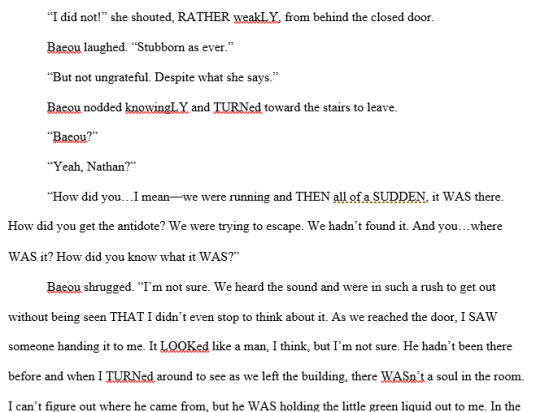
Use Find and Replace. Replace any and all of the aforementioned words in ALL-CAPS. Now, if you’ve paid attention to my advice in using emphasis, then those all-caps will really stick out as you’re reading over your work and you can decide at each instance whether your usage is appropriate, or if it needs to be rewritten. As I did to this very old draft of mine from my first NaNoWriMo (in which I used every single word on this list, I’m sure).
When I used this method with my most recent WIP, I was able to cut my word count from 105k to 93k without cutting any content whatsoever. It takes a lot of work and it’s pretty tedious but the results are amazing!
It wouldn’t be the English language without exceptions, would it?
Now, there is actually an important time for intentionally using any or all of the words on this list. You know when that is?
When it fits the character’s voice. – More on this in my next post!
Other, More Considerate People: I like to keep my story as close to canon and ship-free as possible so everyone can enjoy it. 🙂
My Self-Indulgent Ass: ‘Sup, assholes, here’re all my implausible OTPs, their future children, a bunch of OCs that play prominent roles, and all my sexuality headcanons are in effect.
“To understand this fic you’ll need to refer to page 15, side A of my Extensive headcanon timeline of the entire history of this character and everyone he ever met, the contents of which are helpfully provided absolutely nowhere.”
“behold as I construct the precarious scaffolding of this story from discarded tumblr shitposts, my id, a dream I had once, poorly concealed psychological projection, the abstract concept of the way it feels to look out at the sea, and a bunch of dumb jokes I couldn’t stop cackling to myself about. oh, but it’s fanfiction.“


 I-want-my-IWTV