First off, darkfic as an umbrella term encompasses a lot of subjects and ‘dark’ topics, abuse being only one of many. It may be therapeutic for people who’ve endured abuse, but it can also be helpful for people who’ve struggled with other forms of trauma, or with mental illness, or other negative things. Depictions of intense, dark experiences can serve as a catharsis by being a direct analog for one’s own experiences, but they can also function more indirectly as a parallel, or a metaphor. Someone who has not been assaulted, but who has struggled with mental illness, may find a story about an assault victim resonating with them as they can identify with the fear and lack of control. And someone who has never been through a specific traumatic experience, but has a lot of fear of it and cultural anxiety around it, may feel bolstered by stories of characters surviving and recovering from that experience.
So for many people, with many different experiences, there can be a direct, therapeutic/comforting benefit to darkfic.
But darkfic doesn’t need to be therapeutic.
There are, of course, other kinds of benefits. Someone who has never been abused might read a story featuring abuse (and clearly tagged for it) and because of it, identify potential warning signs in a real life relationship down the road and know to get out early before things get worse. Or, they might develop a better understanding of what abuse victims go through and as a result, have more empathy for real-life survivors they encounter.
But it’s also 100% ok to like darkfic purely for entertainment value! It is, after all, fiction.
Dark stories challenge us – and we can really enjoy that challenge. They take us to extremes of emotion and the human experience. They plumb the depths of the human id. Even someone with the most charmed life still lives in a world where bad things happen, and even the sweetest, naive person has the capacity for darkness in them. Darkfic lets all of us explore those in relative safety. It makes us feel, and can thrill and horrify us as much as any thriller or horror movie. It can make us consider our own darkness, and be more aware of it. And it can take us to a place so much worse than our reality, that when we resurface into our mundane lives, there’s a sense of relief; we’ve escaped from our escapism, and our hum-drum lives seem so much better and more manageable by comparison.
Plenty of people create dark content who aren’t abuse survivors. There are books with very dark themes that are written by, edited by, published by, and consumed and made popular by people who have not been abused, but which may prove a lifeline for a survivor – one that might not have existed if the entire genre was limited to only people with lived experience. And by accepting that anyone can produce or consume dark content, we allow survivors the protection of anonymity, by not forcing anyone to disclose and reveal their trauma in order to justify liking a work without being harassed and shamed for it. Creating an exclusive club of heavily-scrutinized creators and readers who have to be ‘this traumatized to ride’ helps no one. Hell, trying to pass moral judgement on anyone by scrutinizing the potential reasons they may have for enjoying certain kinds of fictional reading material, rather than looking at their actions toward real breathing human beings, is utterly inane. Especially when fiction – including, and sometimes especially dark fiction – can be used to expand our horizons beyond our own lived experiences make us more thoughtful, empathetic people on the whole.
Fiction affects people. And people affect reality.
Can fiction have an indirect effect on reality? Sure. But it’s not what’s responsible. People are the ones with moral agency. They are the ones responsible for what they do with the ideas they’ve been exposed to.
You want to defuse the harm you think a work of fiction can do? Target the links in the chain that actually matter:
Criticize bad ideas to change how they affect people. Don’t criticize with the aim of suppressing, criticize with the aim of discrediting. Censorship/silencing just keeps people from being exposed to ideas once, in a particular context, and leaves them unprepared when they encounter them elsewhere or come up with them themselves. A thorough rebuttal of a bad idea inoculates them against it and puts them on their guard next time they run into it.
Educate people about what aspects of a work of fiction would be harmful or dangerous in real life. If applicable, educate them on how to safely experience something similar. Don’t educate with the aim of killing their love of the fictional version–you will lose them, and it’s cruel and unnecessary. Educate with the aim of promoting understanding of how the fictional version does, and doesn’t, translate to reality.
Like. These are the underlying worries beneath “fiction affects reality,” aren’t they? Worry that someone will absorb messed-up ideas that aren’t adequately disclaimed/discredited in the text. Worry that someone will try to act out something that looks fun and exciting in fiction but is dangerous in real life. So cut out the middleman and go straight to the person whose choices affect reality. Don’t smack the book out of their hand, just tell them: I know you like that ship, but it’s okay if a similar RL relationship sets off all your alarm bells and leaves you scrambling for the exit. Because no matter how romantic the ship is, IRL that would be abuse.
Fiction needn’t be educational and fiction doesn’t always have clear-cut endorsements of who’s in the right. But the discussion that happens around fiction can include both.
(Omg, if you’d written to me back in Feb. of this year, there was a blogger @somniferousdelusion, now deactivated ;A; who said Magnus was their fave character, this blogger could have been someone you might have had good convos with… Does anyone know if they just changed urls?)
No, I don’t think AR has ever been asked about writing a full novel about Magnus, but I wouldn’t be surprised if she did! What are you drawn to about Magnus? There’s plenty of room for fanfic/headcanons about him, so if you are so inclined… write it for us!
I feel like if you want a book about Magnus you must be fascinated with him in some way, so I don’t mean to trample you if you do, but from all my time in fandom, I can say that Magnus is probably considered among the Absolute Worst if not THE MOST Problematic character in the whole series.*
>>>Quick interlude, on the subject of Problematic characters: I found this great essay by Warren Ellis. Here’s a taste, with my emphasis added in bold:
“… Fiction is how we both study and de-fang our monsters. To lock violent fiction away, or to close our eyes to it, is to give our monsters and our fears undeserved power and richer hunting grounds.”
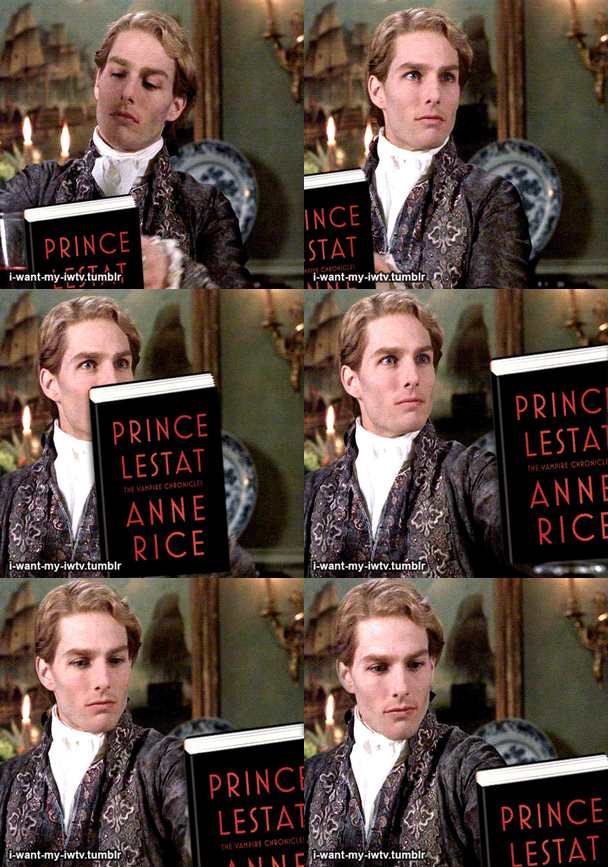
*….Which could be good for him bc AR has been taking the Absolute Worsts and putting them on pedestals lately. I don’t know what you’ve read so far, but as you may be aware, Magnus tells his story, albeit briefly, in Prince Lestat.
Magnus is also in Prince Lestat and the Realms of Atlantis in a snazzy new… erm… “form”?, so we’ll probably see more of him, but my money is on AR focusing on how cool he is now, and not really digging any further into his past or forcing Lestat to have any difficult conversations with him, which they sort of briefly had in PLROA.
There was a Magnus RPer, @theycallmemagnus, gone inactive now, but you might find good stuff in their archive, might reach out to any active RPers you find there, who may be into talking about the character.
// Hey, just adding my 2 cents here, after 10 yrs in this fandom I don’t think there’s any kind of general consensus on who’s the “worst” character in the VC series, and I don’t think it’s really a relevant question either. We see Magnus as an antagonist because he’s mortal!Lestat’s personal bogeyman and Lestat is the narrator, but the same could be said of many beloved characters in the series if their stories were told from a different perspective.
As someone who read the series, spotted the former cult leaders and torturers and went “THIS ONE. THIS ONE IS MY BABY”, don’t feel bad about liking Magnus’ character just because he’s a villain.
He’s a brilliant medieval alchemist who successfully attained eternal life (how many alchemists can say that they actually ACHIEVED the Ultimate Goal??) by figuring out how vampires turned each other and then replicating the process by capturing a vampire and “stealing” the Blood! And then he lived for centuries and eventually went mad! It could be taken straight from an early 20th century horror story à la H. P. Lovecraft or M. R. James, and I for one think it’s awesome.
(ETA: original post edited after reblog, so consider reblogging from OP)
Great addition, @bloodyvampchrons! (The part I removed when I edited the post is under the cut.)
I will 1,000% defend anyone’s interest in any fictional characters, for any reason. @awareofwhatsaforementioned did not express anything other than an interest in learning more about this character, specifically: whether the author would write more about him. That’s all.
Not all fiction is written as propaganda. Not all fiction is written for wish-fulfillment. Fiction may not exist in a vacuum, but it also is, in the end, just a story. It can be shelved, burned, critiqued, enjoyed, by any reader who encounters it.
Problematic characters are there to antagonize, to provide friction, obstacles, whatever the author intends for them to do. Maybe even to be a Hate Sink:
“A Hate Sink is a character whose intended role in the story (the role the authors made for him/her) is to be so despicable that the audience wants him or her to fail just as much as they want the heroes to succeed. However, this individual doesn’t have to be the main villain of the story, or even a villain at all.
…A Hate Sink [provides] an easy target for the reader/audience/player’s contempt where there may not be one, and can serve as a foil to more likable Anti-Hero or Anti-Villain characters.
Essays and books have been written about it, so I’m not going into it in depth, but the issue I see again and again on tunglr dot com is Black and White Morality. From TVTropes.org:
“Good versus Evil. White hat versus black hat. The shining knight of destiny with flowing cape versus the mustache-twirling, card-carrying force of pure malevolence. The most basic form of fictional morality, Black And White Morality deals with the battle between pure good and absolute evil.
…- Motivation: The villains never have a sympathetic motivation for their actions. There aren’t any Well-Intentioned Extremists,… Rather, their intentions are entirely for the sake of Evil (and may involve taking over or destroying the world).”
^Even the most horrific fictional crimes might be done by a character thinking he is doing the right thing, in his own mind.
“In Real Life, seeing the world in absolute Black and White Morality is considered normal for small children, but seen as a far less healthy trait in adults. A person who regards the people around him as entirely good or entirely evil has this.” – Black and White Insanity – TVTropes.org
Every reader can interpret the text differently, and very little is known of Magnus’ intentions. Before you cry MURDER/RAPE APOLOGIST, any reader exploring the reasons for a character’s crime =/= making excuses for it.
Creating/Consuming/Exploring dark fiction and problematic characters =/= endorsement of these things in real life.
People are accountable for actual crimes, not thought crimes.
Give me 100,000 fans like @awareofwhatsaforementioned. In my opinion, the greatest fandom crime is to chase other fans away from fandom by shaming them for having an interest in dark fiction or problematic characters.
I won’t engage in pointless unwinnable debate over what a fan is allowed to be interested in, but to make someone feel ashamed enough about what they’re interested in to the point of making them leave a fandom is a loss to us all. Think of all the friends and discussions they miss out on, all the fanworks they never get to see, or MAKE.
I want the longfic of Magnus’ backstory. I want the fanart of him as a kid, as a monster, all of it! If I’m the only one, so be it. But I don’t think I’m the only one. As I said in my original reply:
There’s plenty of room for fanfic/headcanons about Magnus, so if you are so inclined… write it for us!
I feel like if you want a book about Magnus you must be fascinated with him in some way, so I don’t mean to trample you if you do, but from all my time in fandom, I can say that Magnus is probably considered among the Absolute Worst if not THE MOST Problematic character in the whole series.*
>>>Quick interlude, on the subject of Problematic characters: I found this great essay by Warren Ellis. Here’s a taste, with my emphasis added in bold:
“… Fiction is how we both study and de-fang our monsters. To lock violent fiction away, or to close our eyes to it, is to give our monsters and our fears undeserved power and richer hunting grounds.”
*….Which could be good for him bc AR has been taking the Absolute Worsts and putting them on pedestals lately. I don’t know what you’ve read so far, but as you may be aware, Magnus tells his story, albeit briefly, in Prince Lestat.
Winning the villain over to your side is a power fantasy.
Like, a really big one, too.
Social emphasis has it that men should value strength,
aggression, and violence, and women should value kindness, empathy, and
community. But really, anyone who has
learned to prefer social success to might/aggression is going to favour a
strategy where you can make your enemies into allies of some kind, over one
where you just kill them. As a display of dominance, killing is overly
simplistic. And it’s also hard to ignore the reality that luck usually has more
to do with most fights than actual strength.
So, many people vastly prefer stories where the villains don’t
die, but instead, get won over by the hero. It’s also a much more prevalent
power fantasy among women than it is among men, because women are often taught
that violence on our parts is inherently distasteful and ignoble. If you can’t defeat your enemies by putting a
bullet in their heads, then what could
be more satisfying than convincing that enemy to come and fight other people on
your behalf instead?
This is a major component to why villains end up as popular
shipping material. I honestly don’t think it’s the ‘bad boy’ impulse, or some
branch of misogyny, or at least, not in a majority of cases. It’s a total and
sincere power fantasy. Someone going ‘all I care about is myself and all I want
to do is DESTROY THE WORLD MWAHAHAHA’ meeting you and then being like ‘oh no
wait I also want to please you and spend time with you and I want that so much
that I will now give up those other things’ implies an intoxicating level of
charisma.
Of course, like most power fantasies, it pays to tread
carefully with it. Because real life rarely accommodates such things, and as
with some muscle-bound hero easily lifting a house over his head, being able to
take a wholly selfish being and convert them into a devoted companion is… unlikely to happen outside of fiction.
For a lot of reasons.
However, I bring it up because I am C O N S T A N T L Y
seeing the compulsion to ship characters with villains misattributed to A)
agreeing with the villains, B) some form of self-hatred, C) a noble impulse
towards compassion and understanding, or D) sheer stupidity, and really… it’s
just another power fantasy. Wonder Woman punches a tank. Tony Stark buys an
entire island. Storm calls down a lightning strike. Batman outwits all his clever foes. And some seemingly random,
ordinary human woman convinces Lex Luthor to chill out and stop trying to kill
Superman. It’s all power, displayed
in fantastical proportions.
(Which isn’t to say that you have to like it or think that
every such relationship is good and healthy, gods no, but once you realize that
everyone’s just pretending to be the Superman of relationships, it’s easier to just go ‘oh that’s what you’re after’ and… y’know… fret less.)
It’s no huge secret why I’m into ships where the guy has to confront the fact that he’s super duper wrong and the girl (in various ways) helps make him see that.
With a lot of men generally, but specifically with some in my life, that’s never ever going to happen. That’s why, for me, a fulfilling narrative where a guy realizes and confronts his mistakes is better than the best PWP, tbh.
Thank you for appreciating that [post is here]! It always feels like I’m going out in front of a firing squad when I say that “creating/consuming dark fiction is not endorsement of it in real life” because people who do conflate those will insist that I’m an x,y,z-apologist. No. That’s incorrect.
ANOTHER WALL OF TEXT™ what is happening to me? I just miss you guys a lot, that’s what 😉
“Why did this person say/do this thing?”
I support the creation and consumption of dark content in media, in fic/art/music/etc. as a means of exploring it, as a means of unpacking it, as a means of trying to figure out where it comes from and how to recognize it. Sometimes it’s not so easy to pick out the “bad guy.” Sometimes the “abuser” seems to be a “good” person. Sometimes the “abuser” is reenacting their own trauma. Finding reasons for a behavior are not excuses for that behavior, but it can help provide answers for those of us who want them.
~Story time~
My grandmother was a tough old lady, what we call a “battle-axe.” She was blunt and tactless, and downright MEAN most of the time. She raised her children through terror and bullying, held grudges for decades, was short-tempered with her in-laws and grandchildren.
She was also very smart in her role as a professor in a college, and had a sweetness to her that very few people in my family experienced bc they were so deterred by her tough exterior. I was one of the few who got close to her, and I wanted to know why she behaved the way she did to others.
Seeing movies like Mommie Dearest, in which Joan Crawford was portrayed as somewhat of battle-axe to everyone in her life, too, I could see similarities between her and my grandmother.
Could my grandmother have had the kind of pressure in her life that Joan did, competing with the misogyny in her career? I thought so.
Both of these women set incredibly high expectations for themselves and others, and then reacted badly if reality didn’t meet their expectations. They were not good at handling disappointment and would take it out on others.
In other media, I would see “only” children worshiped by their parents and then these women were dissatisfied, bitter adults, who would never get that kind of attention again. (Not sure about Joan Crawford, but that was my grandmother’s childhood.)
^What I’m saying is that media (fic/movies/books/music/etc.) gave me insights as to why my grandmother behaved the way she did. It provided reasons for the behavior. I didn’t take these as excuses, but it increased my empathy for her and others I met who were like her. Rather than do as the rest of my family did, by writing her off as “a mean old lady,” I could understand her and navigate my way into a better relationship with her. They missed out on her good parts because of her bruises.
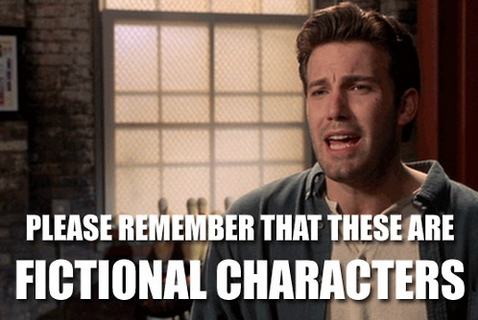
^The first time I saw this graphic, I felt that expression in my soul. These are fictional characters. They are not real.
Writers write them. What is “writing” anyway, but speculative reality? We used to call fanfiction “specs,” short for “speculative fiction.” It’s thoughts. Not all writing is for idealized versions of life and/or wish-fulfillment.
I’ve heard from VC fans who are survivors of child abuse, sexual abuse, etc. who said that VC helped them in some way,
whether it was recognizing that the abuse they suffered really was abuse (and not normal!),
or whether they have since made fanworks with VC characters that helped them explore their own past and examine it from a place of safety,
or in consuming other fanworks, they got some closure on their own experiences in some way and were able to heal or begin to do so,
or just in making friends here that have helped them through difficult times,
I could go on and on… there is enormous value in creating/consuming dark fiction.
Whatever Anne Rice’s agenda is/was in writing the Vampire Chronicles, it doesn’t matter to me, because of how much good I have witnessed that has come from it. If some of her inspiration for certain aspects seems relevant to me, I consider it, but it doesn’t really matter as far as I’m concerned.
It all really boils down to the old adage “Live and Let Live.”
You can ship characters for happily ever afters, sure, you can ship them for tragically-then-happily, you can ship two or three or four or more, you can ship endless combinations of personality types and relationship dynamics
but you can also ship characters under very specific circumstances, or for a certain period of their life but not for all of it, or only in a certain universe. You might say “I ship these characters” and what you mean is you think they are fascinating together and could have a story together. That story could be any kind of story.
Sometimes it means you want them together for the rest of their lives. Sometimes it means something different than that.
I don’t know about you, but for me, “I ship it” means “There is a story in this ship and I am interested in that story.”
for me, “I ship it” means “There is a story in this ship and I am interested in that story.”
Also for those of us who write or consume fanfiction, shipping can mean “I need to fix this thing that bothered me in canon, let me tell you my version of it where it’s not so gross and where I criticize it in a way that the creator did not.” I don’t understand people who can’t grasp this. Black & white thinking is not a good look.
Or I mean. Maybe it’s still gross lol. We wouldn’t have a horror genre if dark and awful shit didn’t intrigue people on a base level. Just because it’s not for you doesn’t mean there’s no value in it for people who like to look hard at things that frighten them.
(I have a backlog of asks, Real Life has been taking my life, and this is the one I decide to answer, bc I am apparently a glutton for punishment) (My senpais re: the topic of allowing writers to write dark fiction (and readers to read it) are @restoringsanity and @freedom-of-fanfic, among others, check them out).
Welcome to our little corner of Tumblrland!
This became a Wall of Text™, but I felt like articulating these thoughts again, as I do periodically. Sorry, no cut, couldn’t find a good place to do it.
Anon, I hope you come into the light and join us, share with us what you like about VC and make our fandom better for being part of it. You might make some of the best friends of your life with us 🙂 I definitely have, and that’s what fandom is about for me.
I think this question was answered very well by @interview-withthevampirehere, with supporting links. I was honored to be tagged as a Certified Old in the fandom, yes, I was around in the Dark Ages of the Internet, for the Spec Massacre, but am I a Respected Old? That’s debatable, lol. I have my opinions about VC, and everyone’s headcanon may vary on all of it.
No sense reinventing the wheel in answering the same way as they did, but I have thoughts to add. @interview-withthevampire started their answer as follows, and I want to start mine the same way:
“the reason why Anne Rice is a bit quarrelsome (I don’t want to use “cr*zy”) is because, well, the kindest way to put it is that she’s a bit of an ego-maniac.”
^YES. She’s probably a bit of an ego-maniac, but not “cr*zy.” “Crazy” is what we use to “other” someone, to dehumanize them by calling their mental faculties into question. It’s a gentle teasing at best and a bullying tactic at worst.
One thing you’ll find in VC fandom is that every so often, like a cycle, we’ll get another round of bashing Anne Rice. Whether or not she is a “good” or “bad” person with “good” or “bad” thoughts/intentions, that’s not the purpose of my blog and not what I base my love for VC on. My blog is primarily for entertainment and fandom positivity.
As fandom has begun a shift into examining authors and content creators who create problematic content (also known as ”dark fiction,” which I prefer as a term bc the word “problematic” has become kind of a joke in its overuse), there is a tendency to conflate that content with their beliefs, that they write what they would like to see happen in reality. I strongly feel that creation/consumption of dark fiction is not endorsement of it.
In brief, people might think Anne Rice is “cr*zy” bc of (1) her Real Life actions against her fans and other people, and (2) the problematic content in her books.
Again, I think @interview-withthevampire covered point (1). In the end, Anne Rice is just a human being who wrote a set of books that have gathered a wide spectrum of fans. I think it took her years (decades?) to understand the nature of her fanbase, and as the internet grew around her, it became easier for fanworks and reviews/feedback to publish into the real world. There were no longer the filters in place of people like magazine editors; any blogger could write a review of her works in full view of millions of fans, and they were not required to pull any punches.
AR had to acclimate to that and after fighting the ficwriters for long enough, she chose to stop suing, and learn to coexist with it all. I don’t know of many other authors treating their own fanbases the way AR treated us, so I would guess that authors who have published works since the internet really got in gear have probably all embraced their fanbases from the beginning. Therefore, VC fandom’s bad blood (pun intended) with Anne Rice stands out as being downright BIZARRE now 😛
As far as (2) the problematic content.
What we’re really talking about is whether dark fiction (pedophilia, incest, etc.) should be written about at all if they are not condemned in the narrative. Personally, I believe that creation/consumption of dark fiction is not endorsement of it.
*Bruised banana analogy*
VC, like any media, be it books/movies/music/video games/etc., is like a banana. It might have gross bruises, those parts that you find squicky or otherwise distasteful. It’s fine to point them out, so that others can be aware, but you are not required to do so. Some areas on a given banana are less bruised than others, and you can eat them. Maybe you eat around all the bruises, even the smaller ones. Maybe you don’t mind bruises and you can eat the whole banana.
I admit, on a subjective level, that VC books have gotten much bruisier for me over the years, and there are several that I find so bruised that there is much less to enjoy, but that’s how it is. I STILL LIKE THE PARTS I LIKE.
[X Banana from fromthedriversseat.co.uk] ^Red would be those bruises that I can’t accept, so I don’t eat them.
Maybe the whole banana is ruined for you and you can’t stomach it. Maybe you can bake it into banana bread, turn it into something else entirely! That’s a fanworks’ purpose. Like a fanfic where you remove/revise the bruises from canon and write the story the way you would prefer it to be. Fluff would probably be a banana with very few
bruises, if any at all.
I’ve made my own headcanons that have “fixed” canon in a way that greatly improved the stories for me. I’ve read fanfic that was basically providing missing pieces from canon. I’ve seen fanart and cosplay that pretty much illustrated my headcanon of the characters. For me, fandom is about taking inspiration from the canon source material to make your own works, sharing that with other fans, and being supportive of those content creators in whatever way you feel comfortable!
It’s every reader’s prerogative, how much of the “banana” they want to eat, if any at all. No one is forcing you to eat it, and other people enjoying the banana does not trample your choice. Your choice not to eat some/all of the bruises does not supersede other’s choice of eating them.
I’ve said that creating/consuming problematic content is not in itself endorsement of
problematic things in REAL LIFE. As far as I know, Anne Rice has committed no REAL crimes, so while I would love it if she had a trusted editor/beta reader,I don’t condemn her for exploring dark topics in fiction. More thoughts on that in my #dark fiction tag.
As fans in the fandom, we can like what we like, critique her work, choose what canon we accept, toss the rest. She put it out there and in that sense, it doesn’t matter if Anne Rice is “cr*zy” or not, or if she is a “good” or “bad” person with “good” or “bad” thoughts. Personally, I believe that AR was interested in sex before she was the age of consent and was frustrated that she was being prevented from pursuing sexual relationships. Those explorations led to bruises in her bananas. Those are her bones to pick, so to speak.
I’ve made some of my best friends in VC fandom, and if they or I had left because of the bruises in our bananas, I might never have met them at all. I consider VC to be a gift to us from AR, no more, no less.
Not sure how to put this coherently but in regards to anti shipping/fiction reality discourse i feel like a lot of the main argument comes from assuming that people view fiction as wish fulfillment. This to me reads as very Freudian/psychoanalytic. e,g the concept that all dreams are somehow wish fulfillment no matter how disturbing. this is quite clearly bullshit as a lot of Freudian ideas are.
A lot of anti shipping rhetoric comes from the idea that somehow you can tell a lot about a person by what they like in fiction, and through that you can tell what kind of person they are (good/pure, bad/demonic (which isnt weirdly christian at all eyeroll))
the fact is people like horror and disturbing content. this doesnt mean people want to expierence this shit irl, but rather fiction is a safe way to explore intense feelings and difficult scenarios. Stop armchair analyzing people based on what they read or write. its not helpful.
[continued] But it rubs at emotional raw points when the agency of a character who is a minor has their agency completely written off. Mostly because it reminds me of the kind of things that were said to keep me repressed. So what I’m saying is’ yeah I can see how someone who has been there would write that’ not that I would, mostly because I live in fear that my weirdness will hurt others.
Hello Anon, thank you for sending me this message. Responding to these kinds of questions is intellectually stimulating for me, and sometimes the research and crowd-sourcing with trusted advisers changes my mind on things I thought I knew! It’s a learning process.
Reminder: This is a fandom blog for a fictional series, for entertainment only.
^Not shouting at you or anyone, Anon. I’m just reminding people that I recognize that I am out of my depth on certain topics, and trying to express myself without hurting anyone, too. I tried to answer that ask as sensitively as possible, as I, too, don’t want to hurt people who were abused, or anyone else. I’m addressing your message because I feel like you were hurt just for your interest in these things, which I feel is unfair.
TL;DR: Anon, I’m sorry that people trampled you to the point that you felt like your interests were harmful to others. Thoughtcrime is not crime.
Being interested in learning about sex, as a minor or as an adult, is not a crime. I don’t know if you create/consume dark fiction, or even specifically the kind of sex you were intrigued about as a minor, but human beings (for the most part) are sexual beings and are interested in it. In Non-fiction:
Books/essays/TED Talks/etc. are written on it,
There are people who devote their careers to it as a scientific study, see Sexology.
There’s at least one Museum for it! The Museum of Sex in NYC, which I still need to check out one of these days.
More than just for the mechanics, there’s the psychological aspect, the power dynamics, the intimacy with another person/people. It’s a unique experience and one that is defined differently by many people. Some relationships involve people who can’t (or don’t want) penetrative sex, but are intimate just the same.
“But it rubs at emotional raw points when the agency of a character who is a minor has their agency completely written off. Mostly because it reminds me of the kind of things that were said to keep me repressed.”
Right. Did Amadeo have agency in his relationship with Marius? That is up to the individual reader to decide. When people trample others, insisting their opinion is fact, and that you must be completely dense or willfully ignorant (or both!) to even suggest otherwise!!! please keep in mind that they are just a person, no matter how strongly they state their opinion, and you have every right to your own opinion and can disagree privately or publicly.
Repression of interest/education/participation/etc. as it relates to sex has long been used as a means of controlling people, and is too big a topic for this blog post. But I absolutely agree that repression is used to control people, for better and for worse.
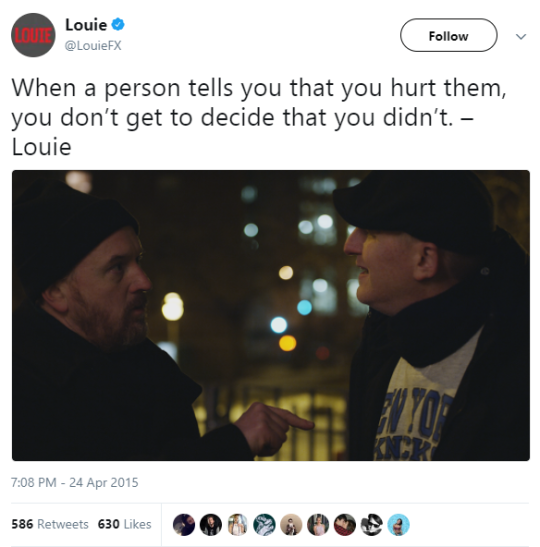
Before we move on, re: the concept of hurting people: I’ve been thinking about this quote, (which I thought it was a McElroy quote, but I see that it might actually a Louis C.K. quote? I don’t know who said it originally) Here’s the tweet:
“When someone opens up and reveals that they have been hurt by you, they are being vulnerable. It’s not always easy to admit that you’ve been hurt, and if someone tells you that you’ve hurt them, the least you owe them is your respect and acknowledgment of their pain. The worst thing that you can do is make them feel bad for opening up to you, make them feel like they’re the one who did something wrong, or tell them that you didn’t actually hurt them. You don’t know their feelings. If they’re telling you that you hurt them, then you hurt them. Accept this and apologize.” [6 Lessons We Can All Learn from Louis C.K.]
^It’s easy enough to apologize when you’ve physically stepped on someone’s toes because you weren’t looking. I’m grateful when someone tells me that I did that, rather than bottling up their frustration and thinking I’m a clumsy person. It’s easy to apologize in that situation.
It’s much harder to apologize when you wrote/said something that you thought was socially acceptable, in private or in public, and someone tells you that it was hurtful. A sincere apology is still necessary, but harder to do.
I struggle with wanting to be able to speak my mind on these very sensitive topics, like about Anne Rice being interested in sex before the age of consent and how that affected her writing, inspiring socially taboo situations in her works. To even suggest that there is nuance and something worth exploring in dark fiction, that could be taken (even unintentionally on the part of the person creating/consuming/discussing dark fiction) as hurtful to abuse survivors or anyone else. When I create/consume dark fiction, it’s an exploration, not promotion. I am not intending to belittle the experience of survivors of abuse or hurt anyone else. I can’t speak for Anne Rice or any other content creator/consumer, but I can keep saying that in my opinion, creating/consuming/discussing dark fiction is not a crime. Dark thoughts are not a crime.
When someone is hurt by this exploration, it is partly their responsibility to avoid it.If X person tells me that my discussion of dark fiction (specifically incestuous/pedophilic undertones) hurt them, Louie C.K. is correct,I do not get to decide that I didn’t hurt X person. AND I apologize sincerely. I might also change my opinion of something based on this interaction.
But I also remind X person that this is only my blog, with my own unauthorized opinions. Every blog is an opt-in experience, you choose to read it. If discussing these things = endorsement to X person, then I would ask them, respectfully, to Unfollow/Block me and not read my blog. In a social network like this, it may be difficult to avoid a blogger that upsets you, especially when it’s one of the fandom’s more popular blogs like mine is, but that’s why we tag things. I’m tagging this post with #pedophilia mention tw and #incest mention tw for those who don’t want to see even mentions of it.
I hope that helped, Anon, and to anyone else reading this, it was not my intention to hurt anyone for expressing my opinions about learning about sex or about dark fiction.
Hit the jump for more, cut for length.
To get back to your question…
Anon asked:
“What you were saying about Anne being interested in sex before she was the age of consent, and that being part of her motivation in writing sexual stuff with underage characters. It makes a lot of sense to me. I have some.. interesting emotional baggage from being interested in sex when I was a minor.”
*nods* I think many people are interested in sex before the age of consent, if not the psychological implications, then just the mechanics of it. It’s like anything you learn to do, like anything else, there’s a first time, it takes some practice and there’s awkwardness, so of course we’re curious about it!
I was curious about it as a child, my parents never tried to sell me on anything fictional like the stork bringing babies to expectant adults.
The fact that the age of consent varies by country and even states in the US shows that different societies have different ideas about when a person can consent to physical intimacy, and it’s not universally 12:00 am on your 18th birthday.
Anecdote: My ex-roommate lost her virginity to her boyfriend at age 15. She told me she had no regrets about it. Maybe she did and never told me, or never admitted it to herself, but I am sure that there are those who had similar experiences and were not necessarily abused.
“A lot of wounds that tumblr likes to stick it’s fingers in and that I dare not react to for fear of how aggressive this site can be”
You’re absolutely right about that. I have seen people dogpiled for all kinds of reasons. Generally, it’s thrilling to feel righteous. It feels good to be part of a group attacking a common enemy. There are all kinds of reasons for it and you are absolutely not obligated to expose yourself to people who are looking to pick a fight and bully someone off the site. As someone accurately described it to me, some people are predisposed to disagreement, and you do not have to engage in fruitless, unwinnable arguments. They’ll even move the goal posts so if you think you’ve made a valid response to their point, supported by reasons, they’ll say that wasn’t the point in the first place *eyeroll.* For some people it’s more about just winning your submission.
{{ BTW, I don’t think we often address when X person claims that they were hurt in ways (or for reasons) that are hurtful to the one they claim has hurt them, but that absolutely happens. X person might say this is tone-policing or victim-blaming, but I’m sure that some of them are aware that they wield their argument more as a sword than anything else. Both sides can be hurt by call-out posts, for example, which are less about teaching and more about mob mentality and shouting into the void, but I don’t want to delve further into that. }}


 I-want-my-IWTV