like i have my problems with harry potter and jk rowling but it will never stop meaning something to me that rowling was a depressed 30-year single mother living on welfare when she thought of this story, that she was – in her own words– at rock bottom and she managed to put herself out there, to create this brilliant amazing series that has impacted so many people’s lives. there’s something to be said for hope.
Yeah, that is a good question – why do some scifi twist endings fail?
As a teenager obsessed with Rod Serling and the Twilight Zone, I bought every single one of Rod Serling’s guides to writing. I wanted to know what he knew.
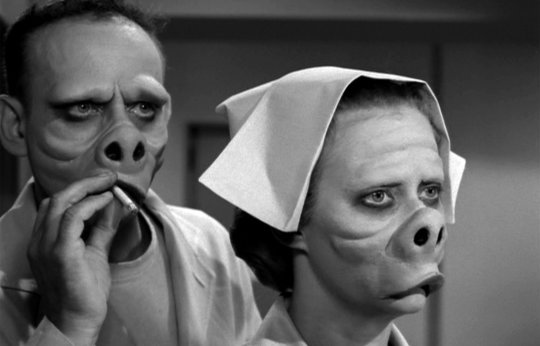
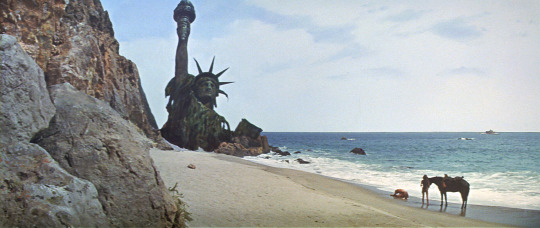
The reason that Rod Serling’s twist endings work is because they “answer the question” that the story raised in the first place. They are connected to the very clear reason to even tell the story at all. Rod’s story structures were all about starting off with a question, the way he did in his script for Planet of the Apes (yes, Rod Serling wrote the script for Planet of the Apes, which makes sense, since it feels like a Twilight Zone episode): “is mankind inherently violent and self-destructive?” The plot of Planet of the Apes argues the point back and forth, and finally, we get an answer to the question: the Planet of the Apes was earth, after we destroyed ourselves. The reason the ending has “oomph” is because it answers the question that the story asked.
According to Rod Serling, every story has three parts: proposal, argument, and conclusion. Proposal is where you express the idea the story will go over, like, “are humans violent and self destructive?” Argument is where the characters go back and forth on this, and conclusion is where you answer the question the story raised in a definitive and clear fashion.
The reason that a lot of twist endings like those of M. Night Shyamalan’s and a lot of the 1950s horror comics fail is that they’re just a thing that happens instead of being connected to the theme of the story.
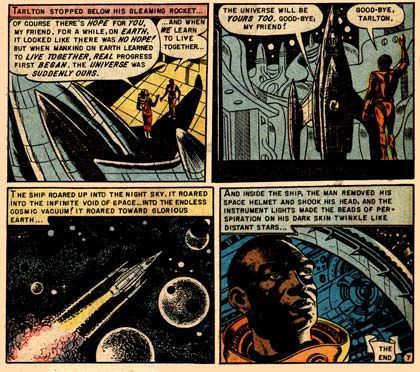
One of the most effective and memorable “final panels” in old scifi comics is EC Comics’ “Judgment Day,” where an astronaut from an enlightened earth visits a backward planet divided between orange and blue robots, where one group has more rights than the other. The point of the story is “is prejudice permanent, and will things ever get better?” And in the final panel, the astronaut from earth takes his helmet off and reveals he is a black man, answering the question the story raised.
IIRC “Judgment Day” was part of the inspiration for the excellent Star Trek: Deep Space Nine episode “Far Beyond the Stars.”
This whole post is liquid gold for writers.
I didn’t say I liked it. I said it fascinated me. There is a great difference.
Oscar Wilde,The Picture of Dorian Gray (via foxmvlders)
But, I do think that if there’s a sort of “moral” to Frankenstein, that who did Mary Shelley herself most identify with? Probably the creature. You know, as Joey said, the “unnamed creature.” Why? Because that’s how people responded to her. As an intellectual woman and as an unwed mother, she was called a whore. When people found out that she wrote Frankenstein they said what kind of woman would write such a book? Must be something wrong with her. There’s something perverse about a woman who would write such a book.
So later in her life she says, “I wrote it, but that’s because the idea came to me in a dream.” And we know that isn’t true because we have her notebooks. She in fact thought of the idea. She worked on it really hard. She worked on it really hard while young women around her were killing themselves. And also, incidentally, she was reading the history of slavery. So she’s dedicating herself to the ideas of social injustice and the suffering of those who are considered monstrous by their own society, herself included.
So, she sees herself as a woman who’s trying—she wants to publish and be smart in her world, as someone who’s going evoke feelings of monst— [To audience (Joey Eschrich?)] You said a feeling of monstrosity? People will react to her as though she’s a monster, and she’s saying, “Don’t do that.”










 I-want-my-IWTV