“This is my birthday present from Louis. Use as I like, he tells me…
I do not understand entirely what is meant by birthday. Was I born into this world on the 21st of September or was it on that day that I departed all things human to become this?
My gentlemen parents are forever reluctant to illuminate such simple matters. One would think it bad taste to dwell on such subjects. Louis looks puzzled, then miserable, before he returns to the evening paper. And Lestat, he smiles and plays a little Mozart for me, then answers with a shrug: ‘It was the day you were born to us.’ ”
– Claudia de Lioncourt, Queen of the Damned
Is this her birthday? Or the night she was turned? They don’t answer her. I think it was the night she was turned, “you were born to US”
According to this, September 21 is Michele Rice’s birthday, 1966. Michele died of
It’s his mortal birthday, not explicitly stated in canon. It’s what Anne Rice has told us, so not everyone accepts it as canon. As for his vampire birthday, we don’t know the exact date, but I headcanon he wouldn’t celebrate it. I don’t think any of the vampires celebrate or even mention the exact dates for when they were turned, except Claudia (L/L seem to celebrate the night she was turned).
AR has said she based Lestat on her husband, Stan Rice, whose birthday was Nov. 7.
“This is my birthday present from Louis. Use as I like, he tells me…
I do not understand entirely what is meant by birthday. Was I born into this world on the 21st of September or was it on that day that I departed all things human to become this?
My gentlemen parents are forever reluctant to illuminate such simple matters. One would think it bad taste to dwell on such subjects. Louis looks puzzled, then miserable, before he returns to the evening paper. And Lestat, he smiles and plays a little Mozart for me, then answers with a shrug: ‘It was the day you were born to us.’ ”
– Claudia de Lioncourt, Queen of the Damned
Is this her birthday? Or the night she was turned? They don’t answer her. I think it was the night she was turned, “you were born to US”
According to this, September 21 is Michele Rice’s birthday, 1966. Michele died of
Yep, she gave us their birthdates (Louis – October 4; Lestat – November 7) outside of canon. Neither date is mentioned explicitly in canon, and so some ppl do not accept that information as canon.
(There is also some fanon that Armand’s bday is November 11, which AR never mentioned at all.)
I don’t recall the vampires ever celebrating their birthdays explicitly in canon, but I headcanon that some of them do. Some of them prefer to celebrate the date they were turned, some celebrate both (exception: I headcanon that Lestat doesn’t celebrate the date he was turned) and some celebrate neither (Khayman, maybe).
EDIT: Claudia mentions in her diary entry in QOTD that Sep. 21 is the night her dads honor every year as her birthday, and she doesn’t know why. It’s probably the night she was turned, bc Lestat tells her “‘It was the day you were born to us.’ ” It’s Michele Rice’s birthday, Anne Rice’s daughter.
[X] BTW, I was looking for a reference as to Lestat and Louis’ birthdays for an Ask and found this. Someone used one of my memeythings for Becket’s birthday in 2015. The POTP are aware of me… *shudders*
And no, AR was not among the 21 who Liked that pic.
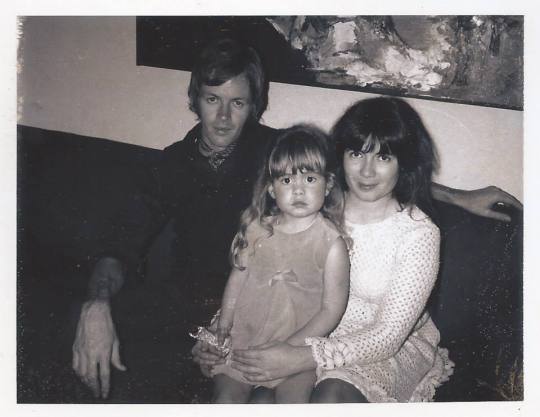
Is this a screencap from Mad Men? Stan is so dapper (but also he has a touch of like, Macauley Culkin from Richie Rich, no?), Anne is like a gotdamn illustration LOOK AT THOSE CHEEKBONES DAMN.
#the parents#anne rice#stan rice#i’m constantly shocked how much chris looks like stan#it’s adorable#good news cause he was a handsome dude#I JUST FEEL LIKE WHEN I LOOK AT THIS PICTURE#IT MAKES ME LAUGH#cause they look relatively normal#AND YOU WOULD HAVE NO IDEA#kinkiest freaks#adorable
“Lestat’s name doesn’t mean anything. It is a name that I made up. I search hard and long for names that are unique, and Lestat is, in a way, a mistake. There is an old French name in Louisiana, "Lestan”, and my husband’s name is Stan, and I thought I was using the old French name when I wrote Lestat . It was only later that I realized I had added a “t” for an “n”, and created a name that didn’t exist, so you might call it a Freudian slip. Lestat was definitely like Stan. His self confidence, his blonde hair, his blue eyes, his feline grace — all of that was inspired by my husband, Stan. So maybe it means ‘the Stan’.“
I wasn’t even thinking about Lestat when I wrote interview with the vampire I was thinking about Louis. Louis was the hero, everything revolved around Louis. Lestat just sprang to life in the corner of my eye. This character took on all this ferocity. I never sat down and thought “Well, this is based on my husband, Stan,” or “This is what Stan would do.” I had an idea of Lestat as the man of action, the man who could do things that I couldn’t do, that man who could make the decision that I never had the nerve to make; and the person who could go through life joyfully in spite of the questions that torment me — the doubts that torment me, the horror of death that torments me. Of course, that was tied up with the idea that he was an 18th century personality; he was from the age of reason, he was much more rational, much more cynical in some ways than Louis. Louis was more a naïve romantic character, much more I think 19th century. All of that was working in my mind. Not that the Romantic period is limited to the 19th century, certainly not; it starts in the 18th. But still, Lestat represented the Enlightenment. He represented a different view on things. He’s also inherently a comic character, in the sense of always triumphing and always coming back and never being really destroyed. He never really absorbs a tragic definition of himself for very long. He always comes back laughing at everything and just rebounding. It may take him a few years, but he always does it. I really wanted to explore a personality different from my own. He became a kind of dream version of what I’d like to be; he was the man I wanted to be; he was the person I wanted to be. I wanted his strength. And once he became a living character I never had to consciously steer him in any direction. It was just a matter of getting into Lestat and then he’d go, and he’d take me where he wanted in the novel. I never had to worry about his dialogue. My knowledge of him was so complete, and so instinctive, that I could just write. The other characters I might have to think about — where they were coming from, what they had to say. But not him. I know exactly what he thinks about everything. If I walk into a theater and see a play, I know whether he likes it or not. If I watch an opera, I know whether he loves that opera. If I go visit a city, I know what he thinks of that city. I’ll never be away from him; he’ll always be apart of me.
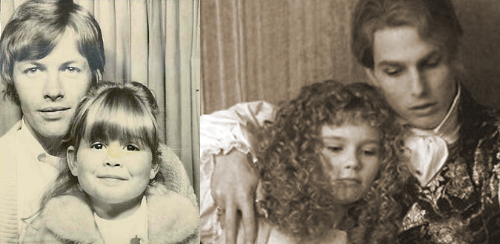
^Stan and Michele Rice on the left, Lestat and Claudia de Lioncourt on the right. As a side note, before this gets into the more serious topic, AR has said she based Lestat on Stan, and there is a story out there that his name was meant to be “Lestan,” but ended up as “Lestat” bc of a typographical error. I don’t have a source on that.
(In the first draft of [IWTV], Rice described Claudia as three or four years old.)… Rice based Claudia’s appearance on her own daughter, Michele, who died at the age of five from leukemia. Claudia even shares Michele’s birthday, September 21.* However, despite the intense tone of suffering and guilt evident in Louis’s telling of the story, Rice insists that she had not been aware that she had included her feelings about Michele’s tragic death. “I never consciously thought about it when I was writing the book,” she says. “I wasn’t conscious of the connection. I knew that I was using the physical beauty of Michele as the model, but Claudia was a fictional character in her own right. The character, the voice, and the things Claudia say have nothing to do with my daughter – but there’s no question that this is the symbolic working out of a terrible grief. What else can it possibly be?”
In the first version of [IWTV], Claudia eventually goes off with three vampire brothers whom she meets in Paris. She does not die. As such, it was as if Rice had attempted to give her daughter a form of immortality. Rice, however, experienced psychological problems that cleared up only after she had rewritten the ending – by killing off Claudia and taking Louis through an experience of intense grieving. This version was much more cathartic for Rice.
Hit the jump for more, cut for length, not content.
From Premiere Magazine, November 1994:
(sorry, I don’t have a link, I transcribed this from the page)
In real life, Claudia was a nickname for Michele Rice, Anne Rice’s vibrant blond daughter, who had once piled her hair on top of her head, and spoken in a smoky voice like Claudia Cardinale. She was three years old when she developed leukemia, and five when she died, in 1972.
At first, Rice soaked her maternal despair in a steady stream of sixpacks. Then she unleashed her rage unto paper, into what eventually became Interview with the Vampire. Michele was reincarnated as Claudia, the raging woman locked in a child’s body. “Louis was me,” says Rice. “That dark, brooding, melancholy person ripped from Catholic faith and tormented with guilt – that was me. I’d love to be Lestat: the wishful me, the active, the dream, the other one. Louis was the more true, autobiographical portrait of the conflicted and lost and orphaned person. That’s what the book is about. It’s about being orphaned.”
“Writers write about what obsesses them,” says Rice. “You draw those cards. I lost my mother when I was 14. My daughter died at the age of 6. I lost my faith as a Catholic. When I’m writing, the darkness is always there. I go where the pain is.“

 I-want-my-IWTV