There’s this… phenomenon… I’ve witnessed in several fandoms, where a particular blog gets really popular within a fandom.
And suddenly that blog will start getting people literally asking them for permission to hold certain opinions. I don’t mean someone just asking “hey can I get your feelings/opinions on this subject” but “is it okay if I think/do xyz?” like some child asking their parent if they can go somewhere.
Worse, is when these blogs start taking these questions seriously and feeding them answers. Like they suddenly start believing that they truly have this authority. I mean it’s bad enough when people do this and the blogger is just like “well I have my own opinion but don’t ask me” but when they start to actually act like they can tell other people what they are “allowed” to do.
This I the creepiest fucking thing on tumblr I swear.
Why would you give some random stranger on the internet that much power over your mind? Why would you be so afraid of forming your own opinions that you have to ask someone else to give you opinions to hold?
And so often they end up with a rabble ready to crucify anyone who doesn’t do as they are told, and that’s when I really run for the hills…
It probably looks a little egotistical to reblog this post, as someone who relates to having the “particular blog gets really popular within a fandom,” but I deeply agree with this post from both sides. It has been suggested to me privately that my opinions hold sway over people and I have a responsibility to answer a certain way so that the other fans aren’t led astray, that they are so gullible that they take my every word as fact. I sincerely hope that this is not the case.
I refuse this responsibility bc that’s not the kind of blog I want to have. I don’t want anyone taking my opinions as an authority, or the Law of the Land or whatever… *~popularity~* shouldn’t give me any more authority than anyone else!
Please don’t feel like you have to literally ask anyone for permission to hold certain opinions. I’m happy to share my ideas, but they are only my ideas. I’m a random stranger on the internet! I love my followers, the interactions we’ve had, the messages you’ve sent me publicly and privately over the past few years have kept my blog alive, and I can’t thank you enough for that ❤
But! If I can just paraphrase from the above, Do not give some random stranger on the internet that much power over your mind! Don’t be so afraid of forming your own opinions that you have to ask someone else to give you opinions to hold!
Please do not become part of some random stranger on the internet’s rabble ready to crucify anyone who doesn’t do as they are told!
The Mayfair House: Anne Rice’s former New Orleans home is back on the market again, as per this Curbed.com article, from which I’ve selected some photos. This is the house that inspired the Mayfair witches’ haunted family home…
Yeah, that is a good question – why do some scifi twist endings fail?
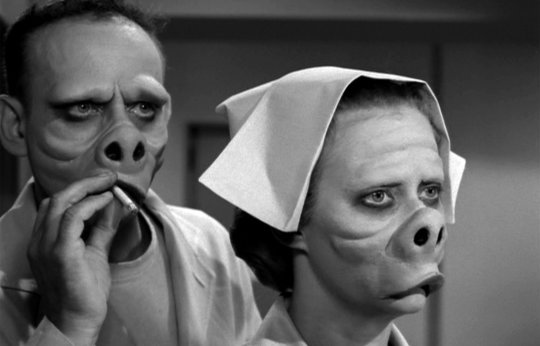
As a teenager obsessed with Rod Serling and the Twilight Zone, I bought every single one of Rod Serling’s guides to writing. I wanted to know what he knew.
The reason that Rod Serling’s twist endings work is because they “answer the question” that the story raised in the first place. They are connected to the very clear reason to even tell the story at all. Rod’s story structures were all about starting off with a question, the way he did in his script for Planet of the Apes (yes, Rod Serling wrote the script for Planet of the Apes, which makes sense, since it feels like a Twilight Zone episode): “is mankind inherently violent and self-destructive?” The plot of Planet of the Apes argues the point back and forth, and finally, we get an answer to the question: the Planet of the Apes was earth, after we destroyed ourselves. The reason the ending has “oomph” is because it answers the question that the story asked.
According to Rod Serling, every story has three parts: proposal, argument, and conclusion. Proposal is where you express the idea the story will go over, like, “are humans violent and self destructive?” Argument is where the characters go back and forth on this, and conclusion is where you answer the question the story raised in a definitive and clear fashion.
The reason that a lot of twist endings like those of M. Night Shyamalan’s and a lot of the 1950s horror comics fail is that they’re just a thing that happens instead of being connected to the theme of the story.
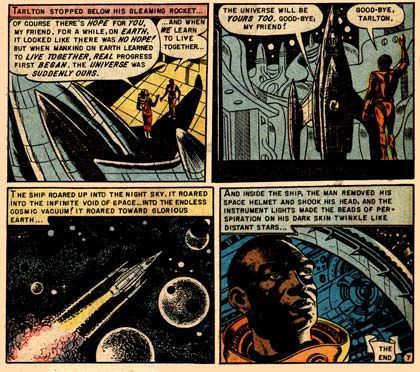
One of the most effective and memorable “final panels” in old scifi comics is EC Comics’ “Judgment Day,” where an astronaut from an enlightened earth visits a backward planet divided between orange and blue robots, where one group has more rights than the other. The point of the story is “is prejudice permanent, and will things ever get better?” And in the final panel, the astronaut from earth takes his helmet off and reveals he is a black man, answering the question the story raised.
IIRC “Judgment Day” was part of the inspiration for the excellent Star Trek: Deep Space Nine episode “Far Beyond the Stars.”














 I-want-my-IWTV