I wanted to share my progress story of the past sixteen years because I know how hard it is to not give up, because I know how much crap you have to produce to finally start producing something slightly less crappy. Because I know it’s hard to look at all that gorgeous art on the internet and not be discouraged.
I’m still learning, I’m still not happy with what I can do. I may never be. But it doesn’t matter.
You have time, you can do this. Just don’t give up.
I’m really tired of seeing people broken up into labels of absolutes.
People are not just “good” or “bad”.
People are not a list of labels.
People are complex, situations are complex.
I know, that makes it a lot harder when you want to just write off everything someone’s ever done as bad – but that’s not how people actually are, and it would do everyone good to stop pretending they are.
I am tired of hearing about the fear people have in putting themselves out there. And it is a scary thing! Putting yourself out there means subjecting yourself to people who want a really good reason to tear you down, who will jump at the first chance to feel “good” by labeling someone else as “bad”.
I reject this. I reject the idea that there should be fear in speaking up and talking about experiences and trying to reach an understanding of a situation.
I’m unhappy to see people spitefully urging others to cut off ties with their friends under the guise of “well, that person’s just inherently bad, so if you talk to them you’re bad too.” That is fucked up. You definitely have the right to let the friend know you don’t want to hear about whoever troubles you, but you do not at all have the right to decide who their friends should be. This includes guilt trips.
Anyway, just try to be more aware of others. Everyone else is a person like you. They might not have the same experiences as you. They might not understand how their words are harmful, or how what they’re doing is wrong. They certainly won’t if you never tell them.
Most people are trying to be good, but they’re going to mess it up sometimes. Try to keep that in mind. Even when people do really fucked up shit, sometimes they are trying to do good. “The road to hell is paved with good intentions” and all that.
Nothing gets solved, no growth happens when you put people into a box from which you’ll never let them escape.
Yes, you absolutely must be careful about people who have tendencies and patterns that are harmfulto you. Sometimes people try to overcome those patterns and they fail, and you have to distance yourself from them: that is the sad reality of life. Sometimes though, they can overcome it. But they certainly won’t if the first thing you do is write them off after a fuck up.
Being a good person is a choice. Don’t let people fool you into believing that truly good people never have bad thoughts, are never tempted by the easier path, by the low road, never mess up or act out selfishly. Never believe a person can be good without making a conscious effort.
Every single time you do something good, you’ve made a decision to make the world a little brighter.
Goodness is not an inherent trait, it is a choice. Keep making it! I see you, I’m proud of you, and I’m rooting for you!
“Evil is always possible. And goodness is eternally difficult.” – Louis de Pointe du Lac, Interview with the Vampire
I used to think tension and conflict were the same thing. I mean don’t they go together?
Well, a lot of the time they do, but it’s entirely possible to have one
without the other. They often go hand-in-hand, but they aren’t the same
thing. Conflict doesn’t necessarily equal tension, and tension doesn’t
equal conflict.
Lately I’ve been editing stories that seem to have so much conflict and
no tension! I don’t care about the conflicts. I don’t care about the
characters. Because there is no tension.
Tension isn’t the conflict.
A couple of months ago, I wrote this post on Mastering Stylistic Tension. In the comments, Becca Puglisi said:
I learned a long time ago that while conflict and tension are often
considered to be synonymous, they’re different. Tension is key for
winding up the character’s—and therefore the reader’s-emotions.
I admit that for some reason I read it as “Tension is the key for
winding up,” and my mind filled with an actual image of a key winding
something up. Tension winds up. Conflict is problems that collide.
Tension doesn’t need problems to collide, tension is often the promise or potential for
problems colliding. My oldest brother pointed out that there are action
movies that have conflict after conflict, but no tension. They are a
spectacle–blasts, explosions, fire. Then, he went on to say, there are
movies like Jaws that have scenes that work largely off tension.
I said in my Mastering Stylistic Tension post, “In some ways, it’s not the conflict itself that draws readers in, it’s the promise of conflicts,” which is often the tension.
Tension invests us personally in the story. We feel it. It’s
anticipation, it’s hope or dread for what will happen. It’s a tangible subtext or undercurrent for what could happen.
Tension is defined as a straining or stretching; intense suppressed emotions.
Conflict means “to come to a collision;” to fight or contend.
So tension may suggest a conflict, but it is not the conflict itself.
Conflict may be an object, but tension is the key winding it up.
Sometimes writers try so hard to put in so much conflict to make their
stories interesting when what their story needs is tension for the
conflicts they already have.
I’ll give an example from my own experience.
Last year I was working on a sequence of flashbacks for my novel. While
not the main purpose of the flashbacks, it was important that I
illustrate a romantic relationship in them, because the relationship
itself is important to a main character and what happens in the present
timeline. I was stuck trying to figure out how to communicate the
uniqueness and complexity of the relationship in such a short space. In
an old, old version of this story, I had planned to use a lot of
romantic gestures to convey the relationship, but in working on these
flashbacks, I realized that the romance and the conflict it brought
(which deals with “forbidden love”) wasn’t as powerful as the tension it could have.
I scrapped the idea of the characters touching and kissing, and instead focused on their powerful desires to touch and kiss when they weren’t allowed or able to; I gave one of
the characters a particular reason and a personal commitment to not give
the other affection.
The scene immediately became more interesting. The tension was palpable,
their desires electric, but because they could not give into their
desires, the tension couldn’t release, regardless of how much they or
the audience wanted it to.
The conflict is forbidden love, but the tension is held in the drawn out moments of a desire that can’t be manifested.
This is one of the reasons that sexual tension can be so powerful in
stories. It’s not the colliding problems that come with being with that
person, it’s the subtext and undercurrent of wanting to be with that
person, but not being with them. Once the couple is together, that
tension ends.
Likewise, some of the best dialogue comes from tension, not straight-up
conflict. It comes from subtext, from what’s not being directly said.
Once the dialogue becomes direct, the tension ends and the problems
collide in conflict. Tension often comes before direct conflict. And if
that isn’t happening much in your story, it should.
As Mindy Kaling once explained, sometimes the best tension comes from
the characters trying to avoid conflict, from them trying to stop it
from bubbling out into the open. The closer the conflict gets to the
open and the harder a character tries to stop it, the stronger the
tension gets. It winds up, tighter and tighter. We as an audience
anticipate its release.
That’s what draws a reader into the story.
So make sure that your story has tension and conflict, and not just one
or the other. If you have a story with a bunch of conflict, but your
readers aren’t interested, you may need more tension. If you only have
tension and no conflict, the reader may end the story feeling cheated.
Use both.
It seems like you have sort of made up your mind about him, Anon, listing those crimes 😦 If you don’t like him for those reasons, or any reasons, you are under no obligation to change your mind, but I appreciate that you want to understand why ppl do like him.
If you’re on Memnoch then you know most of Armand’s story, and you know that Armand’s book follows MtD. His book goes into his story more deeply, and from his own perspective, and I think that’s part of what ppl like about him. His narration is different than Lestat’s (most of the books are Lestat’s POV or his recording of what others tell him), and I think some Armand fans are just glad to get out of Lestat’s head!! lol.
In TVA, you get more detail and scenes from Armand’s mortal life and fledgling life, and some of what follows. You get how he feels about seeing Lestat in MtD and a moment of intimacy between these two alpha personalities who have had a simmering competition between them since they met.
Some ppl find that Anne Rice has done Armand a disservice in his own book by having him claim any amount of agency in what happened between him and Marius. That’s up to the individual reader to decide, what they think of that relationship, regardless of what the author’s agenda was when she wrote it.
I do think some of the things Armand says in TVA are
somewhat
exaggerated because he is telling the story to David, who was flirting at him really hard in the beginning of that book, and I think Armand wanted to remind David that he’s not the cute bb 17 year old he appears to be, and not to mistake him as such. So the scene describing Claudia, I’m not sure I trust Armand that he really did anything to her other than do nothing when the other vampires of the theatre put her in that sun-well-thingie.
I wouldn’t say that most of the fandom likes Armand. I think that certain characters have waves of popularity, and some are talked about more than others at any given time… there was a period about two years ago, I think, that ppl were all over Nicolas, discussing him, theorizing that he might have survived, etc.
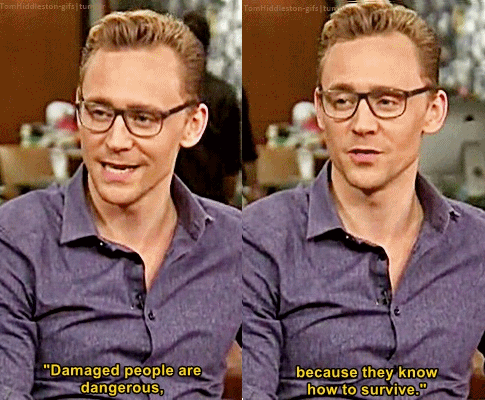
Tom Hiddleston is talking about Loki here, I think, but the concept is captivating, and it applies to Nicki and Armand:
Nicki seemed to be one of the only canon characters that explicitly had a mental illness, and that was during a time on tumblr that ppl were being more open about having mental illness and identifying with fictional characters who also had mental illness.
We are drawn to characters who have traits like ourselves, and/or those that survive, and overcome obstacles when they are faced with challenges like our own.
I think Nicki also represented some of the disillusionment ppl were feeling about the world at large at the time.
It might be that Armand has taken on more of that role, some fans also headcanon that Armand has mental illness(es) and he can also represent fans who feel disillusioned about the world at large, since the world has been so cruel to him.
More on all that later*, so I can address the other part of your statement now.
He (1) cut off Nicolas’s hands, (2) killed Claudia, and (3) kills suicidal people. (I’m not trying to shame anyone, I just want to understand why.)
^Ok, I’m going to address each of these things, since you want to understand. I’ll take it at face value that you’re not trying to shame anyone for liking a fictional character who does those things.
Whether you want to agree with my explanations is entirely up to you. If you judge him by human, real-world standards, yes, each of these things is maniacal and horrible. So my explanations are for FICTION.
NO CUTS WE LONGPOST LIKE MEN.
^I have to stop doing that I’m going to get in trouble.
First off, I would like to point out that I don’t think canon indicates that he takes pleasure in any of those things individually, except for the normal pleasure of that last one, vampires love feeding, there’s no getting around that 😉
(1) He cut off Nicolas’s hands,
This seems like fairly standard vampire punishment from a coven master. @damnitarmand, an Armand RPer, responded very well to this question, I’ll reblog it momentarily.
Armand may have been trying to help Nicki in the ways he knew how. Armand had been a coven master for hundreds of years, dealt with madness from many ages of vampires, maybe this was something that helped in other cases. It could be seen as cruel from our mortal standards, but maybe that was considered a reasonable form of treatment for vampires.
Eleni writes to Lestat in TVL:
“[Nicolas] must be watched constantly so that he does not enlarge our ranks. His dining habits are extremely sloppy. And on occasion he says most shocking things to strangers, which fortunately they are too sensible to believe.“ In other words, he tried to make other vampires. And he didn’t hunt in stealth. “In the main it is Our Oldest Friend [Armand, obviously] who is relied upon to restrain him. And that he does with the most caustic threats. But I must say that these do not have an enduring effect upon our Violinist.”
“…I tell you these things not to haunt you but to let you know that we do our utmost to protect this child who should never have been Born to Darkness. He is overwhelmed by his powers, dazzled and maddened by his vision. We have seen it all and its sorry finish before.”
^So clearly, Armand does everything he can before punishing him so viscerally, and Nicolas really was getting out of control. Eleni even notes that Nicolas is not taking to vampirism very well and would never have been turned by the coven, they’ve had hundreds of years to learn about who can handle it and who can’t, and they have their own system of psychological care, such as it is.
When Armand does take his hands, yes, it’s bc
Armand
has been pushed to being “maddened by the excesses” of Nicki! Not maddened for nothing. There is no indication that Armand takes pleasure in it. Further proof that it’s a standard punishment is when Eleni explains to Lestat that it’s temporary:
“It has come to the worst, as I feared. Our Oldest Friend, maddened by the excesses of Our Violinist, finally imprisoned him in your old residence. And though his violin was given him in his cell, his hands were taken away. But understand that with us, such appendages can always be restored.”
^So for all of the above, I don’t consider Armand’s cutting off of Nicki’s hands as a crime but as a merciful thing that’s standard procedure, albeit probably a last resort, for restoring vampire sanity.
(2) killed Claudia,
^Armand tried to get Claudia a new adult vampire companion when he pressured Louis into turning Madeleine. Armand even admits to Louis that he himself takes the responsibility for Madeleine:
“ `But if it’s any consolation to you … surely you realize I had a
hand in it.’
” [Armand said]
`That I did it to be free of Claudia, to be free to come to you …
yes, I realize that. But the ultimate responsibility lies with me!’ [Louis] said.
“`No. I mean, directly. I made you do it! I was near you the night you did it. I exerted my strongest power to persuade you to do it. Didn’t you know this?’ Woe.
I bowed my head.
‘I would have made this woman a vampire,’ [Armand] said softly. `But I thought it best you have a hand in it. Otherwise you would not give Claudia up. You must know you wanted it…
“ `I loathe what I did!’ I said. ” `Then loathe me, not yourself.’
^To me, Armand’s plan was to have Madeleine take Claudia off of Louis’ hands, so that Louis could still communicate with Claudia but not be responsible for her anymore.
I do think that the theatre vampires, led by Santiago, had other plans in mind, and that Armand had to cut his losses and let them kill Claudia since they were bloodthirsty for it. It’s exciting to kill vampires, as Santiago has said. Armand probably knew also, as a coven master, that it was a crime to turn a child anyway, and that she would have died at some point anyway (she might have even taken her own life).
(3) and kills suicidal people.
^In canon, yes, it’s described as Armand calling to those who wanted to die. Whether they could have been saved by actual medical care, or psychological therapy, I don’t think that’s addressed in canon. So here you might have an actual crime, of him killing innocent ppl who are consenting to death but not really capable of consenting to death.
This is his approach to the dilemma of being a vampire and needing to kill ppl on a regular basis, there’s a few options for doing it in canon:
Take lots of Little Drinks, if you’re capable of that, and not kill anyone,but spend like 3x the amount of time every night having to find that many more ppl to feed from. For awhile, it seemed like Louis wasn’t capable of this, since he gets so caught up in the swoon that he can’t stop. He might be able to now, tho.
Kill evildoers – bc “they deserve it anyway!” and you’re “protecting the innocents!”, but you still have to struggle to find the ones that deserve the death penalty, do drug dealers deserve to die for selling pot? In TOBT, Lestat kills someone who’s a serial elderly rapist/murderer, one would think that evildoer is evil enough to deserve the death penalty, but everyone is entitled to a defense attorney under U.S. law.
Kill indiscriminately, anyone who crosses your path, and don’t judge, bc they’re in the wrong place at the wrong time – Louis’ method bc he won’t judge evilness, lacking the Mind Gift but also, he doesn’t think he should be making that choice.
Kill innocent ppl – not very nice but some vampires do that. Claudia did.
Kill ppl who want to die as a form of assisted suicide; they are consenting to death – Armand is doing this, at least mentioning it in TVL and again in TVA. Medically assisted suicide is a very controversial thing but it is legal in some countries, and it reduces the prolonged suffering of terminally ill ppl. From wiki: “The three most frequently mentioned end‐of‐life concerns reported by Oregon residents who took advantage of the Death With Dignity Act in 2015 were: decreasing ability to participate in activities that made life enjoyable (96.2%), loss of autonomy (92.4%), and loss of dignity (75.4%).”
Armand’s killing method described in TVL:
[Armand] had perfected the act of
killing beyond the abilities of all the Children of Darkness that he knew. He
had learned to summon those who truly wished to die. He had but to stand near
the dwellings of mortals and call silently to see his victim appear. Old,
young, wretched, diseased, the ugly or the beautiful, it did not matter because
he did not choose. Dazzling visions he gave, if they should want to receive,
but he did not move towards them nor even close his arms around them.
Drawn inexorably towards him, it was they who embraced him. And when their warm
living flesh touched him, when he opened his lips and felt the blood spill, he
knew the only surcease from misery that he could know. It seemed to him in the
best of these moments that his way was profoundly spiritual, uncontaminated by
the appetites and confusions that made up the world, despite the carnal rapture
of the kill. In that act the spiritual and the carnal came together, and it was
the spiritual, he was convinced, that survived. Holy Communion it seemed to
him, the Blood of the Children of Christ serving only to bring the essence of life
itself into his understanding for the split second in which death occurred.
I think Armand’s assisted-suicides were mostly emotionally-driven, I don’t think canon goes into much further detail about it. I would think that Armand is killing ppl who are truly beyond saving, and the time period in which he’s doing it is not one that handled mental healthcare the way we do now. So at that time, that was probably not considered a crime, but a mercy killing.
Currently, his decision to kill “those who wish to die” (and possibly, he influences that on them), yes, he might be killing innocent ppl who might have had a chance at living otherwise.
Armand in TVA, more modern-era, is now killing an evildoer/drug addict:
Now I had to have blood. There was no time for the old game, the game of drawing out those who wanted to die, those who truly craved my embrace, those in love already with the far country of death of which they knew nothing.
…The next [victim] was a common desperate youth, full of festering sores, who had killed twice before for the heroin he needed so badly as I needed the doomed blood inside him.”
We don’t have as much information on whether he’s more of a “kill the suicidal” or “kill the evildoer” in current canon. In the TVA example above, the victim has killed “for the heroin,” so he’s an evildoer anyway.
*SO WHY DO PPL LIKE ARMAND??? O____O
Why do ppl like peanut butter? Or not like it? Some ppl are allergic to peanut butter. There are so many reasons to like a character!
We’re drawn to characters for any number of reasons!
I think this current crop of tumblr VC fans is talking about Armand more bc he is also a victim of CSA, has undergone an enormous amount of trauma in canon, and survived it, even becoming a coven master in the cult that brainwashed him for centuries. It’s inspiring to see a character carry the weight of all that damage and seem to overcome it and, even, become strong and confident, and even happy, at least sometimes. There’s no denying there’s a lot of sass in Armand.
Maybe fandom wants to embrace him and comfort him and give him all the happiness they would want themselves to have. It’s easier to project it onto a fictional character, and see it reflected back when you imagine him, in fanart or fanfic.
Imagining Armand enjoying himself, exploring technology with Daniel or playing videogames and elbowing Lestat to try to mess him up on coven game night, all of his past is still inside him but he’s trying to make the best of things, trying to have a family, such as it is, trying to find his purpose in life. Isn’t that what we’re all looking for? A home. And I think we like to see characters like ourselves find home and feel wanted, at least some of the time.
break up your paragraphs. big paragraphs are scary, your readers will get scared
fuuuuck epithets. “the other man got up” “the taller woman sat down” “the blonde walked away” nahhh. call them by their names or rework the sentence. you can do so much better than this (exception: if the reader doesn’t know the character(s) you’re referring to yet, it’s a-okay to refer to them by an identifying trait)
blunette is not a thing
new speaker, new paragraph. please.
“said” is such a great word. use it. make sweet love to it. but don’t kill it
use “said” more than you use synonyms for it. that way the use of synonyms gets more exciting. getting a sudden description of how a character is saying something (screaming, mumbling, sighing) is more interesting that way.
if your summary says “I suck at summaries” or “story better than summary” you’re turning off the reader, my dude. your summary is supposed to be your hook. you gotta own it, just like you’re gonna own the story they’re about to read
follow long sentences w short ones and short ones w long ones. same goes for paragraphs
your writing is always better than you think it is. you just think it’s bad because the story’s always gonna be predicable to the one who’s writing it
Maybe that applies to fandom in some way, too… bc the joke “When you’re motivated to write smut out of spite,” that’s being salty about someone’s sour opinion about a ship, I would guess, and OP writing smut of that ship just to rebel, that’s the sour to the saltiness?
Salty, sweet, sour, bitter, spicy, umami… all the flavors can be applied to fandom, too, and they’re all of value. We consume canon, fanon, etc… we create our own. This is probably not any kind of definitive statement on flavor (partly bc they’re lumping umami and salty? oddly?) butthis article has some interesting info on flavor interactions that could probably be applied to fiction/media/fanworks/etc….
So YEAH in the article linked above, we get these recommendations with cooking that I think applies to fanfic. Maybe this will help someone with their writing!










 I-want-my-IWTV
