Dr. Alistair McAlpine shared a
series of tweets from his terminally ill child patients, after asking
what they enjoyed in life, and what gave it meaning
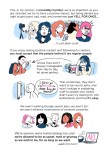
Something I’ve been wanting to talk about for a while now, as I’ve seen it affect other content creators… We might advocate for positivity, but that doesn’t make us invincible 😔Please be mindful of what you send to people you follow.
(I am reposting this from twitter, I don’t know if OP has it posted on another tumblr, if so, I will delete this and reblog from OP.)
It’s a powerful message and a good reminder, especially for blogs like mine that advocate for positivity. I have my moments, like any other mortal human being. I stress, I make mistakes, and I apologize. I try to make peace when possible.
While this blog advocates positivity, it is run by a flawed human being who makes mistakes and is not a walking Google search bar, not Siri, not an ethereal incarnation of constant positivity.
“We’re women, we’re human beings too, and we’re allowed to be as upset, mad or grumpy as we wish to be, for as long as we want.”
a lot of young people say that fanfic made them think abuse was okay, and I think it’s disingenuous to say they’re all lying. but why is this suddenly a problem? this is my theory as to why it’s no longer an understood thing that fandom is about fiction & fantasy.
really good stuff
I’ve said it before– if young people are getting their primary education on consent and sexual relationships from fandom they have already been failed.
And I say this as someone who got my primary education on consent and sexual relationships from fandom, and for whom it worked out pretty well. I mined a ton of good stuff out of fandom and discussions around fandom. But the fact that there was a void of education in my life that I had to fill on my own is not on fandom. That’s on society and rape culture and our puritanical education system.
[First post is screenshots of a twitter thread; here’s the text of it.]
something I think about a lot is how fandom talks to each other.
i suppose that’s obvious, but not just the antagonistic vitriol. the hyper-ramps of joy feedback can produce similarly hyperbolic language.
almost a year ago I got a multi-comment ask from an anti who told me that ‘bad ships’ almost led them into some real life abusive situations in her dating life. I didn’t respond because I wanted to think about it. and while the framework of my feelings was formed 1 month later–
–I’ve been fleshing that out ever since. because she’s not alone in saying this happened – she read smutfic and later felt her impressions were screwed up by them – but why? why is this suddenly a complaint?
and i think it has a lot to do with evolving internet culture interacting poorly with fandom culture and young people looking for easy answers to complicated questions. for instance:
-young women&/or afab people grow up with specific toxic messages targeted at them about sex/purity
a lot of shit mixes together & it’s not weird for afab people to be disgusted by their body &/or come away with dark sex/violence mishmashes brewing in the hindbrain. may or may not be kinks later, but like. USians, think about how sex & violence (towards afab/women) is tied together.
(transphobia adding a WHOLE NEW FUN LEVEL to this, too. trans (&nb) people 10,000% included in this, in case it’s not clear to anyone.) -all the taboo around expressing sexual ideas, esp if you’re not a cis man, makes it hard to express yourself. -then fandom: mostly afab, full of kink
-majority afab and/or women, kink-friendly fandom functions like a release valve for a lot of people. & though it was never explicitly said by anyone I remember, there was always a kind of understanding this was the case: a safe place for women/afab people to be crass and sexual–
–objectifying fictional characters instead of being objectified, exploring sexual fantasies in safe spaces, etc etc. people in fandom would express filthy ideas & wants! it was afab people &/or women being as frank & open about their fantasy lives as cis men could be everywhere else.
but it was also understood that everything in fandom was fictional. like: of course rape is bad, nobody wants rape to happen, but fantasies are fantasies. live it out on a fictional character who can’t be hurt! good way to blow off some steam.
& because this was understood, people talked about kinks – some really taboo, some things that would be very harmful or abusive or illegal irl – without restraint or qualifications. they weren’t needed! fandom was for fiction. say the gross thing, nobody’s judging!
and that was all well and good as long as we were all working off the same context: fandom is for fiction. this is where we put stuff that’s not safe irl. but.
but.
tumblr.
tumblr is a viral sharing platform. every post you make can be boosted independent of its original context. & when you remove all this frank, salacious, unqualified talk about fictional characters from the context of ‘it’s fiction’ and ‘it’s not for rl for good reason’: well.
fandom got visible on tumblr in a new way. tumblr dropped the barriers to entering fandom. and starting in 2012/2013, tumblr entrants had grown up in a world where the internet had been around *their whole lives*. 9/11 happened when they were a /fetus/.
and 2011-2013 fandom tumblr is an unholy, indistinct mix of real life activism, awareness, and …. posts about how sexy Dave Strider is. in exactly the same kinds of tones we used on lj, in fandom-only – fiction-only – spaces.
I can see how baby fans got the wrong idea.
without necessarily knowing it was happening, fandom – in moving to tumblr – went from a delineated safe space for non-cis-male sexual fantasy indulgence to being – for newcomers at least – indistinguishable from the sexual noise they grew up with, except probably more appealing.
losing shared context by being diluted on tumblr means young people could encounter fandom fantasy content independent of the ‘we let it hang out here b/c we’re not allowed to otherwise’ subtext. Mixed well with the much nastier toxic messages of rl & mass media & get a nasty mess.
i don’t want to spoil the punchline, but the reason non-cis-men are more in need of a safe space retreat than cis men is b/c of misogyny. so you’ll never guess what happened when fandom’s version of that space got diluted into pop culture!
(radfems! also misogyny.)
2012/13 tumblr gets a 1-2 punch: structural patriarchy: women who openly like sex are dirty sluts! they raise & teach kids how to be good adults! they’re pure! radfems: women who openly like kinks are feeding into female oppression! women teach women to be good adults! they’re pure!
2012/12 tumblr recognizes the structural punch, kinda, but disguised as Girl Power, they don’t see the second one coming. Bam! fandom – mostly made up of afab people and/or women – is suddenly awful for letting itself be sexually expressive! it abandoned the teaching post!
softened up by structural oppression of non-cis-(straight-white)-male sexuality, young fandom went down like a stone to the idea that women should be teaching other women how to be good women and Good Women Don’t Do Kinks Or Men (add heaping tablespoons of transphobia/racism/etc)
this got out of hand like always, god. but long story short: young fandom didn’t – doesn’t – see how society sets them up for abusive relationships, sexual disasters, and toxic predation. so they look back at fandom – in dialogue with all that grossness – and conclude:
‘the people in fandom failed me.’ – fandom was supposed to teach them how to be safe – society tells them that’s the job of ‘women’. but fandom wasn’t being a mom, and therefore if they weren’t safe it was fandom’s fault.
these people who were abused using fandom as a tool, or feel like they were vulnerable because of fanworks: fanfic didn’t make them that way. it just feels natural to blame it because it’s hard to see the power structure you live in, and it’s hard to admit to being helpless.
the fanworks are easy to point to and blame because they’re fiction. It’s the same reason video games were easy to blame for violence. it feels so clean and straightforward, and it doesn’t require dismantling a whole power system – a whole culture – to get rid of.
but it’s not the fiction.
(here’s the hard part.)
if fandom contributed to the toxic messages about sexuality absorbed by younger members, it’s because of continuing to talk about fictional characters like we were in those old, delineated ‘fantasy only/it’s just fiction’ spaces–
– after the shift to tumblr. and frankly, tumblr is not that kind of delineated space: it’s also an activist space (or was one), and an awareness space.
non-cis-male sexual fantasies about fictional characters & rl social activism/awareness do not mix well, as we’ve seen.
and that contribution was a small, small part, probably: fandom is so queer, so non-cis, so non-straight, so disabled and neurodivergent that our influence on everything but tumblr is really small.
but because we’re not a power structure, we’re easy to point to & tear down.
and we’ve been trained by society to blame our troubles on those we can get at and hurt instead of blaming the very way our cultures are built. hurting other vulnerable people is easy. dismantling the earth under our feet is hard. (why do u think radfems focus on fixing women?)
to wrap up: fandom isn’t perfect by a long shot, and one thing we can do to protect ourselves from harm is assume the best of others and try to put things we see into context.
we can also fuck up white cis male patriarchy instead of each other. (screw the system.) /end





 I-want-my-IWTV