i don’t think people really get how little feedback fanfic authors actually get? like the effort to reaction ratio is so abysmally skewed here that a fic nearly 50,000 words long takes an entire year to amass like. 16 comments. someone reblogged a fic i wrote at 4 am and tagged it with a 5-word compliment and i can’t stop thinking about it, not because it was so nice but because half the time you post a fic you’re going to hear nothing and anything feels like so much
fandom culture is so, so good about giving artists the credit they’re due, but we gotta start doing that for writers too. you’ve got no idea how much people put into their stories and get maybe a handful of reblogs and a dozen-odd kudos. that’s not enough. writing is an endurance sport and y’all need to start giving fic writers a reason to endure it and improve their craft. encourage writers like you encourage artists. reblog fics, leave tags, leave comments, acknowledge that these stories do not just spring into being for your entertainment.
every single damn writer i know feels like at least their readers see them as a machine. that’s gotta change.
So the essence of grimdark is that everyone’s inherently sort of a bad person and does bad things, and that’s awful and disheartening and cynical. It’s looking at human nature and going, “The glass is half empty.”
Hopepunk says, “No, I don’t accept that. Go fuck yourself: The glass is half-full.” YEAH, we’re all a messy mix of good and bad, flaws and virtues. We’ve all been mean and petty and cruel, but (and here’s the important part) we’ve also been soft and forgiving and KIND. Hopepunk says that kindness and softness doesn’t equal weakness, and that in this world of brutal cynicism and nihilism, being kind is a political act. An act of rebellion.
Hopepunk says that genuinely and sincerely caring about something, anything, requires bravery and strength. Hopepunk isn’t ever about submission or acceptance: It’s about standing up and fighting for what you believe in. It’s about standing up for other people. It’s about DEMANDING a better, kinder world, and truly believing that we can get there if we care about each other as hard as we possibly can, with every drop of power in our little hearts.
Going to political protests is hopepunk. Calling your senators is hopepunk. But crying is also hopepunk, because crying means you still have feelings, and feelings are how you know you’re alive. The 1% doesn’t want you to have feelings, they just want you to feel resigned. Feeling resigned is not hopepunk.
Examples! THE HANDMAID’S TALE is arguably hopepunk. It’s scary and dark, and at first glance it looks like grimdark because it’s a dystopia… but goddammit she keeps fighting. That’s the key, right there. She fights every single day, because she won’t let them take away meaning from her life. She survives stubbornly in the hope that one day she can live again. “Don’t let the bastards grind you down,” is one of the core tenets of hopepunk, along with, “The arc of the moral universe is long, but it bends towards justice.”
Jesus and Gandhi and Martin Luther King and Robin Hood and John Lennon were hopepunk. (Remember: Hopepunk isn’t about moral perfection. It’s not about being as pure and innocent as the new-fallen snow. You get grubby when you fight. You make mistakes. You’re sometimes a little bit of an asshole. Maybe you’re as much as 50% an asshole. But the glass is half full, not half empty. You get up, and you keep fighting, and caring, and trying to make the world a little better for the people around you. You get to make mistakes. It’s a process. You get to ask for and earn forgiveness. And you love, and love, and love.)
And THIS, this is hopepunk:
HOPE AND HONESTY IN A SOCIETY THAT VALUES CYNICISM AND DECEPTION IS SUBVERSIVE AND THEREFOR PUNK
I AM HERE FOR THIS MOVEMENT. HOPE AND HONESTY ARE DEEPLY PUNK ROCK. KINDNESS IS GOTH AS FUCK.
Your headcanon is your headcanon. The characters in your mind are what they are, and nobody is trying to take them away from you. Think of the Good Omens TV series as a stage play: for six full hours, actors are going to be portraying the roles of Crowley and Aziraphale, Shadwell and Madame Tracy, Newt and Anathema, Adam, Pepper, Wensleydale and Brian and the rest. Will they look like the people in your head? The ones you’ve been drawing and writing about and imagining for (in some cases) almost 30 years?
Probably not. Which is fine.
The people in your head and your drawings are still there, and still real and still true. I’ve seen drawings of hundreds of different Aziraphales over the years, all with different faces and body-shapes, different hair and skin, and would never have thought to tell anyone who drew or loved them that that wasn’t what Aziraphale looked like. (And a couple of years after we wrote it, I was amused to realise that the Aziraphale in my head looked nothing like the Aziraphale in Terry’s head.) I’ve loved every instance of Good Omens Cosplay I’ve seen, and in no case did I ever think anyone was doing it wrong: they were all Aziraphales and Crowleys, and it was always a delight.
Good Omens has been unillustrated for 27 years, which means that each of you gets to make up your own look for the characters, your own backstories, your own ideas about how they will behave.
The TV version is being made with love and with faithfulness to the story. It’s got material and characters in it that Terry and I had discussed over the years, (some of it from what we would have done it there had been a sequel). Writing it has taken up the greater part of my last three years. You might like it – I really hope you will – but you don’t have to. You can start watching it, decide that you prefer the thing in your head, and stop watching it. (I never saw the last Lord of the Rings movie, because I liked the thing in my head too much.)
Remember we are making this with love.
And that your own personal headCrowleys and headAziraphales and headFourHorsemen and headThem and headHastur and headLigur and headSisterMary and all the rest are yours, and safe, and nobody is ever going to take them away from you.
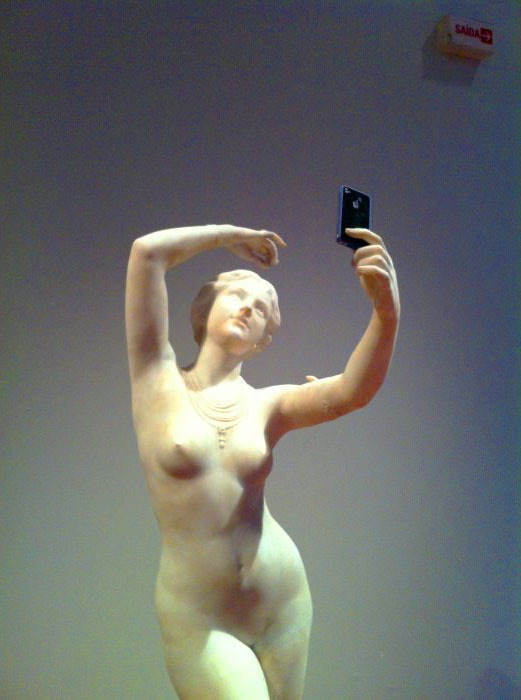
The thing about this is that sculptures like these in art history were for the male gaze. Photoshop a phone to it and suddenly she’s seen as vain and conceited. That’s why I’m 100% for selfie culture because apparently men can gawk at women but when we realize how beautiful we are we’re suddenly full of ourselves…
“You painted a naked woman because you enjoyed looking at her, put a mirror in her hand and you called the painting “Vanity,” thus morally condemning the woman whose nakedness you had depicted for you own pleasure.” ― John Berger, Ways of Seeing
I know I’ve reblogged this before but it’s so important.
It’s almost as if nobody wants to admit that they might not be prepared to do the work it takes to love somebody. And it can be laborious. To be intimate with someone who is flawed (which is the standard) requires us to expose our own flaws. We don’t talk about the heavy responsibility of that. We don’t talk about how we’re too lazy or too cowardly sometimes. We instead accuse love of being elusive. It isn’t. It is omnipresent. It asks us to be better people. And sometimes we flat out refuse.
I didn’t say I liked it. I said it fascinated me. There is a great difference.
Oscar Wilde,The Picture of Dorian Gray (via foxmvlders)
But, I do think that if there’s a sort of “moral” to Frankenstein, that who did Mary Shelley herself most identify with? Probably the creature. You know, as Joey said, the “unnamed creature.” Why? Because that’s how people responded to her. As an intellectual woman and as an unwed mother, she was called a whore. When people found out that she wrote Frankenstein they said what kind of woman would write such a book? Must be something wrong with her. There’s something perverse about a woman who would write such a book.
So later in her life she says, “I wrote it, but that’s because the idea came to me in a dream.” And we know that isn’t true because we have her notebooks. She in fact thought of the idea. She worked on it really hard. She worked on it really hard while young women around her were killing themselves. And also, incidentally, she was reading the history of slavery. So she’s dedicating herself to the ideas of social injustice and the suffering of those who are considered monstrous by their own society, herself included.
So, she sees herself as a woman who’s trying—she wants to publish and be smart in her world, as someone who’s going evoke feelings of monst— [To audience (Joey Eschrich?)] You said a feeling of monstrosity? People will react to her as though she’s a monster, and she’s saying, “Don’t do that.”

 I-want-my-IWTV