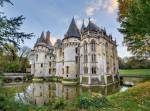
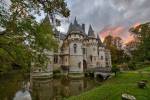
This forgotten castle (Château de la Mothe-Chandeniers) was abandoned after a fire In 1932. Seeing it up close is breathtaking. These days it seems like castles only exist in storybooks and Disney movies. What happened to the foreboding dwellings of our wealthiest ancestors? The truth of the matter is, while there are still many castles in Europe, many have fallen into disrepair and ruin over time. However, a group of preservationists in France are trying to save a 13th century castle that is slowly being reclaimed by nature. The story behind the abandoned property is just as fascinating as what’s left standing today. See an amazing video here.
duendology asked: “Delfe, help me, help us! 😉 I’ve been trying to establish which parts of the France southern region (usually administratively now having different names) belonged to the historic “Auvergne”? Is there, perhaps a historic map with this region marked? So I could see this territory in its full historical context?”
First I’ve to confess I’m pretty
much ignorant of Southern France and Auvergne geography (even if I’m currently living “not-so-far” from there – shame on me), so I did learn a lot of things about the history of Auvergne.
Before speaking more specifically of
Auvergne, a “tiny” point; France has two important
administrative divisions: “région” (created in 1955) and “département” (created
in 1790). The 27 régions are subdivided into 101 départements (the
région of Auvergne, for
example, has 4 départements). Therefore, the number of régions is going to be
reduced to 18 in
2016, and Auvergne
will be merged with the
région of Rhône-Alpes. Lyon will most certainly become the administrative
center, so Clermont-Ferrand will lose its
official title of Auvergne’s
capital.
Now, back to the main topic!
Current Auvergne is basically a combination of historic Auvergne and the provinces of Bourbonnais and Velay. The name Auvergne come from gallic tribes of Arvernes, one of
the most famous and powerful confederation of Gaul.
I’m not going to trace the whole history of Auvergne
(I don’t want you to fall asleep and Wikipedia does that 1000 times better than me here anyway) but the “city of Arvernes”, in fact,
covers more or less the territory of 18th century Auvergne. With the Revolution, France is divided in départements, and the province of Auvergne
is split between Puy-de-Dome, Cantal, Haute-Loire and Allier in 1790. A entity similar of
historic Auvergne
is finally brought back in 1955 with the creation of administrative régions.
18th century Auvergne
on a map of current France (with départements divisions) ;
today’s Auvergne
is in red (I made a map combining this map to another one I found on Wikipedia; it’s not a
perfect match, but it makes things easier to visualize)
A map of the provinces of Marche, Bourbonnais, Limousin and Auvergne (in red), dating apparently from 1763. [source]
And a map of the “cité des Arvernes” with actual Auvergne limits. [source]
Voilà !
its also
ridiculously,
incredibly,
gorgeous and
can’t you just
see little baby
mortal Lestat,
hunting and galavanting around this place?
Also, its famous for its rustic wines, hot springs (due to all the dormant volcanoes, such that the Puy-de-Dome that gives it name to the larger region. For all its fields and valleys it also has large areas of thick forest once ridden with wolves and all sorts of other beasties. I did a lot of research on the area for an art project I did in high school, and it shot Auvergne near the top of my “Things to see in France” list.
…see little baby mortal Lestat, hunting and galavanting around this place
duendology asked: “Delfe, help me, help us! 😉 I’ve been trying to establish which parts of the France southern region (usually administratively now having different names) belonged to the historic “Auvergne”? Is there, perhaps a historic map with this region marked? So I could see this territory in its full historical context?”
First I’ve to confess I’m pretty
much ignorant of Southern France and Auvergne geography (even if I’m currently living “not-so-far” from there – shame on me), so I did learn a lot of things about the history of Auvergne.
Before speaking more specifically of
Auvergne, a “tiny” point; France has two important
administrative divisions: “région” (created in 1955) and “département” (created
in 1790). The 27 régions are subdivided into 101 départements (the
région of Auvergne, for
example, has 4 départements). Therefore, the number of régions is going to be
reduced to 18 in
2016, and Auvergne
will be merged with the
région of Rhône-Alpes. Lyon will most certainly become the administrative
center, so Clermont-Ferrand will lose its
official title of Auvergne’s
capital.
Now, back to the main topic!
Current Auvergne is basically a combination of historic Auvergne and the provinces of Bourbonnais and Velay. The name Auvergne come from gallic tribes of Arvernes, one of
the most famous and powerful confederation of Gaul.
I’m not going to trace the whole history of Auvergne
(I don’t want you to fall asleep and Wikipedia does that 1000 times better than me here anyway) but the “city of Arvernes”, in fact,
covers more or less the territory of 18th century Auvergne. With the Revolution, France is divided in départements, and the province of Auvergne
is split between Puy-de-Dome, Cantal, Haute-Loire and Allier in 1790. A entity similar of
historic Auvergne
is finally brought back in 1955 with the creation of administrative régions.
18th century Auvergne
on a map of current France (with départements divisions) ;
today’s Auvergne
is in red (I made a map combining this map to another one I found on Wikipedia; it’s not a
perfect match, but it makes things easier to visualize)
A map of the provinces of Marche, Bourbonnais, Limousin and Auvergne (in red), dating apparently from 1763. [source]
And a map of the “cité des Arvernes” with actual Auvergne limits. [source]
But can you guys imagine when we get to the Auvergne castle in “Blood Paradise” and Lestat is all like “dudes, we need a password just in case the plebes attempt a coup d’état”?
Can you imagine Marius knocking on the door and rolling his eyes as he says the password: “Louis’ thighs are succulent”?





 I-want-my-IWTV
