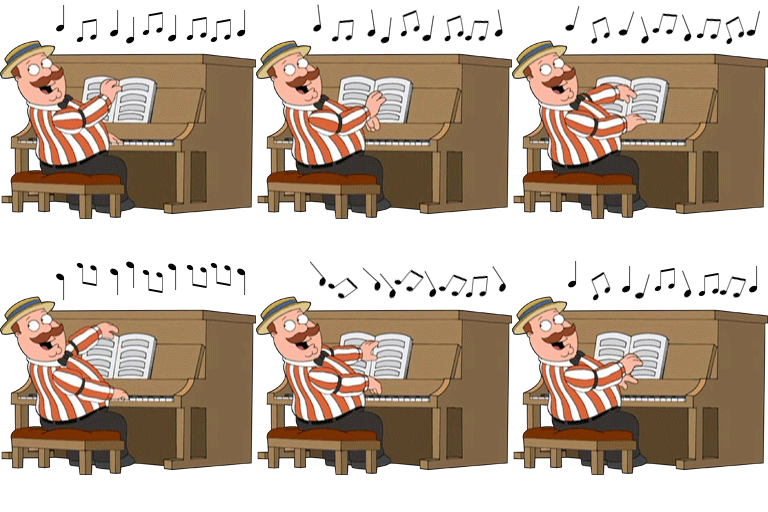
It’s Armand and it’s actually canonand one of my favorite parts to visualize in QotD(although it’s honky-tonk not ragtime, but their styles are related) I mean, just imagine Daniel waking up to that, looking completely DONE.
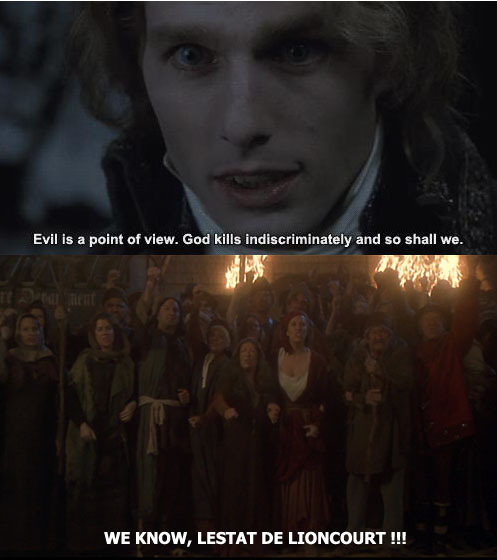
Now I just had this thought. Or a vision without revelation as the line goes… Wait, not a thought, a familiar character. It was Lestat from Interview with the Vampire. He was mean as fuck and cruel even more. I saw him feeding on one of these “lovelies” who justified and absolved him of all his monstrosity because such big and forgiving is the love of a fan, who sees him and understands him… And in this weird vision he was not like James Bond of all vampires, no. He was no Prince either. He was Hannibal Lecter of all vampires….
And I liked that….
And the thing is, it’s as likely as anything else. In QotD Lestat tells us his fantasy of visiting that fan, but the fact he stops before the end allows him to seduce the reader without having to complicate the story with a disturbing ending. In TVL and TTotBT, though, we see him feed on innocence and love it. I think you hit on a very important truth in this idea that Lestat could just as easily bury himself in a fan’s forgiving love – after all, when he does terrible things, he’s counting on the forgiveness and forbearance of those around him (and sometimes, like when he burns Louis’s shack and Marius is Not Amused, it goes very wrong)…
Mmm, yes. One more thing I’d like to add. Let’s forget for a moment it’s a piece of fiction, and so is vampire. Fans tend to forgive Lestat almost everything because he’s Lestat. No? Even the fact he’s a vampire is viewed as his asset and certainly adds much to the general appeal of this character. From the literary point of view, because it’s vampire/horror (supposedly) genre too, it’s understandable. And the irony is we should stand wary, skeptical, and cautious when faced with the creature that, yes, it feels, thinks, sings and dances too, and used to be human even, but the bottom line is… the creature eats us, it’s a serial killer. I find it fascinating. Interestingly enough, Lestat himself in TOTBT warns us not to trust him, not to fall for the image he created himself of himself in his books. He is a killer. His words are smooth, but he’s a killer… I’ve never forgotten that. It’s a subtle yet most powerful warning ever, yet it seems a reader can’t refuse the general romanticism of the books and characters, and of the way the vampires philosophize about the world and humanity, so – one by one – readers are seduced, sometimes against the human basic survival instinct. And yes, it’s fiction, it’s a seduction readers can allow themselves. Yet, there’s a deeper thing to consider and it’s this general notion or belief that someone who speaks so beautifully and feels so much can’t do me harm, right? *winks*
So, yes, thank you, Lestat, for teaching me one of the most important lessons in and about life…
“And the irony is we should stand wary, skeptical, and cautious when faced with the creature that, yes, it feels, thinks, sings and dances too, and used to be human even, but the bottom line is… the creature eats us, it’s a serial killer.”
First of all, do not tell me what is true and not true.
I feel as though I have answered this question a dozen times as if you all expect my answer to change somehow.
Romantic feelings? That sounds very trite. I do not think she would ever appreciate the…bond, shall we say, that we have with one another to be described as such. It is much more profound than that, always has been.So when can I say it first started? Well, at my birth, I suppose.
To see this question continuously asked is infuriating.
Both Lestat and I have, as he said, answered it time and time again.
“Romantic” is a terribly pedantic way of describing how I feel towards my son. Romance is a box in which you can easily place us and point fingers, isn’t it? How easy for you, how slow and simple your lives must be. How utterly boring.
I have described my life in the Auvergne to those who have cared to listen. I have described how it changed when Lestat was born. I have explained how it was to be trapped, to be beaten, to be raped and treated like a mare whose very spirit must be broken at all costs. To have one small life come into that hell hole, one person who I knew immediately was a part of me in every way, who was not the strangely-wrought men I’d birthed before—this was a revolution and a revelation for which words fail to describe.
Lestat was not only my child, not merely the only colour and breath that existed in that godforsaken corner of the earth. Lestat was and is a part of myself.
This has been made abundantly clear on several instances. To continue to ask is to attempt to assign some paltry and sordid meaning to our relationship that it does not have.




 I-want-my-IWTV