A communion wafer, according to the internet, is about .25g. Jesus was a healthy young man, who worked manual labor and walked everywhere. The average male in Biblical times was 5′1″ and about 110 pounds so call it 50kg or 50,000 grams. So 200,000 wafers to make up a whole Jesus. At one wafer a week that’s 3846 to eat a whole Jesus at weekly communion. If you went to Mass daily you could do it in under 550 years.
1000 communion wafers from Amazon costs $15, so acquiring a Jesus load would set you back about $3000
But that’s just the body. Jesus also bade his followers to drink his blood. How much of that Jesus communion wafer supply needs to be replaced with communion wine to account for his blood, and how much of that would need to be consumed to have drunk all his blood as well?
The human body contains roughly 5 liters of blood.
Communion wine costs about $66 for a case of 12 x 750 ml bottles (9000 ml).
So half a case is 4500 ml, or close enough if Jesus was on the small side which is reasonable given what we know of the times.
Thus, Jesus’ blood would be about 6 bottles of communion wine, costing $33.
How much of his weight was his blood, now? We can bring down the wafer count.
Osnap what an excellent question.
Water has a specific gravity of 1.0 and weighs 1kg/liter. Wine has a specific gravity if 1.5 thus weighs 1.5kg per liter.
4.5L of wine would weigh 6.75kg or about 15 pounds.
Reducing the wafer load by 6.75kg yields 43.25kg so call it 161,000 wafers or $2450 and change.
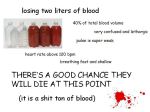
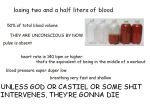
Here are some scientific facts about blood loss for all you psychopaths writers out there.
This is actually very nice. I like the soda bottles as reference. (I remember when I was writing ‘Wizards of Ceres’ how I had to do a similar soda-bottle conversion to try to work out how much blood Fai could drink from Kurogane without killing him.)
On the topic of vampires incidentally, this basically means that there is no reason why feeding from someone should necessitate killing them, unless the vamp can chug two soda bottles worth of liquid in one go or carelessly leaves the bottle open when they’re done
@fieldofclover thought this might come in handy for, you know, vampirey things
Ooh, I like this! The bottles as a reference makes it quite easy to picture mentally – especially since, having previously experienced just how much mess a litre-bottle spilt on the floor actually makes, it gives a better idea of volume etc.
Incidentally, as a frequent blood donor myself (thank you, haemochromatosis), and thus being more aware of the volume of blood donated at each session (the average appears to be 450ml, or 0.45 litres per blood bag filled) and needing to know how long it takes red blood cells and plasma to recover after donation–
about 24 hours for plasma, and up to 8 weeks for red blood cells themselves, which is why the average length between donations is 12 weeks, to ensure the body is well recovered by the next donation (which is also why I was so fucking tired after having to donate once a month for the first three months of my treatment)
– I ended up doing a bit of reading re: blood loss, but this really is the best imagery for it I’ve seen without bogging down into too much science stuff.
Other crucially important facts relevant to vampire porn I have learned:
yes, you can get an erection after donating blood, as the body generally maintains blood pressure equilibrium even if the volume of red blood cells per liquid ml is lower, though if you lose anything more than half a litre you’re probably gonna find it a bit difficult;
erythropoietin is a funky chemical involved in converting stem cells to red blood cells which your body produces when you need more of ‘em, so if we’re going with the standard ‘vampire saliva is an anticoagulant and narcotic stimulant, and/or induces arousal’ conceit, it probably makes sense that said saliva introduces a similar compound into the human blood stream in the post-feeding stage to encourage their food to recover quickly for a repeat feeding, usually while licking the wounds left behind;
your vamp is probably gonna have a really full belly if they try and drink more than the average 450ml or so in one sitting. Blood is quite a bit thicker than water or soft drink; it’s more like drinking a hearty broth or soup. Can you imagine attempting to chug a litre of pressurised soup as it squirts into your mouth with considerable force? No thanks!
tl;dr the science behind blood loss is fascinating, especially in a vampire context, and the government agencies monitoring my search history probably think I’m a serial killer
@audreycritter was it you who was looking this up for a fic last week?
if your vampire’s killing folks, it’s because they left a couple of great big spurting holes in a jugular, not because they actually drank all their blood. we gotta stop having the scene where the detective says the victim was ‘completely drained of blood’ unless there were like 5 vamps involved.
or if your vamp goes waddling away with a bloated tummy like a milk-drunk kitten, that could work too.
You’re looking at a 3 mm-wide section of a cat tongue more than a century old. David Linstead’s captivating image was a winner in the 2015 Wellcome Image Awards, run by the Wellcome Trust, a biomedical charity in London.
The serrated ridge may be the most intriguing aspect of this picture. Those rough bumps, or papillae, are the reason that a kitty’s tongue feels like sandpaper when it licks you. When a cat grooms herself, the papillae act like a comb to remove dirt and loose hair. But they also serve a grislier purpose: rasping meat off of bones.
Blood loss in fiction is often written very unrealistically. So here’s a short guide about blood loss and the effects to help you out a little.
First of all: The average healthy adult human body contains around 5 litres of blood. A healthy person can lose 10%-15% of their total blood volume without experiencing any difficulties and blood donations usually take 8%-10% of the donor’s blood.
Now let's get to the facts about blood loss:
Class I Hemorrhage | 0%-15% | Minimal blood loss No change in vitals, you may experience anxiousness. In almost all cases blood transfusion won’t be necessary. You will LIVE Class II Hemorrhage | 15%-30% | Mild blood loss Rapid heart beat and decrease in pulse pressure. Rapid breathing. Skin may start to lose temperature and start to look pale. You may feel anxious, irritable and confused. In most cases blood transfusion won’t be necessary. You will LIVE Class II Hemorrhage | 30%-40% | Moderate blood loss Heart rate increases. Shock. Mental status worsens. Blood pressure drops. Lightheadedness/dizziness. Nausea. Blood transfusion is necessary. If you get help in time, you will LIVE Class IV Hemorrhage | >40% | Severe blood loss Symptoms intensify. Probably unconscious. Aggressive resuscitation is required to prevent death. Losing >40% of your total blood volume may be fatal, you will probably DIE.
The chances of surviving after losing 3 litres of blood are REALLY low, the average person doesn’t survive this, so please don’t write a scene where a character loses that much blood without dying. It’s not really realistic.
Chilling Brain Scans Show the Impact of a Mother’s Love on a Child’s Brain Size
A shocking comparison of brain scans from two three-year-old children reveals new evidence of the remarkable impact a mother’s love has on a child’s brain development.
The chilling images reveal that the left brain, which belongs to a normal 3-year-old, is significantly larger and contains fewer spots and dark “fuzzy” areas than the right brain, which belongs to that of a 3-year-old who has suffered extreme neglect.
Neurologists say that the latest images provide more evidence that the way children are treated in their early years is important not only for the child’s emotional development, but also in determining the size of their brains.
Experts say that the sizeable difference in the two brains is primarily caused by the difference in the way each child was treated by their mothers.
While at first glance, the images might indicate that the child with the right brain might have suffered a serious accident or illness, neurologists said that the truth is that the child with the shrunken brain was neglected and abused by its mother, and the child with the larger and more fully developed brain was raised in a loving, supportive home and was looked after by its mother, according to The Sunday Telegraph.
Researchers told the UK newspaper that the image of the brain scan on the right shows that the child lacks some of the most fundamental areas that are present in the image of the brain scan on the left.
They say that the child on the left with the larger brain will be more intelligent and will be more likely to develop the social ability to empathize with others compared to the child on the right.
On the other hand, the child with the smaller brain on the right will be more likely to become addicted to drugs, be involved in violent crimes, be unemployed and dependent on government benefits in the future. (Source)
Look at your wrist, see the blueish veins? The blood flowing through them contains hemoglobin, a protein that has four iron atoms incorporated into its structure. Iron is only naturally produced in one place, it can only be forged in the core of dying stars.
Every time you look at your veins, remember that you are built from, and kept alive by, pieces of stardust.
This is beautiful. I needed this
just learned this in astronomy and can confirm. I love.
It’s not always easy to find a vein under a patient’s skin, especially if they have a darker complexion. This device, called the VeinViewer, solves that problem with augmented reality.
First, the device scans a patient’s skin using infrared light. By capturing and processing the reflected radiation, it identifies the locations of blood vessels and projects a bright green light onto the surface to highlight the where they are.
The resolution can be set so high that even the valves within veins as small as 0.22mm across can be seen, making finding a site for an injection a little less painful. There’s also promise for its use in the treatment and diagnosis of varicose veins, and aid in transfusions and blood sampling.







 I-want-my-IWTV