//Okay, so I find this all very interesting, so a few thoughts/canon/headcanon re: Lestat’s dialect in French and how his French changed/evolved over the years.
-Lestat is born and raised in the Auvergne, which means his French patois is ‘Auvergnat,’ which is a branch of Occitan, a dialect of mostly Provence. This dialect, if you’ve never heard it, is NOTHING like the Parisian French that most of us learn in school, nor is it similar to what would have been spoken in Paris at the time (18th century). Here is an Auvergnat lullaby, and here is what Auvergnat sounds like, around 4:17. Here is an example of L’Occitane.
-Lestat then moves to Paris with Nicolas, and spends quite some time there (I don’t have my book on me). His French of COURSE would have changed, as he’d have been mercilessly teased for his dialect, which would have sounded ‘country’ to the people of Paris. Personally, I headcanon Nicolas’ old Uni friends making fun of Lestat’s dialect and Lestat forcing Nicolas to help him with his Parisian French, but that’s not canon, just my thoughts.
-Lestat then relocates to New Orleans around 1791, a time when Louisiana actually belongs to Spain. The French that Louis de Pointe du Lac is going to be speaking here is a whole OTHER kind of French, probably colored by a number of things: Spanish colonists, French colonists, and the patois of the Haitian peoples who also live there. You can read more about Louisiana French here. I headcanon that Lestat definitely learned the patois of New Orleans, especially since he lived there for around 70 years. By the time he meets Louis, his French is an amalgam of at least two different dialects, though the French he’d speak to the Marquis would have been Auvergnat. It’s a testimony to the fact that Louis must have immigrated while very young (hilariously, Louis is NOT actually Créole), b/c I highly doubt he’d recognize the dialect.
-Lestat then learns English from, as he calls it, ‘flatboatmen’ on the Mississippi and comic books, which is hilarious, and pretty much accounts for his tone.
TL:DR; I just feel very strongly about language, especially the evolution of each of these characters, and I love imagining how their capacities for language and dialect have evolved.
I love Internet grammar I love how “you what mate” is an incredulous question but “u wot m8” is an invitation to fight I love how straight people are different to Straight People I love how smol is so much smaller than small I live how thiS, tHIS and THIS are all different in my mind i luv how dis spelling make sarcasm I love how haha, lol and lmao are completely different emotions I love how….. This…. Makes everything… So much more dramatic???? Tone is so hard to convey in writing u go lil buddies you go
//ooc: mun doesn’t know much about the actual French used by young people, so my Lestat can’t really answer that…
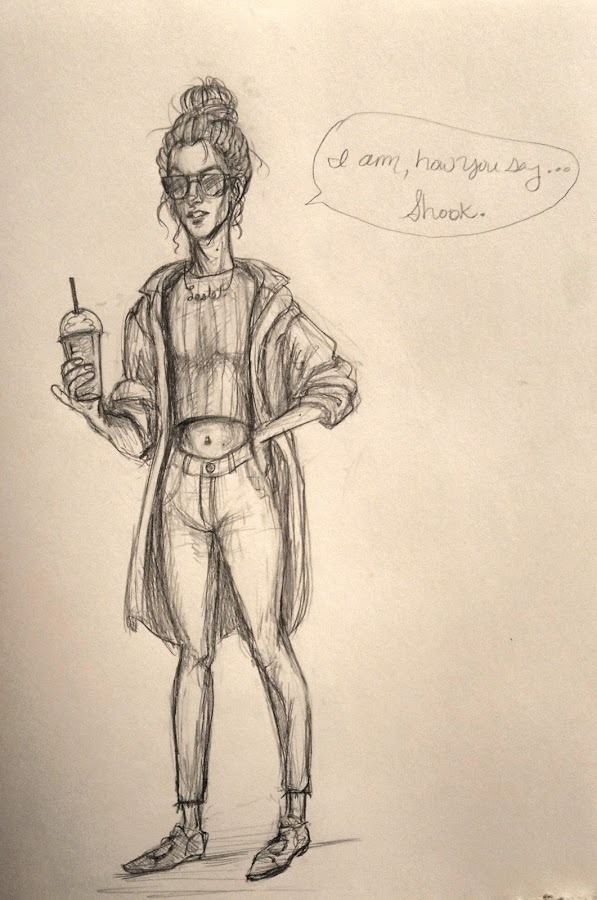
[^X] He loves learning slang and curse words and such, though, so I’m sure he’d be totally into whatever the actual French used by young people today is! I headcanon that he learns these things and loves mixing slang and colloquialisms from different generations accidentally (or purposely!) and ends up sounding pretty ridiculous sometimes.
idk I just love how we Young People Today use ~improper~ punctuation/grammar in actually really defined ways to express tone without having to explicitly state tone like that’s just really fucking cool, like
no = “No,” she said.
no. = "No,” she said sharply.
No = “No,” she
stated
firmly.
No. = “No,” she snapped.
NO = “No!” she shouted.
noooooo = “No,” she moaned.
no~ = “No,” she said with a drawn-out sing-song.
~no~ = “No,” she drawled sarcastically.
NOOOOO = “No!” she screamed dramatically.
no?! = “No,” she said incredulously.
I’ve been calling this “typographical nuance” and I have a few more to add:
*no* = “No,” she said emphatically.
*nopes on out of here* = “No,” she said of herself in the third person, with a touch of humorous emphasis.
~*~noooo~*~ = “No,” she moaned in stylized pseudo-desperation.
#no = “No,” she added as a side comment.
“no” = “No,” she scare-quoted.
wtf are you kidding no = “No,” she said flatly. “And I can’t believe I have to say this.”
no no No No NO NO NO NO = "No,” she repeated over and over again, growing louder and more emphatic.
nooOOOO = “No,” she said, starting out quietly and turning into a scream.
*no = “Oops, I meant ‘no,’” she corrected, “Sorry for the typo in my previous message.”
I cannot express how strongly I absolutely love language and writing and communication but if anyone asks why I will be showing them this post from now on
I sometimes forget that no everyone can read all of these correctly and tend to create misunderstandings. It’s honestly fascinating to see there are certain nuances to written language that are completely inaccessible to certain groups of people, while for others it’s second nature. Not to mention how easily people sometimes navigate these different kinds of written languge, switching from one to the next in a moment.
My new favourite thing is mixing slang and colloquialisms from different generations, because the possibilities are endless. What I’m saying is it’s dandy, my home dude. Straight Wizard, m’lady. Sick af, rapscallions. are you picking up what I’m digging, my mellow cats? Not to toot my own horn but it’s the sickest. The illest, darling. A strumpet dont get shivery, me timbers




 I-want-my-IWTV