The author reinforce this by adding that, when they adopted Claudia, Louis took the maternal role. What do you think? ( Pt 2/2 )
It’s not a groundbreaking concept, we often talk of mommy!Louis in fandom. If there were a “mom” in that relationship, Louis would be more of that than Lestat was! ❤
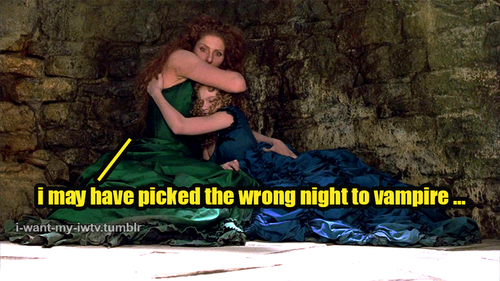
#don’t you love the way Claudia snuggles in there #tucks herself in #like she’s actually Louis’ doll? #she is 80% made of that dress and those curls #how he places that little kiss on top of her head right before he shuts the lid #Right before theyll be in total darkness #just to reassure her #He is such a good mom
^my tags on that gif, bc I do love mommy!Louis ❤
(Lestat was actually Claudia’s biological maker, it’s his blood that turns her; she is technically Lestat’s fledgling, which actually makes Louis her “brother”!)
Louis was based on Anne Rice herself; Lestat was based on her husband, Stan; and Claudia on her own daughter, Michele, so you could say Louis was the “mom” bc of who he was based on. IWTV was partly about AR investigating the tragic loss of her own daughter through these characters. Louis’ separation from Claudia was not his choice; neither was AR’s from her own daughter ;A;
When you’re a Ricean vampire, gender doesn’t really matter, it definitely doesn’t matter physically in making new vampires, which is how they procreate. Post-IWTV!Lestat is much more into fashion, jewelry, and other typically “feminine-specific” stuff/activities that Louis has little or no tolerance for. Lestat is also one of the most prolific makers we know of in the series. The act of making fledglings could be compared to pregnancy, and he loves doing it, so that could make him more “feminine” than Louis, who has only made two fledglings (but both were made under duress, not 100% his choice).
Lestat and Louis both parented her in their own ways. Lestat took Claudia out and taught her to hunt, and all this other stuff he shared with her that Louis couldn’t. Hunting can be considered more “masculine.” You could label more domestic things like literature “feminine,” I guess, and that’s what Louis offered her. IWTV!Lestat was just more interested in action and less interested in introspection. Your author says that one of Louis’ feminine traits is “speaking about his feelings,” Lestat does TONS of that in later books. So if you only read IWTV, you miss out on that.
The other thing is that IWTV is Louis’ account, so yes, it paints Lestat a certain way, when Lestat was frustrated that he couldn’t reveal so many secrets that it drove a wedge between them. I feel like most of Lestat’s “masculine” behavior is just about that frustration, at having to keep his history a secret because of Marius’s threats.
As Lestat puts it in TVL, Louis’ account is somewhat accurate:
“…which for all its contradictions and terrible
misunderstandings manages to capture the atmosphere in which Claudia and Louis and I came together and stayed together for sixty-five
years…
But he adds this about Louis as a narrator:
“[Louis’] blindness to
the motives or the suffering of others was as much a part of his charm
as his soft unkempt black hair or the eternally troubled expression in
his green eyes.
So I wouldn’t say you can totally define Lestat and Louis’ gender roles in their relationship based solely on reading IWTV. But many of us, myself included, enjoy daydreaming about mommy!Louis ❤
Poor Madeleine! Did not deserve to die like that ;A; Unfortunately, I’d say she was condemned to die by proxy, being so attached to Claudia.
I don’t think Madeleine’s death was totally under Armand’s control. He was not really the leader of the TdV (see more quotes on that below the cut); in TVA Armand says: “For the record, [Claudia] was slain by my Coven of mad demon actors and actresses,… it became all too clear to too many that she had tried to murder her principal Maker, The Vampire Lestat. It was a crime punishable by death, the murdering of one’s creator or the attempt at it”
^“slain by my Coven”but not that he ordered them to do it. Just that he didn’t stop it from happening.
This is an #unreliable narrator situation again, as there are at least three different accounts of the trial that was held under TdV (see more below the cut)(four if you include the above statement from TVA). In all instances, the important part of the “trial” was that Claudia was the one who had to be convicted and sentenced to death. Louis and Madeleine were secondary concerns.
There was no explanation for why Madeleine was also condemned to death, I would suggest that Santiago (and/or Armand) wanted to kill Madeleine bc she was mad (the extent of which we don’t really know) and/or they didn’t really know what else to do with her. Santiago probably wanted to do it bc it’s thrilling to kill another vampire, as Armand pointed out in book!IWTV: “`You see,’ he said, `killing other vampires is very exciting; that is why it is forbidden under penalty of death.’
Movie!IWTV – Armand is not part of the “trial,” we see him close the door against the whole scene, and he waits until later to free Louis from his (upside-down!!! SO MEAN) imprisonment in the walled-in coffin o’ doom. So one would guess that Armand at least negotiated w/ Santiago to have Louis’ life to be spared in this way.
Book!IWTV – Armand was not present at the “trial.” Santiago seemed to be the one running that show.
Again, one would guess that Armand at least negotiated w/ Santiago beforehand.
TVL – Armand was present at the “trial” and seemed to be the one running that show, and Madeleine is not even mentioned.
In movie!IWTV, we see Armand closing the door on the screams of the condemned, and the explanation as to why he didn’t come out to help when Louis called for him? He had told Louis that he wasn’t really the leader of this coven, “But if there were a leader, I would be that one.”
In book!IWTV, similarly:
“ `Are you the leader of this group?’ [Louis] asked him. ” `Not in the way you mean leader,’ [Armand] answered. But if there were a leader here, I would be that one.’
Armand knows that to exert power, you have to defend it:
[Louis says:] “ `Stop them if you will, advise them that we don’t mean any harm.
Why can’t you do this? You say yourself we’re not your enemies, no
matter what we’ve done… ’
” I could hear him sigh, faintly. [Armand says:] `I have stopped them for the time
being,’ he said. `But I don’t want such power over them as would be
necessary to stop them entirely. Because if I exercise such power, then
I must protect it. I will make enemies. And I would have forever to
deal with my enemies when all I want here as a certain space, a certain
peace. Or not to be here at all. I accept the scepter of sorts they’ve
given me, but not to rule over them, only to keep them at a distance.‘
Ah, they’re all mixed into my stuff ;A; But yeah, another purpose, originally, of my blog was that there weren’t enough decent IWTV screencaps out there for fanartists to draw from! I ended up not having that as much, just blank, but I make my memes from screencaps I pull, and I gather production stills.
(2/2) moment to moment in a way that made me picture a silver clock ticking in a void: the painted face, the delicately carved hands looked upon by no one, looking out at no one, illuminated by a light which was not a light, like the light by which God made the world before He had made light. Ticking, ticking, ticking, the precision of the clock, in a room as vast as the universe.”
Are you homework anon? I got this ask right around the same time as the homework ask… part of your assignment (if you are homework anon!) is probably to practice critical thinking on your own and figure out what you think this passage means.
It doesn’t have to mean the same exact thing to everyone, and that’s what makes discussion about canon interesting, all our varied opinions. It’s great when we agree, but we don’t always on all topics 😉
But of course I wrote out a long answer despite the fact that I didn’t want to! Oh well.
“The great adventure of our lives.”
I’d suggest that the opening line is the topic sentence on which he’s going to build support or undermine the statement, or both. Louis has already had a number of great adventures (or so it appears to the reader!), so what makes him call THIS one the great adventure? Only now, embarking on the great Looking for Other Vampires: European Tour w/ Claudia, does he feel the freedom Lestat wanted him to feel when he was first turned. Louis didn’t embrace his vampire nature then, he fought it, he fought Lestat, he was not having a good time at all, and although he did reluctantly admit to enjoying some of the aspects of vampiring, he was holding back. Claudia shows up and Louis has a new purpose, he loves her, and she helps to inspire in him a hunger to be alive. ❤
“What does it mean to die when you can live until the end of the world?” – He’s not saying that he can’t still die, bc he’s seen a vampire be killed (at least, he thinks so). But now he’s really considering immortality as a possibility, maybe he wants to be with Claudia forever!
“And what is `the end of the world’ except a phrase, because who knows even what is the world itself?” – Now he’s asking questions of his topic sentence, he’s unsure of the excitement he feels about this new chapter in his life. Is it legit? Can he actually give himself over to enjoying it and being excited about it? Keep in mind that he’s never mentioned traveling before (except for the fact that he came to America from France), he’s lived an isolated life in NOLA and probably expected to die there. He might really have mixed anxiety and excitement about everything and everywhere outside of NOLA.
“I had now lived in two centuries,” – it’s around 1860 when he leaves NOLA with Claudia, he was alive at the end of the 18th century, and experienced half of the 19th century. Obviously a lot of things changed, as he says he’s “seen the illusions of one utterly shattered by the other,”
Then he goes on to talk about himself, and how he’s had internal changes of his own, probably re: embracing his nature, finding a will to live, and I don’t want to translate each piece for you bc it seems fairly self-explanatory: “been eternally young and eternally ancient, possessing no illusions,”
This is Louis being poetic:
“living moment to moment in a way that made me picture a silver clock ticking in a void: the painted face, the delicately carved hands looked upon by no one, looking out at no one, illuminated by a light which was not a light, like the light by which God made the world before He had made light. Ticking, ticking, ticking, the precision of the clock, in a room as vast as the universe.”
^but it seems to relate to him feeling outside of nature, outside of religion, and yet still touched by God’s light, being a vampire, like something that can’t affect anything but can watch and take notice of all the things evolving around it. Something Marius later calls a continuous awareness:
“And for no apparent reason, I was possessed of a strange idea about life, a strange concern that amounted almost to a pleasant obsession… That it came to me in these last free hours as a Roman citizen was no more than coincidence.
The idea was simply that there was somebody who knew everything, somebody who had seen everything. I did not mean by this that a Supreme Being existed, but rather that there was on earth a continual intelligence, a continual awareness.
…My idea of who or what it was, was vague. But I was comforted by the notion that nothing spiritual – and knowing was spiritual – was lost to us. That there was this continuous knowing…” (TVL)
^It seems like something Anne Rice has always been passionate about, how the vampires exist in this world, and how they are dependent upon it, fascinated by it, and yet kept apart from it, how they absorb and contain all this historical knowledge of this world that they’re obsessed with by their very nature… and she has carried through to some extent in even the most recent VC.
I hope you’re not the anon with the project for class, asking me to do your homework for you! But I do want to answer this, so you get my opinion, which may not be the actual answer.
I think there’s more than one climax, depending on what your reading of IWTV focuses on. I’m not as religious as some ppl, so I don’t give that theme as much weight as other readers might. And that is a huge aspect of Louis’ struggle with vampiring and giving into his vampire nature, being in direct conflict with the most important of commandments, Thou Shalt Not Kill (in conjunction with Thou Shalt Not Steal, bc this kind of killing is doing both).
Here’s one definition I found for climax, the noun: “the most intense, exciting, or important point of something; a culmination or apex.” For me, that moment could be a catalyst, too, changing a character to some extent, could be a drastic re-calibration of their inner dialogue with themselves, reconfiguration of their moral values, etc.
I’m not quite sure which scene in IWTV (book or movie) that would be for you, but for me, one of the most intense moments was when Louis found Madeleine and Claudia’s ashes:
First is denial.
It’s in this moment that Louis has lost the most precious person, the one who’s told him what to do, someone he could worship and follow, someone who metered out his doses of happiness with her approval.
He’s also lost his own
(and very first!)
fledgling, and even though in both the book and the movie there doesn’t appear to be much attachment to between them, @vampchronfic/@gairid‘s headcanons about that have convinced me that there IS a bond, deep and invisible, created in the act of turning. Maker and fledgling are drawn together. Something like the attachment between a mother and her child, perhaps more powerful bc (hopefully) the giving of the Dark Gift was a consensual act between adults. It’s even more cruel in the movie bc she dies the same night she was turned, talk about bad life choices.
ANYWAY.
He holds off on the anger for now, goes straight to bargaining. He reaches out to touch them, maybe he thinks there’s some way to save them still? Or maybe the ashes are just on the surface, maybe Claudia and Madeleine are still intact under there? It feels like a nightmare and he wants to prove it’s not real.
But it is real, and they crumble, and everything that they were is gone.
This, his lightest touch, it’s heartbreaking, their final destruction at his own hand ;A;
Depression and acceptance. It’s real, they’re beyond saving, he’s failed them both in so many ways. The only thing left is (anger stage) revenge against this injustice, against the Theatre troupe, and once that’s accomplished, against himself.
So I’d say this was a climax bc it acted as a catalyst for Louis, he finally burst into action because of this, and any remaining illusions he had about vampiring and immortality were shattered. He’s 1,000% done and he’s gonna go out in a blaze of fiery glory punishment.



 I-want-my-IWTV