There is PLENTY wrong with TOBT. Plenty. So much so that there are many fandom ppl who don’t consider it canon.
I’ve seen attitudes about this book change over time. In ‘94, when that book was 2 yrs old, I remember ppl telling me they felt the series had ended with QOTD, bc TOBT was written off as simply being “the body-swap episode” (many films and TV series have tried their hand at that concept, and it’s usually a wacky ride). When Memnoch the Devil came out in ‘95, ppl didn’t like that one either, too offensive for its ideas about religion, and/or too preposterous of a plot; TOBT + MTD seemed to confirm that VC had jumped the shark, and a lot of ppl decided that the series ended at QOTD.
TOBT has wackiness in it, I mean, the difficulty of peeing (with a dick) is described in such vivid detail, there’s just too much comedy in it for me to discard it all outright.
(Oh! And perfect cinnamon roll Mojo the doge is in this book <3)
(Trying not to spoil it too much here but it’s pretty obvious what happens, but POSSIBLE SPOILERS AHEAD)
If TOBT was really just “the body-swap episode,” it could be written off as “wacky,” we could talk about the silliness of the details of the body swap, all that. We could even talk about how frustrating it was that Lestat went into a deal with a self-proclaimed THIEF and assumed that this dude would, you know, HONOR THE TERMS OF THEIR DEAL to the letter, but such were the poor state of the trust issues of our lovable but hamburger-brained moron de Lioncourt at that point in canon. He was also extra vulnerable to being taken advantage of bc he was feeling unworthy of life at all and pulled an Icarus ;A;
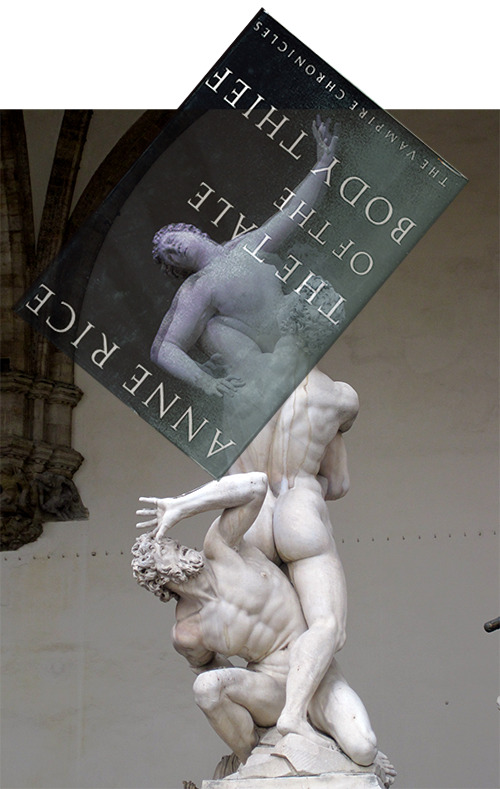
^So this was the cover for the edition that I read, it’s the first edition that was published. And the cover actually is relevant to this story, bc the statue you see here getting enveloped in a gray mist (it was a dull silver in real life) is The Rape of the Sabine Women by Giambologna in Loggia dei Lanzi. I’m not going to go into a deep comparison of this to TOBT, essays can be and probably have been written on it.
I think a lot of those ppl in 1994 who wrote TOBT off as “wacky” had not actually read it bc this book takes the body horror to a place that most body-swap episodes/films wouldn’t dare to go. There are major consent issues, sexual and otherwise. There’s rape. I think AR was exploring sin and consent, she unflinchingly went there. Some ppl in the fandom refuse to accept it as canon bc they did read it and are repulsed by how far it went with these explorations.
Personally, I always advocate reading the book, and stopping if you need to, or engaging with it however works best for you. I think there are good things in that book and I think Lestat changes through the course of the story. Improvement is not always an easy trajectory. Just like in real life,
improving oneself can be a struggle, and there are often setbacks, sometimes devastating. One could say he ends up worse than he begins this story, one could say he ends up better than he begins. Just because you read/write problematic things, does not mean you condone them.
Oprah walked out of a screening of IWTV when it was first in theatres. [X] Tom Cruise told her afterwards that he wasn’t surprised. “The movie is not for everyone.” Similarly with fiction. This book is not for everyone.
[^X The pic I chose of the statue is not from the same angle as the pic used on the cover, but you get the idea.]
That’s a good one for Armand, too! Yeah, he seems preternaturally chill considering he’s riddled with arrows…how does he not feel them??! (I mean yes he’s an illustration but still)
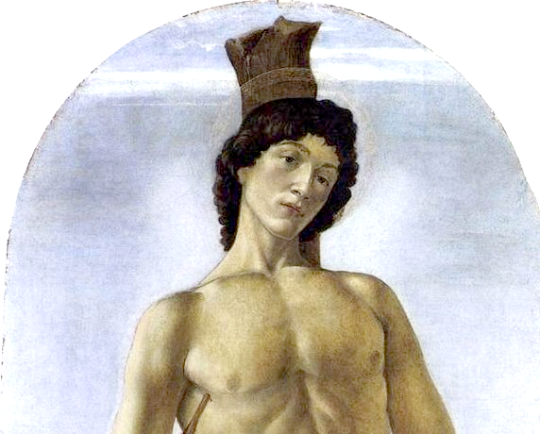
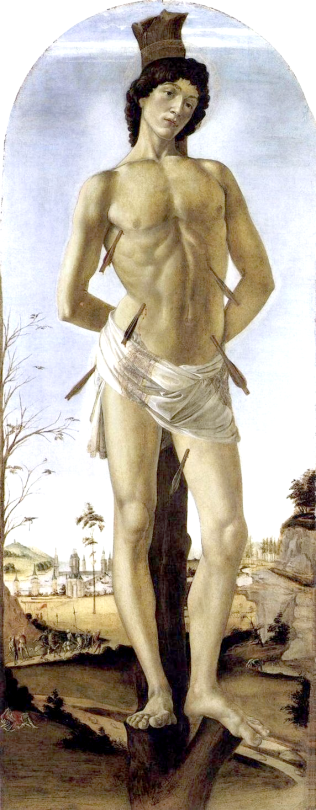
Sandro Botticelli: Saint Sebastian, 1474.
With his martyrdom in progress, the young saint fixes the viewer with a firm, serene gaze. The facial expression, conveying belief in victory over Death, underscores the trust placed at the time in Saint Sebastian that he would protect people from the Bubonic plague.
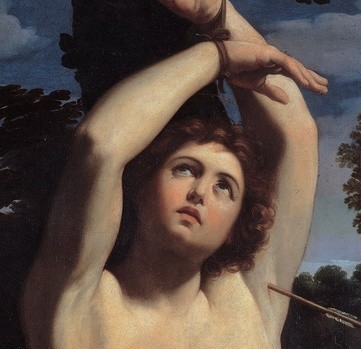
There are many depictions of this subject, apparently! I really like Reni’s here.
Guido Reni’s Saint Sebastian, “probably one of the most famous, probably because the martyr’s placid expression conveys the idea that he’s already halfway in Heaven. [X] This looks more angelic to me, more like my headcanon of Armand. BTW, who shoots a guy in the armpit?? Gross. RUDE. Gross and rude.
^And I knew that looked familiar, the Reni version was used for the cover of Violin! Which I didn’t read… but I should, right?
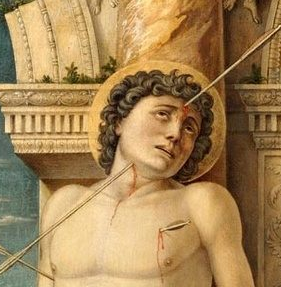
^[X] Similarly, here’s one by Andrea Mantegna. Who shoots a guy in the head like this??? Like, at first I thought it was one arrow going thru his face, but there are two arrows there, a forehead arrow and an under-the-chin arrow, it’s just awkward, gross, and rude.
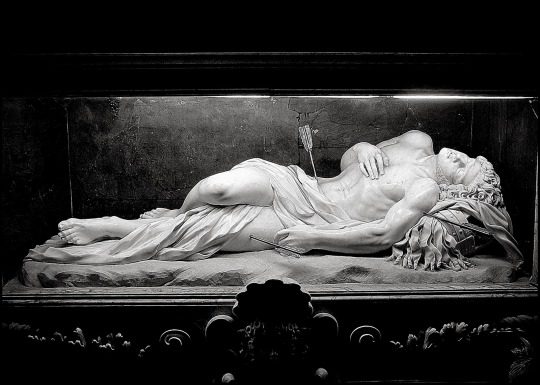
^[X] Sculpture of Saint Sebastian by Antonio Giorgetti (1672). One of my faaaave fanfic writers used this re: their Lestat, and I hope they write more, as they’ve said they are trying to! But anyway, this reminds me of when Lestat was in a coma ;A;
There’s a painting that looks like this and they used it for the cover of Blood & Gold and I know I’m going to have to post about that.
Full shot of Botticelli’s St. Seb under the cut, cut for length.
^He doesn’t look like he’s in any pain at all, really. More like he’s really proud of himself. Very Armand. #CONCEAL DONT FEEL.
god i can never stop thinking about certain sculptures used in modern art and how they can be used to elicit the beautiful and terrible feeling of true and genuine horror in ways that a lot of horror movies can never do
like when you ask people “what is horror?” they’ll tend to give examples of monsters, of killers, of dark places, of sharp teeth and too many legs and lots and lots of blood. which is true, that can be used as horror! but i’d like to call that “the horror of being eaten/hurt/killed” or more succinctly “the horror of vulnerability”. it’s a horror that something, whether it’s a killer or a monster or some phenomenon, has the ability to cause us harm. we see large amounts of teeth and we think “that thing is going to tear us to pieces with those teeth” or we see spilled blood and we think “someone has been hurt, there’s a chance we can be hurt too by whatever spilled this blood”.
but what certain modern sculptures can do is elicit a very physical visceral reaction of a completely different kind of horror.
it’s “the horror that something is a thing that SHOULD not exist, and you are absolutely powerless to understand what it is, but it is existing in your space, right now, it is real and you cannot make it unreal no matter what you do”
or perhaps, in a shorter fashion, it’s “the horror of wrongness”
like one of the sculptures that made me feel this way is this sculpture here, named “Monekana” located in the American Art Museum in Washington D.C:
“okay,” you say, with a shrug. “it’s a horse made of wood? what’s so scary about that?”. but this is the lie of the photograph! a photograph of a sculpture rarely grasps the experience of standing next to a sculpture. you have to picture yourself walking into this room, practically devoid of people, and coming face to face with this sculpture that is very large and very real.
and your brain screams that “THIS IS WRONG. MAKE IT GO AWAY. THIS IS WRONG”, like at any moment you expect it to move, to twist its head, to follow you with eyes that aren’t simply there. it looks like a horse but it is no horse. you could almost argue that maybe it isn’t even an art piece at all, but it wandered in from god knows what kind of world and it’s blending in with everything else. maybe it’s fooling you. maybe it isn’t.
anyways, i’m not trying to say that this sculpture in particular is SUPPOSED to be scary, it may make other people feel nothing at all (or even positive feelings!), but what i’m trying to say is that feeling i had that day, when i saw this thing, when i felt this fearful instinct to stay away and not stare, it’s THAT feeling that i feel so many writers and makers of horror don’t completely understand. you don’t need teeth. you don’t need blood. you don’t need to make Spooky Scary Skeletons or chainsaw-wielding villains. all you need is to create something wrong in its existence, something to make parts of us fear the fact that we can’t entirely rationalize what we’re seeing.
The experience of sculpture absolutely gets lost in images. I’ve walked into museums and been like WOW THE FUCK even when I knew it was coming.
I love this subject, though. I love “implication horror.” You see something, and the realization of what it means, which often comes a few moments later, is where the real horror lies—not in how splattery or gratuitously shocking it is. The wrongness of a thing in fiction, when done well, is the best. I was watching Melancholia the other day, and what a terrifying example of wrongness horror.
Anyway this is such a great post thanks for putting the whole idea into words so well. ❤
Hand Blown Glass Wine Decanters Inspired By Arterial Blood Flow By Etienne Meneau
Artist Etienne Meneau crafts the traditional wine decanters with an artistic twist – glass veins become red wine holders in his “Stranger Carafes” series.




 I-want-my-IWTV
