//As somebody who got their last mark/grade on all of their egyptology exams at the University today and finally passed, I want to set my inner history nerd free:
(sources are to be found at the bottom or within the text)
Enkil is supposed to be a predynastic King.
So what is the Predynastic Era to begin with? According to most historians that would be the Neolithic period (a.k.a. New Stone Age!), beginning ca. 6000 BC, with the first human settlements known in the area and ending around 3100 BC, with the first Pharaoh (= Narmer/Menes).
That’s right. Enkil’s reign as a predynastic king could very roughly(!) be placed somewhere in between 6000 BC to 3100 BC. For reference and amusement: the creation of writing is roughly to be sat about 5000 years ago (which marks the beginning of history).
Now, we can’t have the Father of all Vampires be Stone Age man, can we? Let’s try to narrow that time frame down a bit:
I think, since Anne Rice describes some sort of a holding of court, we are pretty safe in ruling the time of the earliest settlements out (little mud brick houses consisting of only one window-less room for a whole family and the earliest form of homo sapiens as subject just don’t make for an epic court to rule over.)
Egyptologists speak of a so called Naqada culture, spanning from ca. 4400 BC to 3000 BC, which can be divided into the following three parts:
Naqada I (4400-3500 BC) -> almost no refined artwork/craftsmanship
Naqada II (3500-3200 BC) -> first metalworking (meteoritical iron)
Naqada III (3200-3000 BC)
We can skip the first two Naqada periods, since there wasn’t really any (known) form of sovereignty comparable to the rule of a king.
Which leads us to Naqada III: Naqada III is also referred to as Dynasty 0 or the Protodynastic Period.
Here is the issue with chronology within the subject of Egyptology: When the early egyptologists tried to name dynasties there were multiple debates and, like every time when too many big egos are involved, things went wrong. To make things short: There is now a time called “Zero Dynasty” (which comes before the 1st dyn.), which might be characterized as Predynastic by some and Early Dynastic by others.
There were kings in Naqada III, but they weren’t part of a dynasty yet (hence Protodynastic or Predynastic). Most of them were most likely not related (a dynasty is the succession of kings of the same blood line), but fighting for dominion with each other. The above mentioned King Narmer (aka Menes) is thought to be the last King of that period and the first Pharaoh of the 1st dynasty(He had been the first known King to unify Egypt).
In conclusion, Enkil’s reign should precede Narmer, but still be set in Naqada III, around 3200-3100 BC.
(We managed to narrow his reign down to 100 years, yay!)
There are, actually, some known Kings from that time that could give us an example for Enkil’s reign, or – which I find very interesting – a possible alias. Stay with me for a bit longer.
9 of them ruled in Lower Egypt, but only one can be placed in Naqada III for sure (forgive me for leaving out the rest): That King is known as “Double Falcon”, after the depiction of his crest (they didn’t use cartouches by then but crests known as serekh and the historians named them after the depicted animals). Some say he might also have ruled in Upper Egypt. 3 kings are known to have ruled Upper Egypt during Naqada III: “Elephant”, “Bull” and “Scorpion I.”
Bull was probably the predecessor of Scorpion I., whose successor is believed to have been Double Falcon and later a king names Iry-Hor (late 32th dynasty.Iry-Hor is the earliest ruler of Egypt known by name and possibly the earliest historical person known by name). No one knows for sure where to place Elephant. All of them are believed to have lived during the early 32th century BC (which allows us to place them near the year 3200 BC to 3150 BC).
Iry-Hor was succeeded by “Ka”/”Sekhen”, who was probably succeeded by “Scorpion II.” or, more probable, by Narmer himself.
Now we have a sorry excuse of a chronology of rulers close to Enkil’s mortal years, ending with Narmer:
Bull
Scorpion I.
Double Falcon
Iry-Hor
Ka (Sekhen)
Scorpion II. or Narmer (Menes)
As you can see, there is a line of succession, albeit not one you should bet on, since egyptologists are still not 100% sure about the line of succession. BUT: Where to place Elephant?
Enkil was the Pharaoh, whose throne-name was Pen-abu (“Great one from the (throne) seat”) how fitting. Historians how call him “Elephant” and he was the predecessor of “Bull”, one of the earliest rulers of Naqada III period, in the early 32. dynasty.
Let’s be real here, AR probably forgot how she had described it or hadn’t decided on how it should be, bc IIRC it’s only those two instances in all of canon that it’s described as straight, and those were in books 1 and 3, while she might still have been developing him as a character.
IIRC, Armand’s hair is described as curly when he was mortal and when he was a fledgling, so I think that’s the natural state of it. I don’t recall him ever mentioning straightening it, but when it’s mentioned in IWTV, it’s the 1970′s, and in QOTD, it’s the 1980′s, so he had access to straightening products if he felt like straightening his hair.
^X@amadeo-child-of-the-renaissance found this, another Botticelli angel Armand 😉 AR bases Armand off these Botticelli angels and they have varying straight and curly hair.
I don’t know the story of Leonardo Davinci /Salai! It’s possible AR was inspired by it, I haven’t seen her mention Salai… Did they do this kind of cute stuff?
Even the physical traits they share are not easily missed. Leonardo da Vince was, actually, blonde. Salai had auburn curls (his actual name was Giangiacomo Caprotti. “Salai” was the name Leonardo gave him. Sounds familiar?)
//This was drawn in March 2014. I used a reference but the link was deleted. If anybody happens to stumble across it please send it to me so I can set a link. I’d be thankful!
14.06.2012 and it had been reposted on tumblr before I even had an account here. After I found it I never re-uploaded it on my blog since I thought I would never get the amount of reblogs/likes the other had, but @i-want-my-iwtv just encouraged me.So, here you go: one of my first VC fanworks ever.
Give this wonderful fanartist some love, their fanart was reposted ages ago, and used in aesthetic posts w/o credit, but this is the original artist for this very classic fanart of Nicolas de Lenfent ❤
Poor Madeleine! Did not deserve to die like that ;A; Unfortunately, I’d say she was condembed to die by proxy, being so attached to Claudia.
I don’t think Madeleine’s death was totally under Armand’s control. He was not really the leader of the TdV (see more quotes on that below the cut); in TVA Armand says: “For the record, [Claudia] was slain by my Coven of mad demon actors and actresses,… it became all too clear to too many that she had tried to murder her principal Maker, The Vampire Lestat. It was a crime punishable by death, the murdering of one’s creator or the attempt at it”
^“slain by my Coven”but not that he ordered them to do it. Just that he didn’t stop it from happening.
This is an #unreliable narrator situation again, as there are at least three different accounts of the trial that was held under TdV (see more below the cut)(four if you include the above statement from TVA). In all instances, the important part of the “trial” was that Claudia was the one who had to be convicted and sentenced to death. Louis and Madeleine were secondary concerns.
There was no explanation for why Madeleine was also condemned to death, I would suggest that Santiago (and/or Armand) wanted to kill Madeleine bc she was mad (the extent of which we don’t really know) and/or they didn’t really know what else to do with her. Santiago probably wanted to do it bc it’s thrilling to kill another vampire, as Armand pointed out in book!IWTV: “`You see,’ he said, `killing other vampires is very exciting; that is why it is forbidden under penalty of death.’
Thanks for the info! Wow, we are going to be spoiled w/ all these TV adaptations… all the glorious bingeing…
The whole gender thing for Eli is ambiguous in the films, and, from what ppl who have read the books have told me, also ambiguous in the book.
From what I’ve heard about the book, the character is referred to with female pronouns until the ritual castration is revealed, and then the character is referred to with male pronouns. It is up to every reader’s interpretation to determine gender of the character at any point. If the author wanted us to have a definitive answer, I feel like that answer would have been made less open to interpretation.
amadeo-child-of-the-renaissance said: //Adding it here: Eli himself doesn’t mind being addressed with female pronouns. Please keep that in mind. Best regards- a genderfluid person.
skeletalroses said: I ~have~ read the book (and seen the Swedish film), and Eli did not seem to me to identify as a cis boy. I could certainly see agender or something as an alternative to the transgirl interpretation, but I’d be pretty skeptical of calling Eli a cis boy.
Re: Eli saying “I’m not a girl,” in the films, annabellioncourt said: yeah the book (original and translation to english) and the american film call her “her/she” and its 90% clear she means “not human” in this film.
Hopefully, the TV series will clarify this debate, if it is important to the creators/director to do so. Even without an answer to this, the story is still very compelling and I’m excited to see more of these characters!
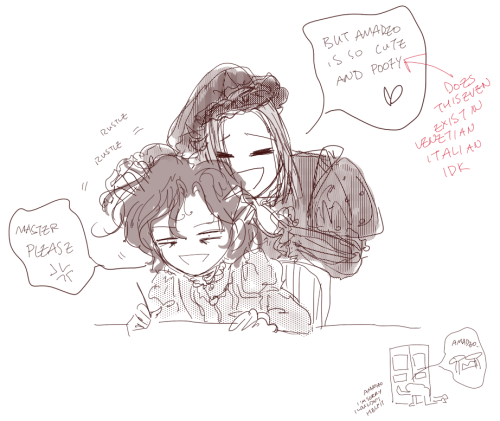
//have some badly sketched coven!Armand. The bus-ride was long ans shaky, but I had to get this out of my system. Halloween is coming and I hope I’ll get some decent fanwork done.






 I-want-my-IWTV