aperfectdevil:

Casual reminder that Anne Rice once tried to put out a frivilous lawsuit against a new orleans restaurant while acting incharacter as Lestat. 

“Anne replied with another full page ad written by Lestat! In it ‘Lestat’ said "Mr. Copeland, nothing short of your indescribable restaurant could shock me out of my torpor and my coma. I am now myself again. It is nothing short of a stroke of genius on your part to create a restaurant that will be immortalized in history, legend and literature.” “

^SO WE HAVE THIS COPELAND GUY TO THANK FOR THE SERIES CONTINUING AND BECOMING THE VAMPIRE CRACKICLES GDI.

My favorite part:

” “a whole brigade of revelers appeared wearing plates of rice and beans around their waists, promoting a dish they called Red Beans Anne Rice”. Obviously fun times were had by all as everyone pointed and laughed.“

You know what would be a great Christmas gift? If you could put together all of the questions Lestat answered on Facebook a few weeks ago, in a post here on your blog!

GRANTED (ノ◕ヮ◕)ノ*:・゚✧ Fan Questions for Lestat! Let me know if I missed any 😉 i tried so hard and got so far but in the end i couldnt keep up with the onslaught of those fan questions argh

This ficlet is worth mentioning, too, since it takes one of those FQL’s as inspiration 😉

I also has a tag for other Facebook posts, some are relevant for various reasons, like this one:

image

[X]

FQL:

Lestat here. This question is from Chuck Johnson: “Undoubtedly you know of Armand’s attempted suicide following your acquisition of Veronica’s Veil. Do you have any theories on how he saved Sybelle and Benji? Was it truly Divine Intervention, or a form of projection?” — Chuck, no, I don’t have any theory on how Armand managed to save Sybelle and Benji — based on his description in his memoir. I suspect, however, that it was as you said, “a form of projection.” Armand has always had enormous psychic powers as a vampire, including the power to spellbind others with immense and very convincing illusions, the ability to hypnotize and control others, and to slip into altered states himself in which his dreams seem to provide some real gateway to another plane. I don’t doubt that he could do what we call astral projecting and take it perhaps one step further than many others, materializing or affecting matter in the location to which he’s projected himself. But I’m a novice in all this. I make no judgments on Armand’s abilities but I don’t fully understand them. I take him at his word that he did save Benji and Sybelle, and I’m not entirely sure that even he knows quite how he did it. Due to those mysterious psychic abilities, Armand makes a much better friend than an enemy. His spellbinding gifts are particularly dangerous. Being a person of action and a sensualist, I’m not really on Armand’s level when it comes to these mental skills. Armand’s thoughts are almost impossible for me to penetrate, and his boyish countenance often reveals nothing of his true calculations and feelings. I love him and I respect him — and I know that he loves me — but I never for a moment imagine I’m entirely safe with him.

I love him and I respect him — and I know that he loves me — but I never for a moment imagine I’m entirely safe with him.

FQL:

Lestat here. I want to answer this questions from Ksenia Stepanova. “Hello Lestat… What do you find the single best thing about living in the 21st Century compared to the 18th?” Well, Ksenia, let me offer two answers. The selfish sensuous being in me says: electric light is the single best thing. The 21st century, like the 20th, in the West, is awash with artificial light which has endowed the nighttime with the energy and optimism of the daytime, and wholly changed the public life of the human race after dark. I love the splendidly lighted libraries, theaters, opera houses, movie houses, shopping malls, public thoroughfares, common streets, homes and parks. That’s my first selfish answer. But let me also give a longer philosophical answer: the moral being in me has to say that the single best thing in West today is the lack of the poverty and misery that was taken for granted in the 18th century. In the West, people today are well fed, healthy, wearing adequate and generally well constructed clothing and shoes, and free from starvation, death from exposure, and the diseases that ran rampant in the 18th century. Understand, the 18th century still saw cruel public executions, starvation right in the middle of capital cities like Paris or London, and massive death through contagious diseases and through poor sanitation. People today have almost no idea what all that was like. And at the time, of course, we thought the world would always be that way…mud and raw sewage in public streets, many children dying before the age of five, women gone at an early age from the ravages of childbirth, and people dying of common infections. We had no idea that the world could be the way it is now in Western nations. Working democracy was a vague dream when I came of age; the world was sharply divided between the rich and the poor; and criminals were still tortured and cruelly put to death before cheering mobs at places of public execution. Again, people today have no real idea how very different life was before. To say these are astonishing times is an understatement. Thanks for your question, Ksenia. —– And now I’m ready for more questions if any of you all want to enter them into this thread.

Gallery

“make movies from my heartbreaking works

of staggering genius." 

– Lestat de Lioncourt, at some point recently, probably.

People of the Page have difficulty with canon.

FQL: Social Justice Edition

Lestat here. I want to answer this question from Mike Chandler: “Lestat, my question is simple. What would you do to fix the world?” —- Mike, I would not do anything because I don’t believe the world is “broken” or in need of fixing. I am aware of the age old belief of many that this is a “fallen” or “broken” world, but I’ve never accepted those ideas. At the present time, more than ever, I’m convinced the world is evolving. There never was any Golden Age or Garden of Eden. We are all evolving, physically and morally as the universe unfolds according to discernible scientific laws. And I’m fascinated by the process. As I explained earlier in another answer, I am by nature optimistic and confident, convinced that we can do much to make this world better for us and others. We vampires face essentially the same challenge as humans: how do we live with our own fallibility, our own greed, our own ruthlessness, yet co-exist with other creatures? That’s why just about every vampire story is essentially a human story. We acknowledge the same dilemma.

FQL:

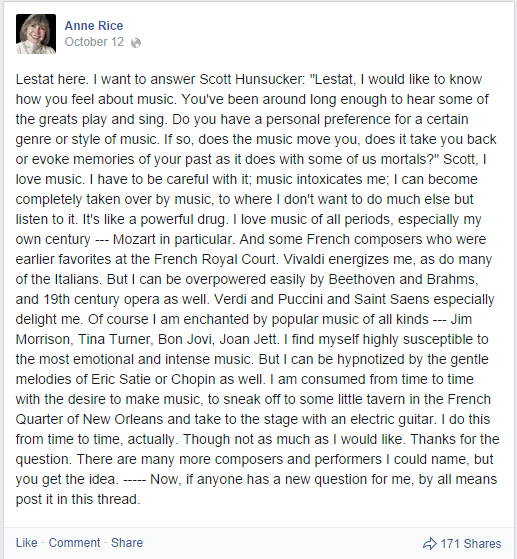
Lestat here. I want to answer Scott Hunsucker: “Lestat, I would like to know how you feel about music. You’ve been around long enough to hear some of the greats play and sing. Do you have a personal preference for a certain genre or style of music. If so, does the music move you, does it take you back or evoke memories of your past as it does with some of us mortals?” Scott, I love music. I have to be careful with it; music intoxicates me; I can become completely taken over by music, to where I don’t want to do much else but listen to it. It’s like a powerful drug. I love music of all periods, especially my own century — Mozart in particular. And some French composers who were earlier favorites at the French Royal Court. Vivaldi energizes me, as do many of the Italians. But I can be overpowered easily by Beethoven and Brahms, and 19th century opera as well. Verdi and Puccini and Saint Saens especially delight me. Of course I am enchanted by popular music of all kinds — Jim Morrison, Tina Turner, Bon Jovi, Joan Jett. I find myself highly susceptible to the most emotional and intense music. But I can be hypnotized by the gentle melodies of Eric Satie or Chopin as well. I am consumed from time to time with the desire to make music, to sneak off to some little tavern in the French Quarter of New Orleans and take to the stage with an electric guitar. I do this from time to time, actually. Though not as much as I would like. Thanks for the question. There are many more composers and performers I could name, but you get the idea. —– Now, if anyone has a new question for me, by all means post it in this thread.

FQL:

Lestat here. I want to answer this question from Amanda Rice: Lestat, is it hard for you to watch humankind tear each other apart over social issues such as marriage equality or freedom of religion? After living so long, I am sure you realize that most of the fighting between us mortals is absurd and pointless, but I am curious to know what you make of all of it? Do you think humans will ever learn to do better?—- Amanda, you’re assuming we vampires, due to our long lives, are somehow emotionally and morally superior to humans and wiser than humans. I’m not so sure that we are. We are after all monsters with human brains and human hearts. We engage in a lot of struggle ourselves that is “absurd and pointless.” —- Actually when I witness humans struggling over social issues and religion, I marvel at their courage and stamina and determination to live meaningful, fruitful and compassionate lives. I marvel at their patience as they struggle to persuade others through reason and reasonable argument, rather than violence. And yes, over the centuries, humans, in my opinion, are certainly doing “better.” They are making great progress, particularly in the West, towards maintaining a secular humanist society in which no blood is shed over race, color, or creed. This is historically remarkable. I can understand your frustration, Amanda. But history, as I’ve lived it, supports a steady advance in human rights in the West that is not only inspiring, but beyond the wildest dreams of those born when I was born. Thanks for a marvelous question.