Oh, gosh. That’s a toughie, since there are so many different types of horror films out there, and lots of mini subgenres. For the most part, I think they fall into five main categories:
Slasher (human vs human): A slasher like Freddy Krueger pushes the boundaries of the genre by adding a supernatural element, but in the end, the focus is on the body count, and Freddy began life as a human. The same applies to Jason Voorhees. Peripherally included in the slasher genre are the Italian giallo (a precursor to the modern slasher), and the German krimi. These are murder mysteries of a very specific tone (I covered the giallo previously here). The krimi is essentially a German giallo. The slasher genre is not restricted just to a single killer, but can include multiple killers (such as in Last House on the Left). Slashers also include killer kids, though killer babies tend to fall into either the Physical or Creature Feature designations due to the fact that there has to be an unnatural force at work for a baby to successfully become a threat.
Supernatural (paranormal or religious): Ghosts, religion, magic, witches, the occult, demons, and possession, for the most part. Depending on the tone and handling, vampires are typically found here, though there are vampire films that defy this classification (such as Near Dark). Gothic horror is most often found under this category.
Psychological (horrors of the mind): Extreme psychological stress and psychosis. Mind games, delusions–basically an attack from one’s own psyche, or someone trying to induce psychosis in another. Often includes amnesia.
Physical (horrors of the body): Anything that transforms the human body in an unnatural way. This includes viruses, extreme surgeries (Tusk; American Mary), scientific experimentation not too distanced from reality (Re-Animator), “melt movies” (Slime City; Street Trash), mutations (From Beyond), and extreme physical torture (Grotesque; Flower of Flesh and Blood). Zombies are typically represented by this category, but may also be considered a genre of their own due to other interpretations (see below). This is also the genre that cannibal films call home. While the conflict is human, cannibal films are not slasher films due to the obvious taboo. There are slashers that also consumed their victims, but the designation depends mostly on tone and setting (the most popular Italian cannibal films are set in exotic locales), or the emphasis on the cannibalism (a film like Feed would absolutely be considered physical horror). When it comes to mutations, if they veer too far away from human, they then fall under the category of:
Creature Feature (non-human adversaries). This includes animals (of the “nature gone awry” trope), monsters (werewolves, and other creatures of folklore), aliens, giants, and occasionally kaiju. Human/creature hybrids (The Fly; Creature) also belong here.
Due to their overwhelming popularity, zombie movies may be considered their own category. While the conflict is human at its roots, zombies usually don’t retain enough faculties to be placed on the same level as slashers, and the greatest threat comes from their numbers. Many of them fall into the category of physical horror as well, but others (like White Zombie) are more cultural in nature, thus necessitating a distinction of its own.
Then there are the subgenres that cross over with other genres of film in general:
Science-fiction horror: Ridley Scott’s Alien is an excellent example of this. It’s sci-fi, but scary.
Fantasy horror: These are most often based on, or reminiscent of, well-known fairy tales, or feature fairy tale elements. Troll is an excellent example of this.
Horror comedy: Humor plays a large part, whether in visual slapstick (Evil Dead II; Dead Alive), comical characters, or intentional camp/cheese (Killer Klowns from Outer Space).
Horror anthology: Multiple stories within the same film. Examples include Creepshow, The ABC’s of Death, and Kwaidan.
Horror romance: A somewhat rare category. Includes films such as A Chinese Ghost Story, Warm Bodies, and Let the Right One In.
Erotic horror: Horror with a strong emphasis on sexual content. Jesus “Jess” Franco was well-known for this particular style. Quite a lot of vampire films featuring lesbianism can be found here, including Daughters of Darkness.
Thriller: Thrillers–while a category of their own–can bear much resemblance to horror. Giallo and krimi may often be considered thrillers as well. These tend to encompass murder mysteries, but the level of violence and a tense enough atmosphere can easily make a thriller qualify as horror.
Troma movies, also, may be considered in a category of their own due to
(deliberately) not fitting into only one–or even two–categories at a
time.
All of these categories branch off into numerous subsets. There are a few designations in particular that can apply across nearly any of these genres.
Splatter: Splatter refers specifically to the level of explicit gore, and disregards all other plot aspects. As long as it contains an absurd amount of grue, it can be classified as splatter. Psychological horror can contain splatter in the form of physical horror manifesting only in the mind, such as in a film like Jacob’s Ladder (though even so, it doesn’t meet the high level of gore required to make it splatter).
Exploitation/Grindhouse: What makes a film exploitation depends on the time period (late 60′s to early 80′s), independent production, lower budget, and most importantly–whether or not there is something to exploit (whether it be nudity, violence, gore, or taboos). The films of Herschell Gordon Lewis, Ted V Mikels, and Roger Corman can often be found here. The term “grindhouse” simply refers to the type of privately-owned theaters willing to play exploitation films.
Horror documentary/Mondo: As the name implies, this can be a documentary about horror in general, specific subgenres, specific films/franchises, or “mondo” films. The Faces of Death series is a good example of the mondo film: An exploitation documentary covering taboo subjects (sex and death), traditions from foreign cultures (usually portrayed with an inherently ethnocentric lens), and staged sequences that are being touted as genuine. The name originated from the film Mondo Cane.
Extreme: This refers to those films that go so far beyond the boundaries of literally everything that they have become infamous. This is usually due to outrageous subject matter, full frontal nudity, explicit sexuality, social taboos, and excessive levels of violence and gore. Many films of this nature have seen themselves classified as “video nasties”, the director and crew taken to court for allegations of murder, or have been outright banned in multiple countries. Examples include Nekromantik, A Serbian Film, The Men Behind the Sun, the Japanese Guinea Pig films, and the August Underground films.
There are also categories that have to do specifically with how the movie is filmed.
Found footage: Films that are made to appear as though it is all amateur footage, typically belonging to protagonists that have “disappeared” since filming. The footage is alleged to be the only thing remaining of the missing characters. Beginning with Cannibal Holocaust, the genre saw a tremendous resurgence with the popularity of The Blair Witch Project, and is excellently executed in The Bay.
Shot-on-video: Exactly as the name implies. These are typically independent films shot on a shoestring budget, and shot either onto video tape, or digitally. The majority were produced for the burgeoning home video market of the 80′s. Because they are rarely (if ever) released theatrically, they are not obligated to remain within MPAA ratings, and thus often contain high levels of gore, taboo subject matter, and strictly no-name casts. Very rarely, a high-profile film arises that was shot digitally, and thus transcends the SoV subgenre (28 Days Later is the best example of this). Shot-on-video films tend to be highly unappreciated, but many are forgotten gems just waiting to be discovered. Both the found footage and SoV genres came together (at least in spirit) in the V/H/S franchise.
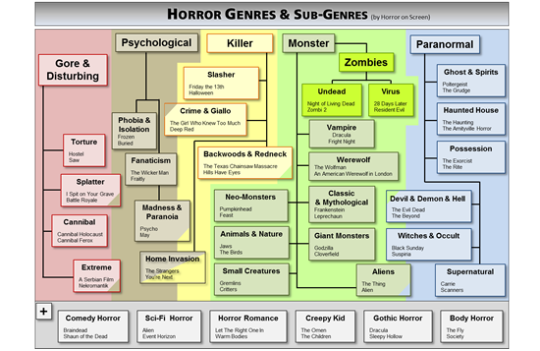
The website Horror on Screen created this handy chart, though their classifications and terminology differ a bit from mine:
The chart uses color to show where there is often crossover between categories. The site also offers numerous examples of the various lesser categories.
When it comes to scares/terror, there are really only four kinds:
Tension/Suspense: This is the most valuable for a horror film, because this is what keeps the audience glued to their seats.
Jump Scares: The cheapest of all scares, these rely on simply catching the viewer off-guard, and startling them. Anything from a cat randomly landing on the hood of a car, to the killer coming back one last time to grab the heroine’s ankle as she attempts to flee.
Disturbing revelations: Usually present in the solving of a mystery, or in an unexpected twist. Examples include the discovery of previously-unknown parental lineage, and unveiling the murderer.
Sheer abject horror: This can be the result of a disturbing revelation. This is reserved mainly for extreme circumstances. This is basically how I felt at the very last line of dialogue in A Serbian Film. It’s that feeling where you’re internally screaming “NO” repeatedly at the screen.
When it comes to effects, the best time period for effects has to be the 80′s, as they were a time when on-set, practical effects were a major selling point of horror. This is where masters like Tom Savini, Rob Bottin, and the KNB Effects crew carved out their niche. Many newer horror films rely on a combination of practical and digital, and can blend them to marvelous effect (Slither does a good job of this…mostly). Splatter films will likely showcase a lot of effects work to accomplish the gore, while non-animal creature features show off all manner of elaborate monsters. Physical horror is the most intimate, as it deals with the human body exclusively, so it can often be the hardest to watch, and horror that merges closely with science fiction will likely include a cavalcade of intergalactic intruders. Other subgenres, such as thrillers or milder supernatural horror (old-fashioned house hauntings, for example) may rely solely on suspense and sound design, and not feature much at all in the way of blood. Other films are quite successful at suggesting a much higher level of blood and violence than they actually show (The Texas Chainsaw Massacre is the epitome of this). When it comes to exploitation and shot-on-video horror, don’t expect miracles, but do marvel at what can still be accomplished on a low budget. Ozone is a fantastic example of getting the best out of having little to work with.
Here is a list of found footage tapes (from movies or posted on youtube) and creepy videos. Not all of these are real, of course.
In the Woods: Last footage of a guy walking in the woods. He begins to hear growling sounds. These sounds seem like they are from a human-animal hybrid in pain. At the end something pops out of the bushes, and he runs away.
No Thorough Road: Video of a group of boys driving around, when odd things begin to occur. Horrifying things that they first treat as a joke but then begin to get genuinely scared about.
Indonesian Ghost Tuyul: Footage of a ghost that can only be seen by one person at a time. Two dudes are playing the guitar when and do not sense the tuyul lurking around them.
Paris Catacombs: Found footage of a guy who was lost in the never ending halls of the Paris catacombs. Some suspect that something else was down there with him.
Ghost of Henry VII: Found on a security tape is the ghost of Henry VII in Hampton Court. You can make out his apparition floating through the doors.
V.H.S: A horror film in a found footage style video. They are terrifying and is something I recommend to watch in the dark at 12 a.m
Slenderman: An enormous stick like figure found climbing the buildings in Russia. Many link it to the urban legend of slender man.
Imaginary Friends: A father decides to play hide and seek with his daughter, but it seems like there’s a third identified player involved.
The Rake: Some humanoid creature is found climbing around the roof of a man. Needless to say he is extremely creeped out.
Japanese Haunted Hospital: Part of a Japanese t.v show, in a “found footage” style of the spirits that lurk around a long dead abandoned hospital
i’ve been asked this a lot: what horror movies would you recommend to people who try to stay away from the genre in general, for whatever reason? some people don’t enjoy being scared, some people find horror too unrealistic and outlandish, and some people don’t enjoy the repetitive tropes that are admittedly often present in horror films.
that being said, when i do give people recommendations for horror movies to dip their toe into, they’re often the same ones, or very similar ones. so i’ve gathered them here today, in case my horror loving followers have any friends who ask them the same questions, but aren’t sure of how to answer.
Q:Why don’t you like horror?
A: “I don’t like jumpscares.”
Try:
The Silence of the Lambs
The Orphanage
Rosemary’s Baby
The Shining
A: “I can’t stand gore.”
Try:
The Babadook
The Others
Ringu
The Conjuring
A: “I don’t like horror’s cheesy tropes.”
Try:
It Follows
Pontypool
Teeth
A Tale of Two Sisters
A: “I don’t like the way horror treats women.”
Try:
American Mary
Girls Against Boys
You’re Next
All Cheerleaders Die
Excision
The Loved Ones
A: “Horror is too unrealistic.”
Try:
Hush
The Girl Next Door
Wolf Creek
Almost Mercy
Henry: Portrait of a Serial Killer
A: “I’d rather watch something funny.”
Try:
Life After Beth
Jennifer’s Body
Zombieland
Shaun of the Dead
Re-Animator
drag me to hell made my friend stopping being scared of every horror movie ever
god i can never stop thinking about certain sculptures used in modern art and how they can be used to elicit the beautiful and terrible feeling of true and genuine horror in ways that a lot of horror movies can never do
like when you ask people “what is horror?” they’ll tend to give examples of monsters, of killers, of dark places, of sharp teeth and too many legs and lots and lots of blood. which is true, that can be used as horror! but i’d like to call that “the horror of being eaten/hurt/killed” or more succinctly “the horror of vulnerability”. it’s a horror that something, whether it’s a killer or a monster or some phenomenon, has the ability to cause us harm. we see large amounts of teeth and we think “that thing is going to tear us to pieces with those teeth” or we see spilled blood and we think “someone has been hurt, there’s a chance we can be hurt too by whatever spilled this blood”.
but what certain modern sculptures can do is elicit a very physical visceral reaction of a completely different kind of horror.
it’s “the horror that something is a thing that SHOULD not exist, and you are absolutely powerless to understand what it is, but it is existing in your space, right now, it is real and you cannot make it unreal no matter what you do”
or perhaps, in a shorter fashion, it’s “the horror of wrongness”
like one of the sculptures that made me feel this way is this sculpture here, named “Monekana” located in the American Art Museum in Washington D.C:
“okay,” you say, with a shrug. “it’s a horse made of wood? what’s so scary about that?”. but this is the lie of the photograph! a photograph of a sculpture rarely grasps the experience of standing next to a sculpture. you have to picture yourself walking into this room, practically devoid of people, and coming face to face with this sculpture that is very large and very real.
and your brain screams that “THIS IS WRONG. MAKE IT GO AWAY. THIS IS WRONG”, like at any moment you expect it to move, to twist its head, to follow you with eyes that aren’t simply there. it looks like a horse but it is no horse. you could almost argue that maybe it isn’t even an art piece at all, but it wandered in from god knows what kind of world and it’s blending in with everything else. maybe it’s fooling you. maybe it isn’t.
anyways, i’m not trying to say that this sculpture in particular is SUPPOSED to be scary, it may make other people feel nothing at all (or even positive feelings!), but what i’m trying to say is that feeling i had that day, when i saw this thing, when i felt this fearful instinct to stay away and not stare, it’s THAT feeling that i feel so many writers and makers of horror don’t completely understand. you don’t need teeth. you don’t need blood. you don’t need to make Spooky Scary Skeletons or chainsaw-wielding villains. all you need is to create something wrong in its existence, something to make parts of us fear the fact that we can’t entirely rationalize what we’re seeing.
The experience of sculpture absolutely gets lost in images. I’ve walked into museums and been like WOW THE FUCK even when I knew it was coming.
I love this subject, though. I love “implication horror.” You see something, and the realization of what it means, which often comes a few moments later, is where the real horror lies—not in how splattery or gratuitously shocking it is. The wrongness of a thing in fiction, when done well, is the best. I was watching Melancholia the other day, and what a terrifying example of wrongness horror.
Anyway this is such a great post thanks for putting the whole idea into words so well. ❤
I love how werewolf/vampire/monster tv shows are now considered girl shows. Like, that genre is ours now. Fangs, claws, and the supernatural are now considered girl stuff, and that pleases me far more than I’d like to admit.
The first werewolf story written down was Bisclarvet. Written by a woman.
Mary Shelly.
Christina Rossetti’s goblins.
Ann Radcliffe’s Gothic horror castles. Angela Carter’s women with fur and fangs and fear of nothing.
Anne Rice telling of a woman vampire goddess. Shirley Jackson and the horrors rooted in our own suburbia.
Flannery O’Conner. Margaret Atwood at times.
Three sisters on the cold English moors writing stories of ghosts and death and wicked love.
Massive slews of ghost stories written by women and churned out by 18th and 19th century literary pamphlets.



 I-want-my-IWTV

