I don’t watch Supernatural so I can’t really compare Dean and Lestat, but from the gifs I’ve seen, they both have a kind of flippant and bubbly nature, and they both have a lot of bravado to shield their vulnerability. So you might like Lestat for being like Dean, and if so, I would suggest you start with the Vampire Lestat rather than Interview.
VC is basically id fic, it could even be considered porn. To my mind, VC is a more elevated version of the bodice-ripper trashy romance novels that you see at supermarkets, with some substantive stuff mixed in. Anne Rice writes the books she wants to read. It’s the AR lollercoaster.
The idea is that Id Fic panders to the Id, or that part of us that likes things that aren’t always moral or ‘correct’ and bypasses a lot of our moral constraints and strictures. So they might just have like a lot of rape in them, or non-con, or ‘dub-con where the character eventually enjoys it.’ They might have things that we *know* are wrong in real life, but really dig in fiction: like captive/captor, or magical healing cock, or really dangerous powerplay, whump that is just extreme, or even just really unsafe kinks (like no signs of safewording ever). Id Fics used to be considered a ‘guilty’ pleasure, but there’s been a lot of work to reclaim them…. The Id is the Loki of our minds, and nothing’s gonna change that. *g* And indulging it in fantasy and fiction is both normal, healthy, and fun. 🙂
^So that would be what I’d want ppl to know going into the series, that if that bothers you, then you might not like it.
As Tom Cruise put it so eloquently, “The movie is not for everyone.” No value judgement there; the movie and the books are just not everyone’s cup of tea, which is totes fine.
Hello Anon, I’m sorry that it took me almost a month to answer this. It’s an extremely sensitive topic, as I’m sure you know, and these are very loaded questions. I took time to reach out to my trusted advisers, talked to them for hours, and considered their responses very carefully.
I’m very sorry to hear that you are a survivor of this kind of trauma in real life. The fact that you are still able to love the Vampire Chronicles despite the fact that they contain parts that are difficult for you to handle means that there must be something good in them for you, and I hope you don’t lose your love for them. Could you come back and tell me some of the things/characters you love about them? Or how you first got into them? I love those kinds of stories!
This has become a very long post, much to my chagrin. I wish that I could simply agree with you and move on, but I can’t do that. The issues you bring up are very nuanced to the point that a blog post on tumblr can’t truly cover it all, but I will do my best to keep this blog post concise and to the point. I have also placed the cut only after most of my response as I have been accused of hiding things under cuts on past controversial topics, so it’s all out, clogging your dash. Sorry.
Before we go any further: My stance on dark fiction (in this case, incest/pedophilia) is that I do not endorse or condone it in REAL LIFE. Period.
TL;DR: No, I don’t think the VC tv series will “dive too much into the incestuous/pedophilic undertones that the books had at times.” Standards & Practices won’t allow it. I’m going to use the term “dark fiction” because I don’t necessarily agree with you that every instance of fictional adult vampires feeding on fictional children is definitely a very erotic experience for the vampire, and therefore carrying incestuous/pedophilic undertones, but it is definitely harm against fictional minors. Harm against minors and incestuous/pedophilic undertones all fall under dark fiction, however.
I’m not asking you to like dark fiction, Anon. There is some that I can’t stomach, either. I’m not saying people who like dark fiction are in any way superior to those who don’t. I’m advocating that some of us do want some dark fiction, and that consuming/creating dark fiction is not necessarily endorsement, whether you are a best-selling author, a fanfic writer, a filmmaker, a fanartist, a popular metal musician, or a cosplayer, or a consumer of the media made by any of these.
(1) The Rices have said that they will try to adapt the books as close to canon-compliance as possible. Whether that means including incestuous/pedophilic undertones and/or harm against fictional minors, the show will very likely have to follow it’s network’s Standards & Practices Dept.:
In the United States, Standards and Practices (also referred to as Broadcast Standards and Practices) is the name traditionally given to the department at a television network which is responsible for the moral, ethical, and legal implications of the program that network airs.[Wiki]
Further:
…the essential responsibilities of the editors [are]… assuring that the programming is acceptable to the bulk of the mass audience. This involves serving as guardians of taste with respect to language, sexual and other materials inappropriate for children,… [More about S&P from the Museum of Broadcast Communications.]
^These are the people who are paid to point out when dark fiction has crossed the line, and together with the showrunners, they decide whether something in a given episode should be revised or must be “taken out completely,” (which is censorship, defined as “the suppression or prohibition of any parts of books, films, news, etc. that are considered obscene, politically unacceptable, or a threat to security.”).
When we talk about censorship, the easy way to deal with dark fiction would be to just “take it out completely.” After all, why do we even need dark fiction? Not everyone wants it. Hannibal is a good example of why those of us who are fascinated by psychology want dark fiction. I foundthis great essay by Warren Ellis. Here’s a quote from it:
“… Fiction is how we both study and de-fang our monsters. To lock violent fiction away, or to close our eyes to it, is to give our monsters and our fears undeserved power and richer hunting grounds.”
“Fiction, like any other form of art, is there to consider aspects of the real world in the ways that simple objective views can’t — from the inside. We cannot Other characters when we are seeing the world from the inside of their skulls. This is the great success of Thomas Harris’s Hannibal Lecter, both in print and as so richly embodied by Mads Mikkelsen in the Hannibal television series:For every three scary, strange things we discover about him, there is one thing that we can relate to. The Other is revealed as a damaged or alienated human, and we learn something about the roots of violence and the traps of horror.”
(2) For movie!IWTV, I don’t know what the writing or editing process was like, but I would assume that there was a S&P Dept. of some kind (or at least similar considerations were taken into account) because there ARE instances of the vampires feeding on children that were changed from how they were presented in the book!!, there’s a few examples that come to mind, and in each instance, and I think it was revised to make it less incestuous/pedophilic. I have examples under the cut so you can avoid them if you need to.
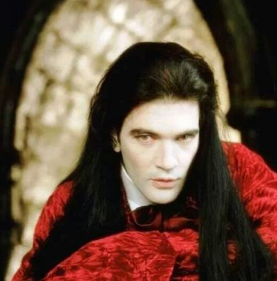
(3) One example of the filmmakers choosing to remove something (almost) entirely from canon: Armand being a teenager around 15 or 16 years old in canon, and he was aged up to the very not-teenage Antonio Banderas, who was 34 yrs old at the time.
^There are still fans today who believe that that change drastically changed the story, and he’s still the butt of jokes about it. Personally, I would say that this change did not drastically change much in IWTV. I don’t think he was described as being that young in book!IWTV, and I don’t think his appearing to be a teenager would have, for example, had enormous impact on Louis’s feelings towards him at that time; that he felt like Armand could be the teacher/mentor Lestat couldn’t be. That’s just my unpopular opinion on that. I have more thoughts on
So yes, I think if some things like that were taken out completely that were not absolutely necessary to their given place in canon, not much would drastically change, but talk to anyone who really dislikes/disliked Antonio!Armand, and you’ll probably get a very different answer.
SO… where does that leave us?
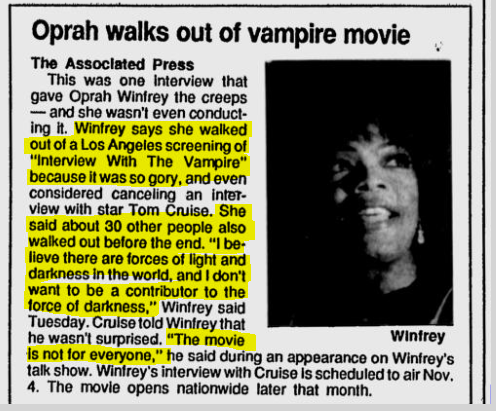
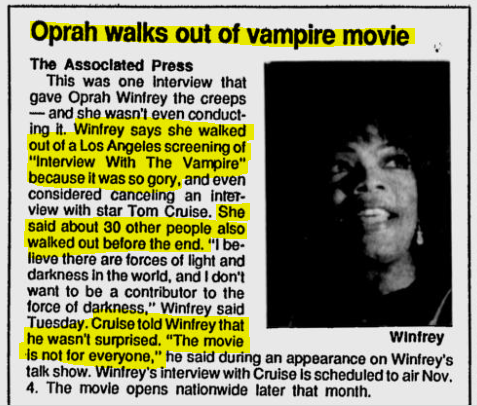
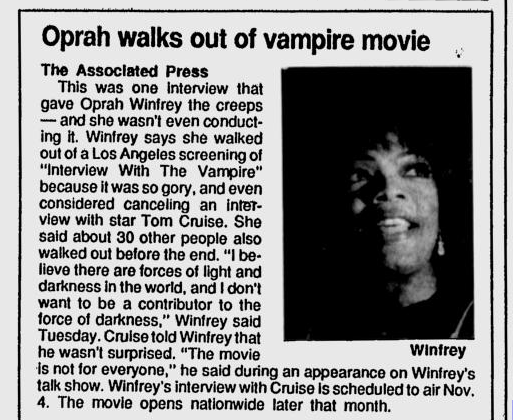
(4) In Fiction, we can explore these things from a place of safety, we can always close the book, or change the channel, or walk out of a movie theatre, as Oprah did during a screening of movie!IWTV in 1994 (my highlights added):
^She walked out because of the gore, which is understandable, there’s alot of blood. That, and the “force of darkness,” which isn’t all that specific. When Tom says, “The movie is not for everyone,” it’s not to say that anyone is lesser for not being able to handle it. I think he was intrigued by the darker aspects, and I think it might be the first truly antagonist/villain role he had taken up until that point. He wanted to explore that.
I don’t believe in just cutting out all the dark fiction, each instance should be considered and handled with nuance. Revision is one option, and total removal might be the better choice in some instances.
I think that’s part of what made movie!IWTV so successful, the enormous amount of care and sensitive handling of dark and light fiction, what they chose to keep, remove, and alter.
(5) The other thing you asked was “Why do you think Anne Rice would go [that] route in particular?”
The question has been raised, many times, whether Anne Rice is, and has been, writing (essentially) propaganda for her own view regarding sexuality, especially as it applies to minors in sexual situations/relationships with adults. Whether Anne Rice endorses sex between minors and adults, it seems pretty clear that she does, as this has been an element of her writing in other series, as well. To my knowledge, she has committed no crimes against minors in real life, and therefore I do not hold her as a criminal of thoughtcrimes. That is definitely an unpopular opinion to other fans, and again, it is why I will not engage in an ultimately fruitless discussion about a crazy lady who writes the books she wants to read. Thoughtcrime is not crime.
Since you asked, I’ll answer why I think AR would pursue that line of thought, under the cut, in case it is upsetting.
I hope that answered your questions in the limited space of a blog post, Anon, and I hope you weren’t offended at any of my response, I tried to be as careful as possible and share my thoughts as respectfully as possible. If any harm was caused, it was not intentional on my part.
Hit the jump for things I said I’d put under a cut.
(2) Instances of the vampires feeding on children that were changed from how they were presented in the book!!:
Louis feeding on Denis (Armand’s mortal “pet”) under the Theatre. In the novel, Louis feels the boy getting a hard-on against his leg. In the movie, their only point of contact is the part of the boy’s hand Louis is biting. Seems to have taken some of the sexuality out of it, and I don’t think it drastically changed that moment.
Movie!Denis himself seemed to be a “peace pipe,” with all those other bites on his hand, and Louis has to feed on him in view of the theatre vampires, making it more about Louis’ discomfort about being watched while feeding which we know from canon he really does not like DUE TO THE INTIMACY of the experience. This, however, is not really clarified in the movie, and it seemed to me to be more about a trust exercise, that he was given this little sip and had to trust that they had not poisoned the blood he was taking. This change worked for me, because the fear of being poisoned was very real in light of how Claudia had poisoned Lestat so easily.
Claudia feeds on Denis in the book, I think she’s even curled up in bed with him. She doesn’t feed on him at all in the movie. I don’t think it drastically changed that moment.
When Lestat turns Claudia in the book, he has Louis drain Claudia a second time, implying that it’s to actually finish her off. This doesn’t happen in the movie, and I was kind of grateful, because it’s more upsetting in the book, when Lestat tears her away from Louis and starts turning her without any discussion about it with Louis first. I’d say that this was a change for the better.
When Claudia offers those boys as a peace offering to Lestat, in the book, he has his hands all in one of their shirts, and as the poison takes effect, his arms are tangled around the dead boy’s body, it’s kind of scarier, this dead body clinging to him and binding him. I would say that this worked for me either way. It’s already a tense and scary moment.
…
(5) “Why do you think Anne Rice would go [that] route in particular?”
From what I understand, she was interested in sex before she was the age of consent, and was frustrated that she was being prevented from pursuing sexual relationships. When she writes these scenes involving underage characters, I think she’s placing herself in the role of the minor, and in some cases, trying to empower that minor with some amount of agency (Amadeo axing Marius’ door down in TVA), but it’s up to each individual reader to interpret the story for themselves and decide for themselves whether that minor was capable of any agency at all or was under duress, or whatever else they might headcanon about that relationship.
Again, I do not think she has committed any actual crimes. Thoughtcrimes are not crimes.
honestly “interview with the vampire” was Next Level Gay for 1994 and i thank god every day for those petty bisexual vampires and their deeply troubled marriage
Gothic Novels of the Twentieth Century, by Elsa J. Radcliffe. I don’t remember how I ran across a mention of this book on Google, but once I did, I was entranced and had to own it. Yes, it’s a list of gothic novels, by author, up to about 1978, with occasional snarky commentary.
What Ms. Radcliffe had to say about Interview with the Vampire:
Seems indicative of this generation when psycho-socio-philosophy creep even into the literature of horror-Gothic. The absurd lengths to which introspection may go are at last met in this study into the inner life of a vampire. Some of the details of vampire life elaborated upon I found repulsive and without redeeming social value. The whole thing just doesn’t come off, in my view – as seems to be true, now that I think of it, with most vampire stories.
So Teen Witch is on Logo, and there’s an advert for their holiday movie line up and the voice over says “We have Gay Apparel” (in reference to the lyric in “deck the halls”) and it cuts to Lestat jumping on top of the coffin, and Louis going “perhaps, yes.” and I aM DYING.
Wait WHAT? IWTV is in this holiday as in Not Halloween, like a happy upbeat movie lineup? Lestat is pleased.
@raydramon hasn’t seen IWTV yet….This is going to be an experience *evil smile*
@i-want-my-iwtv do you have any entering remarks for someone who hasn’t seen it yet?
The story/movie is not for everyone, but hell, just have an open mind and let the gorgeous cinematography, fashion, music, angst, fluff, romance, violence, and fire have your undivided attention put away ur phone and ur interwebs!, let it all sweep you away from reality for 2 hours.
That’s a good idea for a reason she walked out. But I did the math, under the cut, and POC women made up 19% (5 of 26) of the on-screen kills, that’s if she watched an entire hour to include all of them.
I bet the whole mess with Yvette was the actual tipping point. It’s just shy of 30 min into the movie.
I was going to do a post of just the kills, but it was getting to be wayyyy too long, so I just skimmed the whole movie and took a tally. 25 kills total.
– caucasian men: 5
– caucasian women: 7
– children (all were caucasian): 7
– POC women: 1
– POC men: 1
– possibly biracial women: 4
– possibly biracial men: 0
– person who dies during their shipping to Europe: 1



 I-want-my-IWTV