I was born and raised in South Florida, but I have never been proud of that fact. Honestly, not many people outside of hip hop actually brag about being from Florida. Let’s face it, ‘Florida Man’ is a meme for a reason.
But these Parkland kids, these amazingly brave, smart, and incredible people make me so proud to be a South Floridian. For decades American students have been living with a normality that should never be considered “normal”. No child should ever think that an active shooter drill is just like a fire drill. No educator should ever have to plan to face an active shooter. The Parkland students have been outspoken since the day it all happened and they have not stopped using their voices. They have made changes in policy and will continue to do so. These kids, these young adults, are the future of this country and, for the first time in years, I think that the future is in good hands.
Right now, I’m sitting in an airport waiting to board a plane to Nicaragua, but if I wasn’t I would be out there marching with them. I hope those of you who can will. If you can’t march but have funds to donate, please give to Everytown.org
The Gothic novel did not disappear with the turn of the previous
century, but instead evolved to reflect the increasing globalization, and to give new perspectives to the villains and supernatural beings that abound in the novels. As well, the Gothic tropes became very common in the new Young Adult genre, but that deserves its own post, Therefore, here are some of the best modern Gothic novels to date.
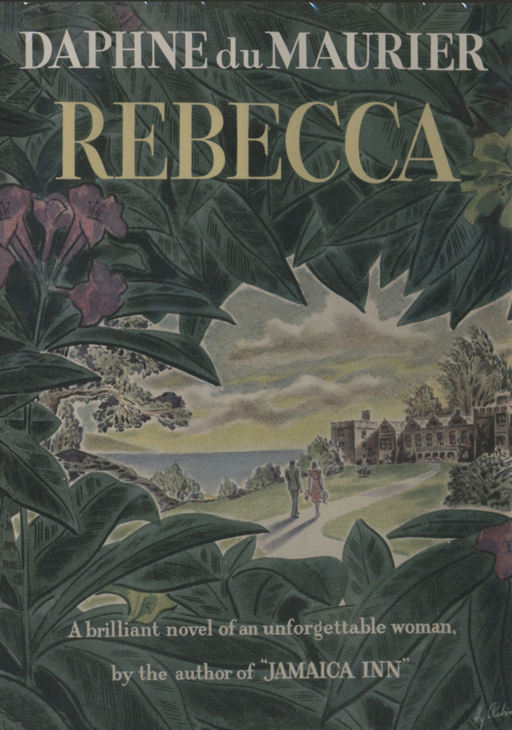
Rebecca, by Daphne du Maurier (1938)
One of the most famous examples of modern Gothic horror, Rebecca is a tale of obsession,
mistrust, and psychological torture. There are no ghosts or
supernatural horrors in this novel – the only spectre is that of the
eponymous Rebecca, haunting the protagonist through her servant Mrs.
Danvers. With the eerie trappings of Gothic horror and the additions of the modern world, such as automobiles and proper medical inquests, Rebecca
defined how the Gothic novel would evolve in the twentieth century.
The Haunting of Hill House, by Shirley Jackson (1959)
Shirley Jackson has traumatized
the last three generations with her short story “The Lottery”,
a Gothic in its own right, but her novel The Haunting of
Hill House is a step past Rebecca, and takes the Gothic novel back into the realm of the supernatural, where it spent the turn of the century. The Haunting involves a scientist, two young women, and the owner of Hill House, trying to unravel the mystery involving the ghosts and the horrors of the house, and how they begin to torment one young woman.
Anne Rice’s novel is infamous among Goths of varying types for
its depiction of grotesquely decadent vampires, flouncing through their afterlife with lacy cravats, temper tantrums, and an excess of fire and blood. Rice took the supernatural Gothic novel and focused it on the Byronic characters, as opposed to focusing on the traditional heroine. Interview With a Vampire is one of the most well-known Gothic novels, though it is Miss A’s personal opinion that it isn’t very good.
Most similar to: Dracula,
the entire life of Lord Byron
Although most people know the movie starring Daniel Radcliffe, the original book came out in the 1980s. It centres around a spectre, the ‘Woman in Black’, who haunts an English village heralding the deaths of children. The protagonist is a young barrister who comes to handle the estate of a deceased woman, but begins to unravel the mystery surrounding the Woman in Black and the secret horrors of the village.
Taking place just after the Spanish Civil War, Shadow of the Wind follows the life of Daniel Sempere, who finds a book in the Cemetary of Forgotten Books, a secret library in the heart of Barcelona. This book launches him into a decades-old mystery that includes a mysterious, scarred stranger, a haunted mansion, and the tragic death of a beautiful woman.
Following in the trail of Shadow of the Wind
is The Thirteenth Tale,
which returns the Gothic novel to the moors. A favourite of Miss A’s, it center around Margaret Lea, a biographer with a gaping hole in her heart that she cannot fill, and the famous writer Vida Winter, who is dying, and finally ready to tell the truth of her past. Two stories, both with their own ghosts and trappings, play out in this novel. There is a movie of this book, starring Olivia Coleman, Vanessa Redgrave, and Sophie Turner. The movie leaves out a number of the plot-points, and changes the past of Margaret, but keeps the haunting aesthetic of the book.
Most similar to: Agnes Grey, Jane Eyre, Turn
of the Screw
It’s tough for me to answer bc I think it depends on every individual reader’s sense of humor,… even within “humorous/ dark tone as VC” there is a range*. So I can’t say definitively that these reccs are in line with what you’re looking for necessarily, but you can use this list as a starting point.
*Lestat dancing w/ Claudia’s mom’s corpse: Some ppl find this moment dark and hilarious and other ppl think it’s just disgusting, so… there is a range. Personally I find it pretty amusing.
(There are some duplicates on this list, sorry about that, but I wanted to list them by recc’er.) (And I added ** next to those that @gothiccharmschool just recc’d in two recent posts which I will reblog momentarily for you.)
In no special order:
(Okay this is the first one bc it IS special, and the closest to the humor of VC I’ve seen in awhile) This is a mockumentary/movie but it sneaks onto the top of the list bc it is just SO good, courtesy of @theamazingdrunk for reminding me in a comment on an older rec post: WHAT WE DO IN THE SHADOWS
**Salem’s Lot – Stephen King, personally, I find several Stephen King books to be darkly humorous, this one is a good one. I find humor in the Shining and Firestarter, too, but less so.
Vittorio – don’t forget Vittorio. Not sure if you read this one. It’s also by Anne Rice and technically not a VC book, he has a different origin story and is not part of the VC vampire group.
@riverofwhispers said: Carmilla is good Anita Blake and Sookie Stackhouse books, but only the early ones. the Rachel Morgan series but again starts out good gets weird later and it’s not about vampires so much as there are vampires in it.
@bluestockingcouture said: ‘The Angel’s Cut’, sequel to ‘The Vintner’s Luck’, is very atmospheric and well worth reading. Not quite as moving and intense, but there are some excellent new characters.
@sanguinivora said: Also, as to voice: IWTV opens in the late 1700’s/early 1800’s. Don’t know about either a southern American or French hinterlands-with-a-gloss-of-Parisian dialect, but for the grammar and vocabulary, one cannot go too far wrong looking to the novels of Jane Austen and Patrick O’Brian.
@dragontrainerdaenerys said: I just read Fevre Dream, George R.R Martin’s own vampire novel, and while I didn’t liked much his vampire mythology the main characters are charming! Besides, it’s set on the late 18XX and goes on the Mississipi River, so it has similar scenarios to IWTV!
@baroquebat said: Vampire Hunter D: Bloodlust, while futuristic, has a loooot of lovely gothic set pieces in the anime movie, plus its just gorgeous and has the rare treat of having a dhampir lead!
@annabellioncourt’s Recs, and these are mostly her descriptions, too, compiled from other recc posts:
The Bloody Chamber And Other Stories – Angela Carter
A Taste of Blood Wine – Freda Warrinton, for romance and decadence.
**Blood Opera Sequence (or “Trilogy”?) – Tanith Lee’s vampire series was out when Lestat was playing rockstar
Historian – Elizabeth Kostova, for its worldliness
**Fevre Dream (yes its spelled fevre) by George R. R. Martin (yes, its THAT Martin, and his take on vampires is Very Good.)
Sunshine by Robin McKinley
**The Delicate Dependency by Michael Talbot, also for romance and decadence. (the recently-published edition from Valancourt Books has a foreword by @gothiccharmschool!)
The Hunger by Whitley Scriber
**Dracula – Bram Stoker, for its stereotype-setting content
Lord Ruthven – Byronic vampire, Lestat doesn’t catch the irony of John Polidori’s mockery of the foppish, arrogant, and well…Lord-Byron-y vampire
what she says: I’m fine
what she means: why is Dorian Gray never played by people with blond hair? why is Dorian always depicted as all pale and dark? oscar literally describes his hair as gold like two seconds after we meet him. directors apparently feel like they have to make Dorian look dark dangerous and brooding, but he’s not supposed to look dark and dangerous and brooding. That’s the whole point. No one ever suspects him because he looks like an innocent little cherub with golden curls and rosy cheeks. His physical appearance is described with terms that Western literary tradition, during the nineteenth century in particular, associated with goodness and godliness, and this is intentionally juxtaposed with the blackness of his soul. If you intentionally play him as someone who looks like a Byronic hero, much of the symbolism of his character is lost, right?
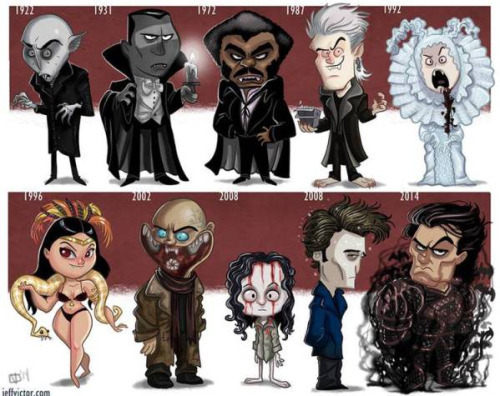
I’m not surprised that you’ve been into vampires in general for 15 yrs. Vampires are such good stuff and can be written/depicted/analyzed in so many different forms and variations. Limitless possibilities really, bc creative ppl can choose to stick to the more classic rules about them, and others throw them away, or explain work-arounds… limitless possibilities! JUST LOOK AT THESE SPECIMENS:
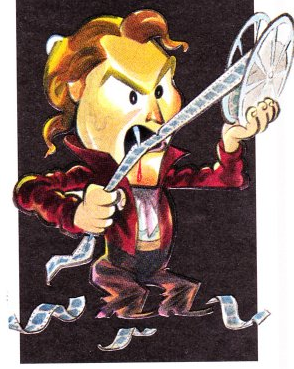
Lestat is THE ONE THAT DIDN’T GET INTERVIEWED but let’s all acknowledge that IWTV was at least 65% about him… also bonus points to THE HALF-BREED ASSASSIN w/ a sword out, inching up on THE SPARKLY ONE…
[^tumblr source, artist unknown, tell me if you know who it is, I did a reverse image search and had no luck]
[^tumblr source, vampire lineup by Jeff Victor, who clearly skipped IWTV. OH WELL HIS LOSS SO I ADDED A LESTAT CARICATURE BELOW, tumblr source, artist unknown]
As for a complete register over all the different kinds of vampire lore from all the different works of fiction, I think that would be fairly difficult, unless it was online and consistently researched and updated by more than one mere mortal.
Every vampire compilation I’ve ever seen in a library or bookstore has been a curated collection only showing specific examples of different vampires, presumably so that the author could move onto other books/projects!
My own blog is a curated collection. While I feature other vampires in my #vampire tag (from the Lost Boys, Only Lovers Left Alive, What We Do in the Shadows, etc.), I actually don’t love all vampires in fiction (*cough* Twilight *cough*) enough to make this blog the register that you’re looking for 😛
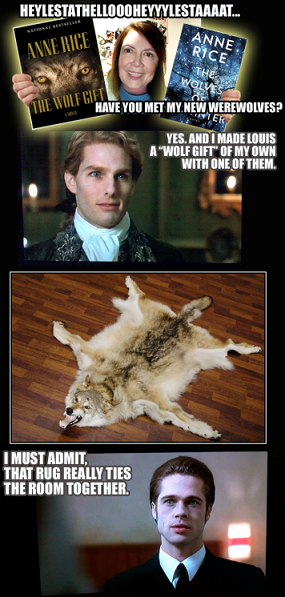
[X] Not that I tried to read it ok i cracked the spine and skimmed it a bit but that was the best I could do for the initial exposure, but Anne Rice has a werewolf series going now. It made that Wiki list above.
I am actually a terrible resource for this question bc I… *gasp* do not really ‘get’ a lot of poetry! I only really like a few poets… like Shel Silverstein (he can be very adult and subversive, btw), Dr. Seuss (who tucked the richness of political/other messages into his works), and other “children’s” authors
yes don’t even think of mocking me on that ok i like what i like, and tbh I headcanon that Lestat has a passion for these, too, since he never got bedtime stories with illustrations as a child (and it’s why he read bedtime stories/poetry to Claudia well beyond the time when she could read to herself bc he loved impressing her with acting out the voices).
HOWEVER. I do love me some Shakespeare, and I think that counts as poetry, and Lestat loves him some Shakespeare, too. That’s canon. He mentions Keats in TOBT as he’s refurbishing the Rue Royale “Ah, wasn’t it the ode by Keats which had inspired that long-ago purchase? Where had the urn gone?” He also mentions Milton in that book. IDK if he read them but he came into possession of a collection of poetry by Wynken de Wilde in MtD.
Book-IWTV!Lestat is not wild about books of poetry, ditching Louis one night with a cruel little snap: “Read your damn poems, then! Rot!”
Lestat also considers music lyrics to “count” as poetry and might get all excited about a new track by Kanye West, Eminem or Macklemore. I think he’d be especially drawn to freestyle rap battles.
Louis quotes from Samuel Taylor Coleridge’s The Rime of the Ancient Mariner, so I would assume he liked (at least at that time) that kind of story/poetry: macabre, dealing with religion v. nature undertones.
I see Marius as liking the quirky poetry in the New Yorker, and Stan Rice’s free-form style, as he likes to study emerging trends in thoughts.
DavidTalbot likes Blake, the Tyger features in his… trajectory, shall we say.
Thank you for clearing that up! I remember Louis mentioning the intimacy thing but I totally forgot about Lestat. I just have a vivid memory of Armand and Daniel in bed and I guess my mind tried to fill in the blanks.
Honestly, It’s been so long since I’ve read them that I’m starting to wonder what I actually read and what my friends and I headcanon’ed.



 I-want-my-IWTV