I’m sure you receive many, many emails of this kind, but I could not let my gratitude go unexpressed.
The short version of it is that I may not be here today were it not for you.
Now, the longer version of it is that in my 17th summer, my sister went to our town’s sparse public library and brought home a massive stack of paperback novels to get us through the long, hot, enui that can be the countryside days and nights. Interview with the Vampire was among the books, and I happened to grab it first. Honestly, I was more amused by the title than interested, so I decided to see if my predictions for “a little light horror fiction” might come true. Well…
I practically locked myself in my room for three days until I had read it, and then re-read certain passages three and four times over. I had found a new respect for the power of literature.
You see, this was a time when I was beginning to understand my homosexuality, and I had never encountered such rich and erotically charged writing with two male figures. But beyond that–and, more importantly–no work of fiction or fact had ever made me feel that its author had, somehow, reached a hand inside my mind, pulled out the most important philosophical questions that I could not yet put into words, and then laid out the answers in ways that made me hunger for more, and which made me want to live.
The true nature of that time is that I was terribly sad and suicidal because, in my very small and inhibited world, I was sure there were no other boys like me. No one to learn from, no one to take solace with, no one to confess all my fears and doubts to. At 17, as you are aware, I’m sure, the world is always about to end for things that people get through every day. For me it was no different, yet it was insanely compounded by the “gay thing” in the rural south. I won’t go further into that, I know you know what it means.
So, as I read, I saw myself so completely in the character of Louis–and I desperately wanted to be him, sad as he was–that I was able to forget my “family prison”, as I called it, and started thinking about how to really be who I was meant to be. I’ll tell you the part that got me weeping, and that I go back to often when I need to re-feel that old passion that first woke me up…
It’s the section of the book when Louis is in Paris with Armand, and they’re in Armand’s chambers discussing the nature of good and evil, and Louis asks him if they are the children of Satan. Growing up in the Baptist church, I had been taught that “my kind” were just that, and so this was one of my eternal questions brought to the printed page for discussion with a Master (I was shaking by this point!). And then came that beautiful answer–please forgive me if I murder the direct quote: “Exactly. And, consequently, if you believe that God made the world around you, then you must also believe that God made Satan, and that all of Satan’s power comes from God. There are no children of Satan, really.”
And that was it. That was the moment I realized I didn’t need to end my life because I was this aweful thing that didn’t belong in the natural world. I decided to embrace what I was, just as Lestat and Armand had been trying to teach that lesson to Louis, and I have never looked back, hard as the road has been at times.
Now, in my 40th summer, I am studying to be a therapist so I can help others overcome the same suffering I went through and overcame. This confession, though, is not the first time I have revealed to others what, or who, saved my life so long ago. In my efforts to fully connect with others who are struggling, I often tell them of the power of your story, and how it offered a perspective rarely encountered even in the best “self-help” books. Sometimes, a beautiful and tragic allegory can elicit the most catharsis. Lucky for all of us.
In closing, I’ll say again how fortunate I feel to have found you and Louis that summer. He is always with me on some level. I’m not really sure I have the exact words to express all the levels of gratitude I feel, but I hope this letter can convey even a 10th of it. You may absolutely feel free to share it with others, if you think it would be of benefit. I am forever grateful, and forever changed for the better, because of your incredible spirit and voice.
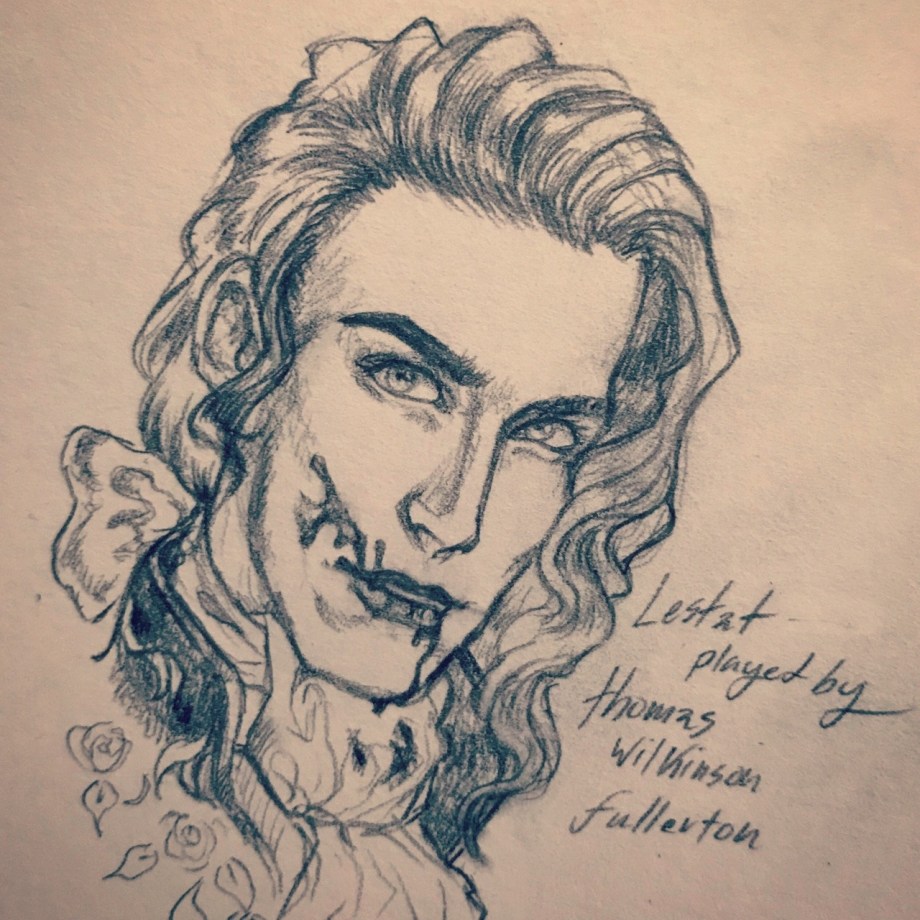
superhiki I’m so hyped about the new #vampirechronicles TV show- I’m throwing my full support behind @thomasjwf as Lestat- if there is any doubt in your heart here is some proof. 💟🦇💟
thomasjwf🤯💖 Oh wow that is so totally flattering. Thank you so much! Let’s hope I get the opportunity to give it a shot. 🤞🏻🎬🧛🏻♂️
superhiki @thomasjwf I hope so too! You’ve got a growing crowd of supporters. 💐💐
Also inspired by @i-want-my-iwtv call for action, I felt the need to defend my personal love for this film, though it is a bad adaptation.
1. Jesse as a co-protagonist of the story. In the book, Jesse is just one piece of a very large puzzle, but the movie gives her almost equal development and time as Lestat. No, I don’t enjoy their forced romance, and would prefer if that had been left out. But I do love that she’s the lens through which we see Lestat’s history, and how she plays more of a forward role in the overall story. She is brave but is allowed to make mistakes, and is a powerful female character because of that.
2. Lena Olin as Maharet. She brings the character alive with the sheer amount of grace and power she puts into her performance. Maharet feels like she is ancient, and also above the world, but not in a pretentious way. Simply that she is separate from humanity, something she slips up on by allowing Jesse to stay at the compound.
3. The design and look of the Great Family Tree. The tiny tablets with ancient writing fits far more into an old world aesthetic than whatever elementary design I had come up with in my head when I’d read the book. I love how they bleed towards the end of the movie. I love how the branches stretch out not so much like branches on a tree, but like veins and arteries, further driving home the importance of blood.
4. The concert venue being outdoors. Whenever I reread QOTD I have a vague feeling of claustrophobia with how small Cow Palace feels. The tight space lends itself to the ensuing chaos, but the outdoor concert gives more tension imo. The threat and danger of the rogue vampires can come from anywhere, and though we see them in the crowd, when they descend from above it heightens the fear that Lestat might really be in danger.
5. The way the blood drinking mind reading is portrayed. Showing mental powers or mind anything in film is hard. It can either read too cheesy or too realistic. I like the way the film makes the mental blood connection look like a tunnel, like we are being transported along blood vessels to see what the characters are seeing, without revealing too much.
6. Aaliyah as Akasha. This is not far down on the list because of any order, simply because it’s been said by so many of us I didn’t want it to be redundant.
7. The soundtrack. Likewise with this. So many people love these songs, and I probably wouldn’t have discovered Deftones, one of my fave bands, without this soundtrack (and the very hot ‘sex’ scene over Change (In the House of Flies)).
Listen, I know this movie isn’t a good representation of the book. I know it probably isn’t even a good movie by objective standards. But I’ve still rewatched it more than IWTV, and I still love way too much of it. Perhaps that is because it came out when I was first reading the books, so to me, it’ll always be the adaptation that I’ll associate with my fledgling VC days.
Now I feel bad for bashing this movie! I had asked for some love for it, and this was so touching and so generous to it, and like, I hope the ppl who were involved with it had fun making it, and I hope they know that some ppl did enjoy it and do think of it affectionately.
“Imagine having a child that refuses to hug you or even look you in the eyes”
Imagine being shamed, as a child, for not showing affection in a way that is unnatural or even painful for you. Imagine being forced, as a child, to show affection in a way that is unnatural or even painful for you. Imagine being told, as a child, that your ways of expressing affection weren’t good enough. Imagine being taught, as a child, to associate physical affection with pain and coercion.
As a preschool special ed para, this is very important to me. All my kids have their own ways of showing affection that are just as meaningful to them as a hug or eye contact is to you or me.
One gently squeezes my hand between both of his palms as he says “squish.” I reciprocate. When he looks like he’s feeling sad or lost, I ask if I can squish him, and he will show me where I can squish him. Sometimes it’s almost like a hug, but most of the time, it’s just a hand or an arm I press between my palms. Then he squishes my hand in return, says “squish,” and moves on. He will come ask for squishes now, when he recognizes that he needs them.
Another boy smiles and sticks his chin out at me, and if he’s really excited, he’ll lean his whole body toward me. The first time he finally won a game at circle time, he got so excited he even ran over and bumped chins with me. He now does it when he sees me outside of school too. I stick out my chin to acknowledge him, and he grins and runs over and I lean down for a chin bump.
Yet another child swings my hand really fast. At a time when another child would be seeking a hug, she stands beside me and holds my hand, and swings it back and forth, with a smile if I’m lucky. The look on her face when I initiate the hand swinging is priceless.
Another one bumps his hip against mine when he walks by in the hallway or on the playground, or when he gets up after I’m done working with him. No eye contact, no words, but he goes out of his way to “crash” into me, and I tell him that it’s good to see him. He now loves to crash into me when I’m least expecting it. He doesn’t want anything, really. Just a bump to say “Hi, I appreciate you’re here.” And when he’s upset and we have to take a break, I’ll bump him, ask if he needs to take a walk, and we just go wander for a bit and discuss whatever’s wrong, and he’s practically glued to my side. Then one more bump before we go back into the room to face the problem.
Moral of the story is, alternative affection is just as valid and vitally important as traditional affection. Reciprocating alternative affection is just as valid and vitally important as returning a hug. That is how you build connections with these children.
This is so goddamn important.
I verbally express affection. A LOT.
My husband… doesn’t. I don’t know why. For the longest time part of me wondered if it meant he loved me less.
At some point I told him about a thing I had done as a kid. Holding hands, three squeezes means ‘I Love You’.
Suddenly he’s telling me I Love You all the time.
Holding my hand, obviously, but also randomly.
taptaptap
on my hand, my shoulder, my butt, my knee, whatever body part is closest to him, with whatever part of him is closest to me
All the time.
More often than I ever verbally said it.
It’s an ingrained signal now, I can tap three times on whatever part of him, and get three taps back in his sleep. Apparently I do the same.
I see more posts by white people asking if it’s “okay” for them to see Black Panther than I do see them asking for links to charity campaigns trying to help young Black kids see the movie.
which is to say the BP tags have like three of the former posts every day, but I have yet to see a SINGLE post by a white person asking people to send them links for campaigns they can support.
I need someone to realize that this is the pinacle of performative allyship.
they’re out here trying to get their hoodpass into wakanda but aren’t ready to let Jerome hold a dollar. They want to be invited to the cookout, but won’t even bring a bag of ice. They want to think themselves the ‘special white people’ but don’t actually want to do the work of the special white people.
and before you, white person clearly missing the point of this posts asks, yes, you CAN reblog this if it’s to show support of the message.
Here’s some links, btw, to gofundmes that still need funding for helping black kids see Black Panther:
“My friend, Mirai, and I – four years ago, we got In-N-Out, we went back to her house, we went up to the roof of her house, and we were eating In-N-Out because we were so upset that we weren’t at the Olympic Games. And tonight, you know. The Olympics are truly magical because we came out here tonight, and – we’re roommates here staying in the Olympic Village – we gave each other a hug and I said, you know, “Mirai, we’re here. We did it.””
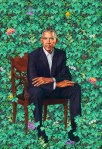
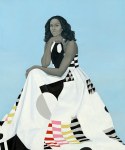
The official Obama portaits unveiled today. President Obama’s portrait was done by Kehinde Wiley, and Michelle Obama’s portrait was done by Amy Sherald, making the two artists the first African-American artists to be commissioned for portraits at the National Portrait Gallery.
“What I was always struck by when I saw his portraits was the degree to which they challenged our ideas of power and privilege,” Obama said.
The juxtaposition of contemporary urban culture with centuries-old postures and wallpaper-like backgrounds make for bold paintings, of which Obama’s is Wiley’s most famous to date.
For her portrait, Michelle Obama chose Baltimore-based artist Amy Sherald. Sherald is another African-American artist known for her unique style, and her portraits also tend to underscore themes of social justice. She often paints black skin tones in gray as a way to take away the assigned “color” of her subjects. Sherald’s work is less about realism in composition and more about shape and color; like Wiley, the choice of Sherald ushers in a new era of presidential portrait … The former first lady said she was thinking about the impact Sherald’s work will have on “girls and girls of color.”
“They will see an image of someone who looks like them hanging on the walls of this great American institution … And I know the kind of impact that will have on their lives because I was one of those girls,” she said.











 I-want-my-IWTV