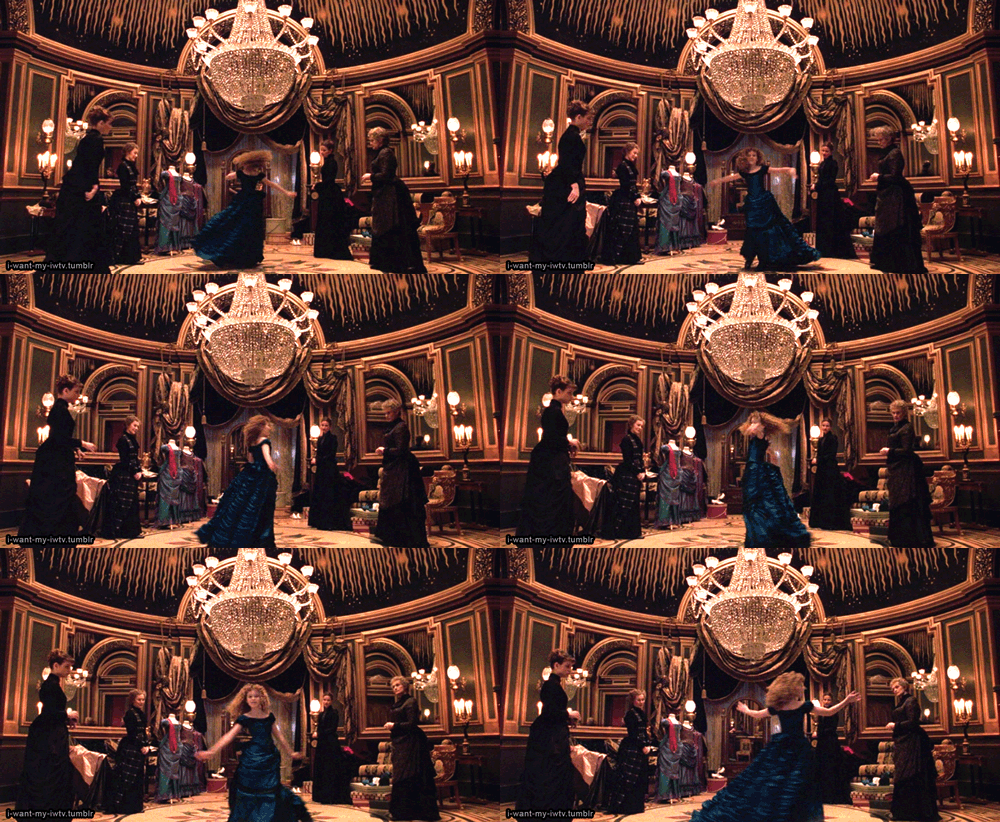
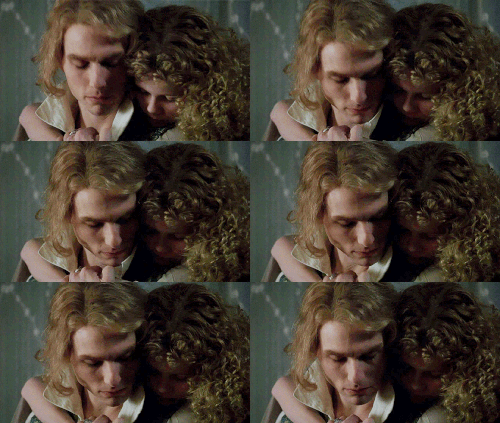
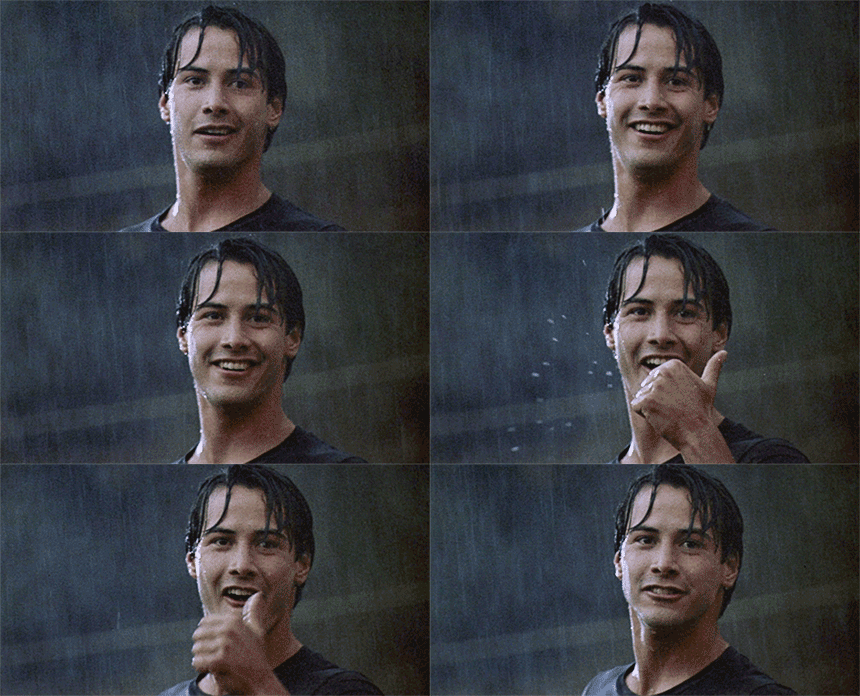
Since it’s stated that Armand and Louis drift around the world until the 1920’s, I like to think that Louis probably had his own little moments in the 1940-50’s, probably collecting records in the privacy of his own chateau… But like?? If Lestat was there wouldn’t it be obvious he’d be the fashion snob to that era?

Oh definitely! And I think you’re right that Armand and Louis would have had their own little moments throughout the time they were together, the art, inventions, social progress, etc. of the early-mid 20th century… there would have been highlights for them, they would have taken little mementos or made records of these times* :,)

I think there’s a reason AR chose to have Lestat effectively sleep through that time period

(”sleep” isn’t quite right, as he was more or less conscious but he was basically in his own little bubble, hiding from the world, buried in comic books). There’s no way Lestat wouldn’t have gained notoriety of some kind if he’d been his usual, confident, glittery-murder-machine self! I think she wanted to skip to the era that fashion and art and all that had really reached a peak that it had been steadily growing towards, and then she would be able to slam it at Lestat in the avalanche that he expresses it is in TVL.


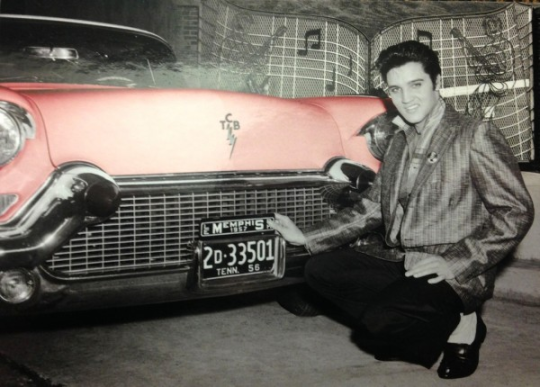
I mean, (skipping over the 1940′s bc WWII, and the world beginning to rebuild itself from war**) the fashion of the 50′s would have been very appealing, the music, the inventions, the art…
image

^Lestat would have LOVED Elvis’ music, and his iconic pink Cadillac, for sure. Aesthetically, that car was so organic (while also having a touch of space-age smoothness!) and sensuous curves, and the color being so unashamedly bright and joyful following such dark times re: WWII, it was a triumph of the human spirit. I pick this car as iconic of the ‘50′s bc I think it was part of the zeitgeist of that time and had international influence.
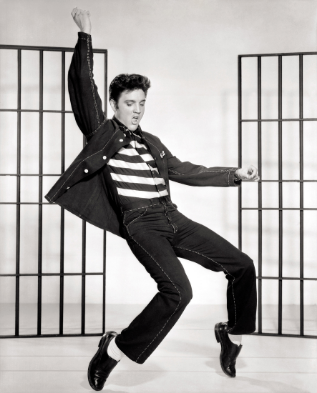
image

^And Elvis’ outfits (which got progressively more glamorous ok Lestat would have copied inspired ALL THOSE LOOKS)
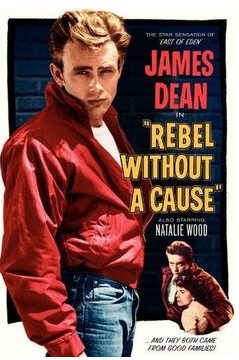
image

^And then of course James Dean and the Bad Boy/Greaser appeal ;D 

Lestat being underground through all this kind of reminds me of the whole god-of-the-grove thing that Marius described the druids imposed on their captive vampires, that the periods during which a vampire rests underground, malnourished, absorbing the world above in a dream-like state, are as natural and cyclical as having autumn & winter precede the vitality of spring & summer. When Lestat rose up in the mid-80s the world was a more vibrant place in many ways than when he’d gone to ground to hibernate, and he was ready to take it all in and join it.

A few more thoughts on all this under the cut, cut for length.


**I had to skip over the 40′s bc I think AR had Lestat out of the picture then for the general policy that she doesn’t address current political conflict in VC.

War is an abstract in the books and I don’t blame her for choosing not to have any of her vampires visibly suiting up for human wars. It would be a complicated thing to tackle, to say the least. How do you explain to your superiors that you have to sleep all day and can fight all night?! How do you choose which side to fight on when you’re providing such an unfair advantage in your preternatural abilities?

That’s partly what the whole confrontation with Akasha in QOTD was about, the VC vampires stating that they have no right to participate in mortal conflicts since they aren’t mortal anymore, and I have to agree on that. Daybreakers had vampire soldiers and idk if that really worked out all that well, I’d have to watch it again to have a proper opinion but I remember it feeling very cringey the whole time I was watching it 😛
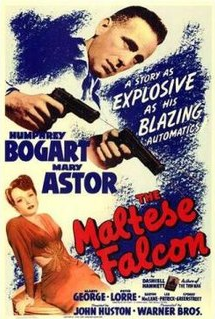
image

^AR acknowledges that Lestat was reading comics from the 1940′s, and I’m sure he had his fave actors like Cary Grant and Humphrey Bogart, and fave actresses (you KNOW HE LOVED JOAN CRAWFORD AND BETTE DAVIS LIKE C’MON). And it seemed like those comics helped to get his spark of lust for life back, he wanted to be the Good Guy he saw in those comics. I’m not well-read on those, but from what I understand about them, the Good Guy made mistakes, and was not necessarily all that civilized all the time, but he tried to be good, and usually succeeded. And he looked good doing it 😉

*Louis/Armand for 100 years: This was probably somewhat like what Armand later did with learning about the world with/through Daniel, but I think Armand held back with Louis for many reasons, partly bc it seemed like Louis/Armand was so fragile. Armand learned that holding back like that can weaken an already tenuous connection (what good did all that holding back really do for either of them?) so I think that’s why we see Armand being more outwardly curious/open-minded with Daniel; the reward for revealing yourself is that you give a person more reason to stay with you, as much as it is the risk of giving them more reason to leave you, but that’s partly how you strengthen the relationship ❤

Given the available technology, how many heart emojis would Lestat send to Louis on a regular basis?

charlie plummer as lestat?

Hmmm… I haven’t seen him act in anything so idk how he is as an actor, I watched the trailer for one of his upcoming movies, Lean on Pete, he plays a 15 yr old in that movie. 

image

^These pics are from 2017, so they’re pretty recent. I think Charlie has an unconventional look, very unique features, with the wide nose, full lips, a prominent forehead and a soft jawline. Re: the mouth, specifically, Lestat describes his mouth as “well shaped but just a little too big for my face. It can look very mean, or extremely generous, my mouth.” Maybe Charlie’s would match that description?

The nose doesn’t match as Lestat has “a fairly short narrow nose”. Now, Tom Cruise wasn’t the right height and he did an amazing job, so sometimes talent outweighs physical deficiencies. But in Tom’s case, they could give him heels, an easier thing to adjust. Tom ALSO had a prominent nose, definitely not short or narrow. And it didn’t stop him from doing an acting job that earned him the glowing praise from Anne Rice herself, who had been very against his casting.

I don’t know if you find Charlie attractive physically, Anon, but there is a recent trend in casting unconventionally attractive actors. While I think the title is a little unnecessarily click-baity, in the article “MILLENNIAL’S GUIDE TO FILM: THE AGE OF THE UGLY ACTOR” Marina B. writes:

Sometimes there aren’t really words to explain why we find someone intriguing, they just have that je ne sais quoi that pretty boy actors can’t achieve. I feel like Adam Driver has that something special, and I’m not alone. Scorsese can back me up on this one. Scorsese can be quoted giving some serious admiration for Driver that he discovered when casting for Silence:

“I love the way he moves, his sense of himself on camera… he also has that remarkable baritone voice. He’s talented, of course, and very, very brave.” -Martin Scorsese

We also have growing antagonists. Caleb Landry Jones is for sure the go-to gross, delinquent star in film lately. He played the crazy brother in both Get Out and American Made. He goes absolutely ape shit with the roles he’s given; there is no amount of crazy that he isn’t willing to take on for a character.

^All that aside, I think Charlie Plummer looks a little too young to play Lestat yet, in both his face and his body. Lestat was a hunter in life, and had to have some muscle for that. We could get a trainer for our eventual actor for Lestat, tho!

Anon, while I always had Lestat in mind as being a conventionally attractive “pretty boy,” you might be onto something. A screen test would be the real determining factor 😉

How do I make a character’s death really sad? (For a VC fic.) (-Memnoch, The Devil.)

I think there are many ways to make a character’s death really sad, and bc we can all have different feelings about a given character, any individual reader will be very sad about the death, when another reader might be totally indifferent (or even glad!). I’ve only written fanfic myself, and I know what makes me sad when I read/write character death, that’s about as informed as I am on the topic, DISCLAIMER: I’m not a professional writer and this is not professional advice.

💀 Some things that come to mind re: making a character’s death really sad: 💀

  1. How they die, 
  2. How preventable their death was, 
  3. How other characters feel their loss and/or the loss of their potential, 
  4. And how much that character meant to the reader/audience, did they like the character?

I don’t know what specifically you’re doing in the Memnoch timeline… I won’t use any examples of deaths from that book in case of spoilers (Idk sometimes I’m more respectful about spoiling ppl than other times *shrugs*)

In IWTV, it was a very sad death when Claudia died. It’s portrayed differently in the book(s) and the movie, but I’m just going to address it re: the points above generally and drawing from both.

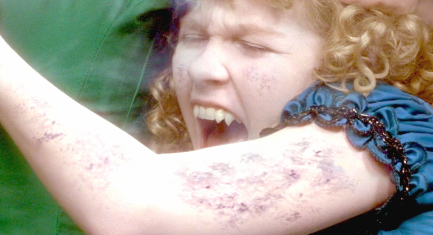
1. She died by sunlight exposure and it seemed extremely painful. 

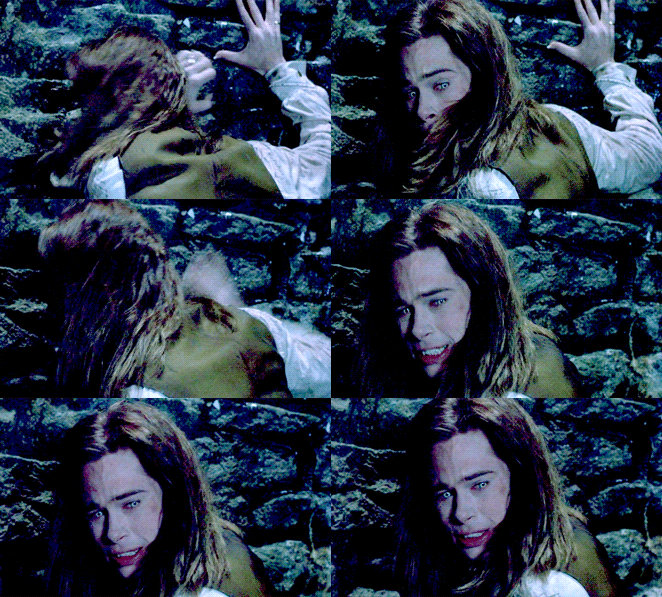
Louis would not have seen it, so he can’t describe the moment of her death in the book, but it’s shown in the movie. Leading up to the death, the tension builds and builds, all these moments where Louis, Claudia and Madeleine are hoping for Armand (or some other deux ex machina) to swoop in and save them all. It doesn’t happen. Probably one of the last shreds of hope they had was when the troupe pull Louis and Claudia apart, from that point on, he can no longer protect her ;A; 

As it was so painfully underscored in Claudia’s Story, the last name Claudia hears Louis call for is “Armand,” bc calling her name won’t do them any good. But to her, it feels like a final betrayal, that he’s calling for Armand bc he cares more about him ;A;

image

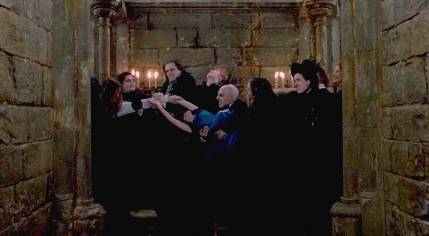
Claudia and Madeleine get locked in the well, and when Claudia sees the sunlight approaching, she’s already starting to cry, trying to wake Madeleine to try to figure out a way out… there is none and then they can only brace themselves bc there IS NO ESCAPE ;A;!! The acceptance of their own deaths is part of the tragedy.

It’s a pretty universally nightmarish situation, even though sunlight is not fatal for ppl (most, anyway), but we can all relate to the experience. It’s like being pushed onto subway tracks and not being able to escape in time ;A;

image

2. Her death was a failure in diplomacy, basically. The Theatre des Vampires, led by Santiago, held a kangaroo court (although they may have felt that they were within their rights) in which they found Claudia guilty of attempted murder of her maker, and decided to punish her with the death penalty. 

Louis tried to protect her from it as best he could, he tried to make a deal to save her life, but failed. In the book:

“ `Listen to me, Lestat,’ I began now. `You let her go, you free her… and I will… I’ll return to you,’ I said, the words sounding hollow, metallic.

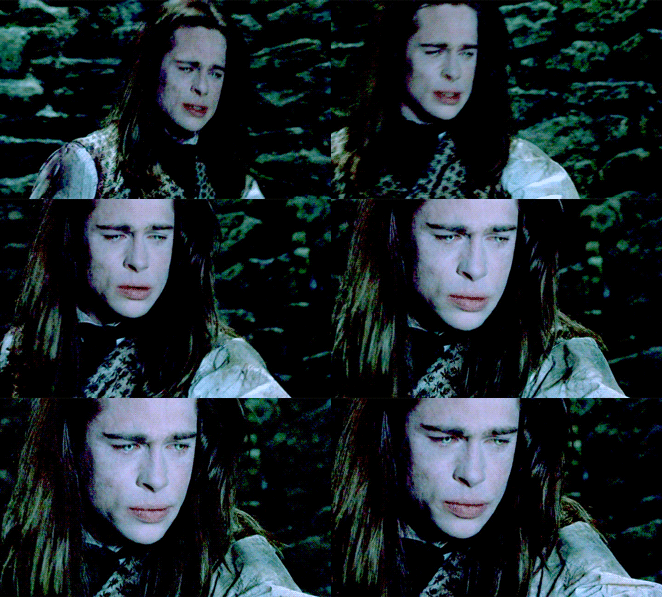
3. It kills a part of Louis when Claudia dies. His immediate reaction is extremely sad (not even factoring in the revenge he takes after).

image
image

I have a more thorough commentary on this scene here. It’s in this moment that Louis has lost the most precious person, the one who’s told him what to do, someone he could worship and follow, someone who metered out his doses of happiness with her approval. In the movie, he calls her “my child,” Armand tries to correct him: “Your lover,” and Louis compromises with “My beloved.” 

In the book, the next night, Louis finds Lestat clutching Claudia’s bloody dress and sobbing over her death, too. Even though he was the very person who testified against her! Even he could not prevent their “justice.”

“And then I saw the thing in [Lestat’s] hands. I knew what it was. And in an instant I’d ripped it from him and was staring at it, at the fragile silken thing that it was – Claudia’s. His hand rose to his lips, his face turned away. And the soft, subdued sobs broke from him as he sat back while I stared at him, while I stared at the dress. My fingers moved slowly over the tears in it, the stains of blood; my hands closing, trembling as I crushed it against my chest.

Louis was expecting Claudia to go on and live with Madeleine, that he would still be in touch with her and see her occasionally. So that potential continued relationship was destroyed, too ;A; 

4. What did Claudia mean to the audience/reader… 

image

I know I sympathized with her and very much enjoyed her overall, and I like to think that other readers/viewers agreed, and don’t totally blame her for her actions against Lestat… after all, she was a victim herself. Lestat doesn’t blame her when he speaks of her in canon. We saw the love they both had for her ❤

image
image

Is that enough to convince the readers/audience to care enough for her that her death is sad for them? All those factors help!

~💀I hope that helps, Anon! Now make us cry!💀~

Do you know of any vampire clichès? (I know that you may not have read that much vampire fiction, but I need to know all the clichès to avoid, it’s for a book.)

Oh man, that is a lot to ask, and you’re correct in that I have not consumed a wide range of vampire media, especially in terms of historical/geographical/etc. 

@thebibliosphere, @annabellioncourt, @gothiccharmschool, @forthegothicheroine, @fyeahgothicromance might have a post with this or similar info.

TL;DR: I don’t think you need to worry about avoiding

clichés, tho. I think you should take Anne Rice’s advice and “write the book you want to read.” It worked well enough for her!


What exactly is a cliché? Wiki says: 

“A cliché or cliche is an expression, idea, or element of an artistic work which has become overused to the point of losing its original meaning or effect, even to the point of being trite or irritating, especially when at some earlier time it was considered meaningful or novel.”

Vampire fiction is so varied and has so many different rules compared to its first inception that I think it’s pretty free of ideas/elements that have “become overused to the point of losing their original meaning or effect, even to the point of being trite or irritating.”

One cliché is the “I vaaant to suck your blooood!” line that a vampire might say to a victim, originating in vampire movies from decades ago, but it’s more of a comical thing now. It can also be modified slightly to increase the comedy:

image

[^X piece of a comic by @heckifiknowcomics]

I will say that some of my fave vampire media takes existing clichés and/or rules/conventions about vampires, and interprets it in a different way or ignores it completely.


I think it’s more important to consider existing conventions/rules, and how your vampires will operate within them, if at all. I have some stuff mixed into my #vampire physiology tag, but not a complete list.

A few conventions/rules are already widely varied in different vampire media:

  • Vampires can’t walk around in sunlight –

    In most vampire media, vampires exposing themselves to sunlight will get them severely burned or killed immediately.

    In Byzantium, I think they can walk around in sunlight with no problems at all.

    In Twilight, the vampires are physically able to do so, but they’re dazzling in the sunlight, so they stand out as non-human when they do (and that’s bad bc revealing themselves as non-human could risk harm from mortals). 

  • Vampires require blood to survive, but they are immortal, so “survive” is more like, “a healthy vampire is one that is feeding on a regular basis, but it’s not a requirement.” – I can’t think of an example of vampires that die from not drinking blood regularly… but I think the What We Do in the Shadows and Only Lovers Left Alive vampires will rapidly weaken if they don’t feed often.
  • Vampires don’t have reflections in mirrors – the Bram Stoker’s Dracula (1992), What We Do in the Shadows, and

    Only Lovers Left Alive

    vampires

    don’t have reflections, but the Interview with the Vampire ones definitely do.

  • Vampires have to be invited into their victim’s home – Only seen this being an issue in the two adaptations of Let the Right One In.
  • Vampires are harmed by crosses/crucifixes – Saw this as an issue in the What We Do in the Shadows vampires, that it frightens Deacon that he might be in close proximity to a cross, but it’s unclear what would happen if he touched it. In Fright Night, a vampire touching a cross ignites it in flames but it doesn’t seem to stop him from continuing to attack.
image

[^X by @horroredits]

So what I’m saying is that you can explore different conventions/rules of vampires and then pick and choose which you’ll incorporate into your vampires, or invent whole new rules! 

hey can u please post the post where anne talks about armands voice and accent, i cant find it :(

@claudia-lilvampire shared this link, which is from Crónicas Vampíricas de Anne Rice, and it’s in Spanish. Google translate offers this translation:

i-want-my-iwtv:

I don’t think I have that, you’ll have to dig around on her Facebook 😛 

^Does anyone know of this post? Let me know. 

In the meantime, there was some discussion about his accent on this post and tbh I probably trust fandom more than Anne on this.

Armand has no accent. You can speak any language to perfection. His English, for example, is soft, fresh, and perfect. Maybe his articulation is a little old, and formal. He has a perfect ear.

Do you not mind passing on this message to ElicaDonce (I think that’s how you spell it.) At first, I thought your art was pictures taken by a camera, but then I realized it was painted. Your art is amazing! (Thank you!)

Thanks, anon! Very kind of you. It looks like eliciadonze’s ask box is closed, so I will tag them here, @eliciadonze and hope that they see this post with your message!

♥♥♥

You can also email them; a screencap of their header with their email address is below the cut. I have emailed them in the past and not received a reply, so I don’t know how often they check it or if they reply to messages, so I will not be emailing them your message.

image