I think there are many ways to make a character’s death really sad, and bc we can all have different feelings about a given character, any individual reader will be very sad about the death, when another reader might be totally indifferent (or even glad!). I’ve only written fanfic myself, and I know what makes me sad when I read/write character death, that’s about as informed as I am on the topic, DISCLAIMER: I’m not a professional writer and this is not professional advice.
💀 Some things that come to mind re: making a character’s death really sad: 💀
How they die,
How preventable their death was,
How other characters feel their loss and/or the loss of their potential,
And how much that character meant to the reader/audience, did they like the character?
I don’t know what specifically you’re doing in the Memnoch timeline… I won’t use any examples of deaths from that book in case of spoilers (Idk sometimes I’m more respectful about spoiling ppl than other times *shrugs*)
In IWTV, it was a very sad death when Claudia died. It’s portrayed differently in the book(s) and the movie, but I’m just going to address it re: the points above generally and drawing from both.
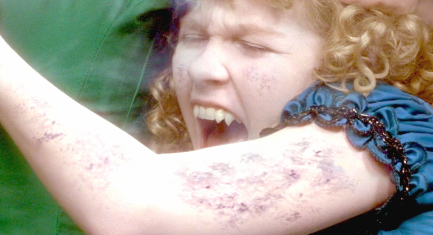
1. She died by sunlight exposure and it seemed extremely painful.
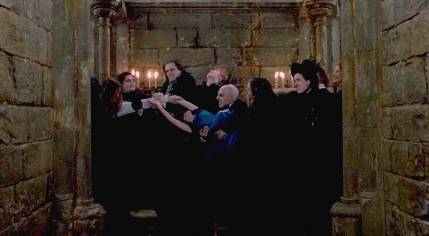
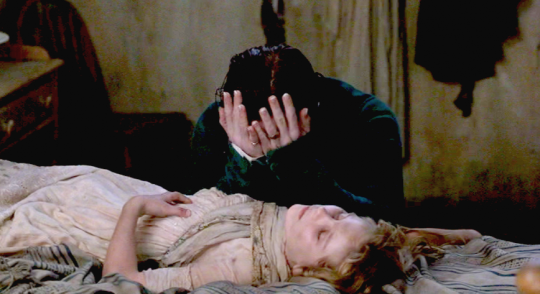
Louis would not have seen it, so he can’t describe the moment of her death in the book, but it’s shown in the movie. Leading up to the death, the tension builds and builds, all these moments where Louis, Claudia and Madeleine are hoping for Armand (or some other deux ex machina) to swoop in and save them all. It doesn’t happen. Probably one of the last shreds of hope they had was when the troupe pull Louis and Claudia apart, from that point on, he can no longer protect her ;A;
As it was so painfully underscored in Claudia’s Story, the last name Claudia hears Louis call for is “Armand,” bc calling her name won’t do them any good. But to her, it feels like a final betrayal, that he’s calling for Armand bc he cares more about him ;A;
Claudia and Madeleine get locked in the well, and when Claudia sees the sunlight approaching, she’s already starting to cry, trying to wake Madeleine to try to figure out a way out… there is none and then they can only brace themselves bc there IS NO ESCAPE ;A;!! The acceptance of their own deaths is part of the tragedy.
It’s a pretty universally nightmarish situation, even though sunlight is not fatal for ppl (most, anyway), but we can all relate to the experience. It’s like being pushed onto subway tracks and not being able to escape in time ;A;
2. Her death was a failure in diplomacy, basically. The Theatre des Vampires, led by Santiago, held a kangaroo court (although they may have felt that they were within their rights) in which they found Claudia guilty of attempted murder of her maker, and decided to punish her with the death penalty.
Louis tried to protect her from it as best he could, he tried to make a deal to save her life, but failed. In the book:
“ `Listen to me, Lestat,’ I began now. `You let her go, you free her… and I will… I’ll return to you,’ I said, the words sounding hollow, metallic.
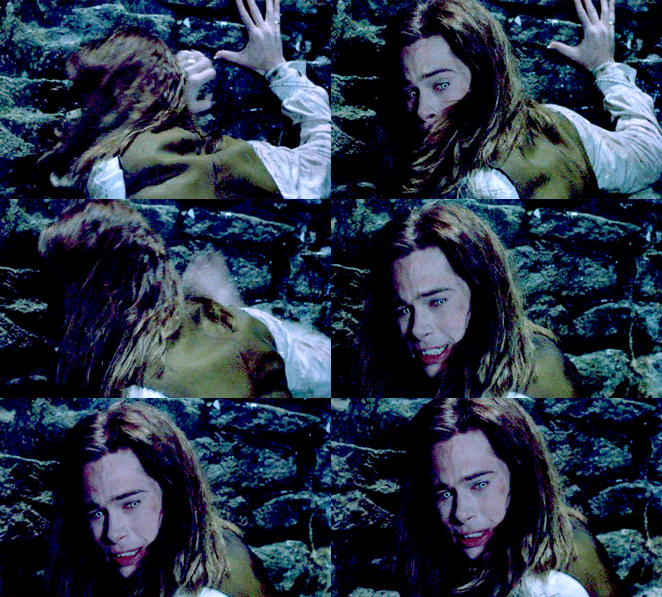
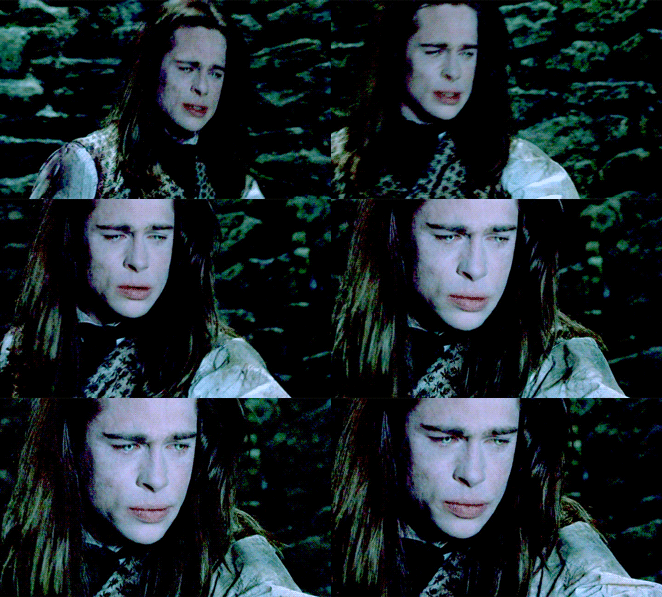
3. It kills a part of Louis when Claudia dies. His immediate reaction is extremely sad (not even factoring in the revenge he takes after).
I have a more thorough commentary on this scene here. It’s in this moment that Louis has lost the most precious person, the one who’s told him what to do, someone he could worship and follow, someone who metered out his doses of happiness with her approval. In the movie, he calls her “my child,” Armand tries to correct him: “Your lover,” and Louis compromises with “My beloved.”
In the book, the next night, Louis finds Lestat clutching Claudia’s bloody dress and sobbing over her death, too. Even though he was the very person who testified against her! Even he could not prevent their “justice.”
“And then I saw the thing in [Lestat’s] hands. I knew what it was. And in an instant I’d ripped it from him and was staring at it, at the fragile silken thing that it was – Claudia’s. His hand rose to his lips, his face turned away. And the soft, subdued sobs broke from him as he sat back while I stared at him, while I stared at the dress. My fingers moved slowly over the tears in it, the stains of blood; my hands closing, trembling as I crushed it against my chest.
Louis was expecting Claudia to go on and live with Madeleine, that he would still be in touch with her and see her occasionally. So that potential continued relationship was destroyed, too ;A;
4. What did Claudia mean to the audience/reader…
I know I sympathized with her and very much enjoyed her overall, and I like to think that other readers/viewers agreed, and don’t totally blame her for her actions against Lestat… after all, she was a victim herself. Lestat doesn’t blame her when he speaks of her in canon. We saw the love they both had for her ❤
Is that enough to convince the readers/audience to care enough for her that her death is sad for them? All those factors help!
This is a tough question for many reasons. It’s hard to know what speaks to you about Vampire Fiction, it may be something different than what speaks to me. I think you should watch the movie again and choose a scene that you love!
As far as the “how that fiction portraits male and/or female characteristics,” I’m not sure what your professor is specifically looking for in that regard. Many of the VC vampires do not necessarily conform to gender stereotypes in the way that they act or present themselves. In the real world, gender presentation can vary widely historically and geographically.*
One example that comes to mind, for me, is Lestat’s turning of Claudia.
Lestat says in the book: “I am like a mother… I want a child!”Are men not equally capable of having that desire? Is it a female characteristic specifically? I don’t know the answer. But this is an example of a scene in which using the book would be better than the movie, because this line was not in the movie.
BTW, this line comes at the end of the often-quoted “Evil is a point of view” monologue, where Lestat talks about the vampires being like God. God creates life, and Lestat wants to do so, too. Is God necessarily female in this regard? I don’t know that either.
In the movie, Louis only tries to stop Lestat in one small, feeble attempt, by catching his hand before it starts, and Lestat places some of the blame on Louis by asking him, “Do you want her to die, then?” Movie!Louis seems to accept some of the blame by allowing Lestat to proceed in ‘giving Claudia another life,’ and we see Louis watch like a nervous father might watch his wife giving birth, with equal parts wonder and horror at the obvious pain involved.
In the movie, his wife had died in childbirth, was he present for that?
Does that then give Louis the male characteristics? This scene happened in a slightly different (but significantly so) way in the book, which I’m not going into since this is already a longish post.
Another example is when Louis carries Yvette out of the plantation house.
^In this scene, it’s evocative of the traditional image of a man carrying his wife across the threshold, away from her friends and/or family, into the home they will share together. Louis is doing it in reverse. He’s carrying her out of the house, bc he has killed her, and is now returning her to her friends and/or family. Later in the movie, Santiago tries to convince a mortal woman to become Death’s Bride. Yvette was one, for sure.
So I would say that Louis has the traditionally male characteristics here.
There is so much more to both of these scenes, in my opinion, but I think I’ll stop here bc I don’t know if you are also supposed to do analysis and I wouldn’t want to do your analysis for you! I hope that’s okay with you, and I hope this answer helped inspire you to choose a scene that speaks to you.
Oh man, that is a lot to ask, and you’re correct in that I have not consumed a wide range of vampire media, especially in terms of historical/geographical/etc.
“A cliché or cliche is an expression, idea, or element of an artistic work which has become overused to the point of losing its original meaning or effect, even to the point of being trite or irritating, especially when at some earlier time it was considered meaningful or novel.”
Vampire fiction is so varied and has so many different rules compared to its first inception that I think it’s pretty free of ideas/elements that have “become overused to the point of losing their original meaning or effect, even to the point of being trite or irritating.”
One cliché is the “I vaaant to suck your blooood!” line that a vampire might say to a victim, originating in vampire movies from decades ago, but it’s more of a comical thing now. It can also be modified slightly to increase the comedy:
I will say that some of my fave vampire media takes existing clichés and/or rules/conventions about vampires, and interprets it in a different way or ignores it completely.
I think it’s more important to consider existing conventions/rules, and how your vampires will operate within them, if at all. I have some stuff mixed into my #vampire physiology tag, but not a complete list.
A few conventions/rules are already widely varied in different vampire media:
Vampires can’t walk around in sunlight –
In most vampire media, vampires exposing themselves to sunlight will get them severely burned or killed immediately.
In Byzantium, I think they can walk around in sunlight with no problems at all.
In Twilight, the vampires are physically able to do so, but they’re dazzling in the sunlight, so they stand out as non-human when they do (and that’s bad bc revealing themselves as non-human could risk harm from mortals).
Vampires require blood to survive, but they are immortal, so “survive” is more like, “a healthy vampire is one that is feeding on a regular basis, but it’s not a requirement.” – I can’t think of an example of vampires that die from not drinking blood regularly… but I think the What We Do in the Shadows and Only Lovers Left Alive vampires will rapidly weaken if they don’t feed often.
Vampires don’t have reflections in mirrors – the Bram Stoker’s Dracula (1992), What We Do in the Shadows, and
Only Lovers Left Alive
vampires
don’t have reflections, but the Interview with the Vampire ones definitely do.
Vampires have to be invited into their victim’s home – Only seen this being an issue in the two adaptations of Let the Right One In.
Vampires are harmed by crosses/crucifixes – Saw this as an issue in the What We Do in the Shadows vampires, that it frightens Deacon that he might be in close proximity to a cross, but it’s unclear what would happen if he touched it. In Fright Night, a vampire touching a cross ignites it in flames but it doesn’t seem to stop him from continuing to attack.
So what I’m saying is that you can explore different conventions/rules of vampires and then pick and choose which you’ll incorporate into your vampires, or invent whole new rules!
I had to think about this one for awhile, bc my immediate reaction was to defend Louis and say: “Oh no, our sweet bb Louis wouldn’t kill a child! Nor a preteen or teens! He may not choose guilty from innocent but surely a teen and under would be safe from him??!”
But he’s NOT a sweet bb. He’s a vampire.
Louis killed Claudia, or attempted to do so. More on that in a bit. The only further explicit reference we have re: his killing methods in canon is in QOTD, when Akasha states that he kills “without regard for age or sex or will to live.“ and since she can read his mind and Louis does not correct her on that statement, I would assume that she’s pinned him accurately.**
(**Note 1: in the scene at the end of book!IWTV (which we still don’t know if it actually happened or not, bc unreliable narrators), Louis takes a baby that a young vampire brings to feed to Lestat, and returns it to its home: “I returned to the small house from which the vampire had taken the child, and left it there in its crib.” So maybe BABIES are safe from Louis!)
(**Note 2: Louis accepts the offer of taking a bite of Denis, Armand’s mortal preteen/teen pet at the Theatre des Vampires, not knowing if Armand intended him to kill this offering or not, but in the book, Louis takes it without any resistance and Armand takes Denis back before Louis can finish him BC HE MIGHT HAVE.)
TL;DR #1: Yes, I do think Louis would kill a lost child/preteen/teen, and I think that the circumstances of such a choice could be worth exploring in fiction.
TL;DR #2: I think it would be unlikely for Louis, on his own, to kill one member of a group of ppl of any age, for the practical difficulty of killing one of them w/o the others noticing and causing a scene. I think this would make his kill more difficult than necessary, as Louis kills perfunctorily, only exerting the amount of time and effort required to satisfy the need:
“I would let the first hours of the evening accumulate in quiet, as hunger accumulated in me, till the drive grew almost too strong, so that I might give myself to it all the more completely, blindly.
“…I lingered only a short while, long enough to take what I must have, soothed in my great melancholy that the town gave me an endless train of magnificent strangers.
“For that was it. I fed on strangers. I drew only close enough to see the pulsing beauty, the unique expression, the new and passionate voice, then killed before those feelings of revulsion could be aroused in me, that fear, that sorrow.” (IWTV)
^If his killing style had changed since then, I think he would have mentioned it to Daniel during the interview.
It also begs the question whether he would kill the elderly, people with disabilities (mental, physical, etc.), and other types of people whose defenses are lowered to some degree, and I think “indiscriminate” applies to all of those categories. Yes to all, Louis kills indiscriminately.
TL;DR #3: Claudia is a child Louis kills (well, attempts to kill) in canon, and her similarity to Anne Rice’s daughter (who died at the age Claudia was turned) was very likely the reason for Anne writing IWTV in the first place. Through the characters in IWTV, I think Anne asked the questions to get the answers to exorcise her demons regarding that loss. Fiction is a safe ground from which we can examine and lance the pain we have experienced in real life and release it, and in sharing the story, we might give others a catharsis, too. I think this novel’s rich exploration of these difficult issues is part of what has made it so beloved by her readers, we can relate deeply with her story in our own ways and feel a catharsis from her explorations.
There are parents who outlive their children bc of these early-childhood diseases (and other reasons) and they have to find a way to go on living, and even trying to be happy again. I’m sure Anne will always experience pain from this loss, but through fiction, she may have been able to achieve enough closure to go on living her life.
I think Anne’s answer for herself at the end of writing IWTV was, “Neither you nor your daughter, nor anyone else, were being punished. Michele was in the wrong place at the wrong time.”
Hit the jump for more, cut for length.
1. “So if a lost child happens to cross his path would he kill them?”
A) I think that Louis feels like he, personally, shouldn’t judge who should die, and that therefore ppl who cross his path of any age are fair game. Louis was very Savage Garden about it before he was aware of the concept. In the Savage Garden, tigers can’t really be held responsible for killing the young, infirm, or elderly of their prey. Vampires are not human, even though they were once human, and some seem very human still… some of them hold themselves to human laws and morality about killing, but some of them do not.
B) If a child is lost at night without a parent or guardian, if the child was as abandoned as Claudia was, I think Louis would probably still kill them. It could be considered a case of the child being in the wrong place at the wrong time.
After all, it would fall under the Savage Garden concept, they’re at risk of more than just being Louis’ dinner. Louis is just another risk out there, maybe scarier because you might be able to reason with him where you can’t with, for example, a virus or a tiger.
C) is for CLAUDIA: While it’s true that Claudia didn’t exactly “cross his path,”
Louis was drawn to her cries and she was a lost child, abandoned by her parents. Her father had left, her mother was dead, and she was defenseless. Claudia might have already been sick with the plague, or might have died from starvation.
One could argue that Louis killing her was more merciful than the slow death she might have suffered if no one had found her ;A; There are situations where death is more preferable to suffering. We don’t know whether she could have been saved from death if brought to the hospital in time; even a hospital and the best medical care is not a guarantee that a life will be saved.
Louis was filled with guilt and shame when Lestat found him with Claudia, and I do think that Lestat turned Claudia to take that guilt from Louis. At that time, this was Louis’ first human kill in years, and Louis might have committed suicide for the guilt of having killed an innocent child if Lestat hadn’t “given her another life.”
2) So if a bunch of punk preteens or teens
happen to cross his path
would he kill them?
As far as “a bunch of punk preteens or teens,” Louis still would not judge them, even though society tends to think less of “punks” for disrupting the peace, vandalizing property, or otherwise purposely causing trouble. So I don’t think they would be targets for Louis specifically because of their “punk” label.
Louis would
probably not be interested in a group of any type or age (even a group of violent middle-aged bikers would be safe!); as it would be difficult to kill one of them in the presence of the others without creating trouble. He goes for people who are out on their own. I don’t think he’d want to go to the effort of coercing one away from the pack.
It’s not canon but I would think Louis can share kills with other vampires now, and he would be able to do so more stealthily with another vampire or two with him, if they wanted to take down more than one victim together, any age.
3) Re: Claudia being Michele Rice: I think that Louis’ attempted killing of Claudia is the major impetus behind IWTV being written in the first place.Anne Rice lost her own daughter at the age Claudia is turned, and Anne was going through the pain of that loss, asking why it happened to her daughter. Had Anne been an irresponsible mother? Was it God’s punishment for Anne (and/or her family) failing to be a devout enough Christian? Was her daughter being punished for some crime?
Was it Satan?? Was it a case of a bad thing happening to a good person?
To my mind, IWTV’s real cornerstone, on which the rest of the story was built around, Anne Rice created muses through which she could ask these questions and try to get the answers.
Anne said she modeled Louis after herself, but he also represented Death. Anne wanted these answers:
Why did Claudia die?! Bc Louis killed her.
Who’s this Louis monster and why did he have to kill her?! Well, he’s a vampire, that’s what they do.
Ok… But why did Louis have to kill an innocent childspecifically?Bc he was a vampire who had been sustaining himself on animal blood for years. and he was in a state of malnutrition and extreme desperation, and this child was nearby and defenseless. She had done nothing wrong.
Also, Louis felt terrible for this, even though he admits to Daniel that the act itself (as all blood drinking is to vampires) was pleasurable. Louis does not bring it up to Claudia herself until she began to rebel and demand answers.
So I think Louis battling with his religious upbringing, whether he was from the Devil, and having so much guilt about killing all victims (especially Claudia!) was a release for Anne, bc she could empathize with the entity she created who killed her child.
If the murderer himself felt guilt over it, that may have helped Anne achieve some measure of peace.
English: I love you
Slovak : Milujem ťa
Finnish: Panisin
Slovenian: Ljubim te
Danish: Jeg elsker dig
Portuguese: Amo-te
Tagalog: Kantotan tayo
Punjabi: Panchod chup kar
Somali: Dhillo iska amus
Arabic: انتا حمار
Spanish: quiero que te ahogues con mi pene
Bangla: Tumi ekta kuthar bacha
Indonesian : Aku cinta kamu
Hindi: Mein ghadhe ka bacha hoon
Pashto: spey pashante khkarey
Urdu: Mujhay tum say mohabbat hai
Tamil: Po da mairu pudungi
Malayalam: Patti kazhuda de mone
Kannada: Nind tale nal gobra thumbide
Telugu: Nee muddilo manta petta
Azeri: Seviram Sani
Russian: иди на хуй (idi na houy)
Bosnian: Mrš u pičku materinu
Marathi: Mi tula prem karate/karato
Kurdish: Ez te hezdikhem
Chinese: 你是个混蛋
Greek: είσαι μαλάκας (ise malakas)
German: Opfere mir dein Erstgeborenes
Swedish: Ät min röv
Romanian: Te iubesc
Norwegian: Jeg elsker deg
Polish : Kocham cię
French : je veux m’étouffer sur ta bite
Lithuanian: Aš myliu tave
Korean: 사랑해 (sa rang hae)
Hungarian: szeretlek
Dutch: Blijf met je vieze tengels van mijn fiets af
Italian: sei un caga coglioni
Hebrew: אני אוהב אותך
Estonia: Ma armastan sind
Latvina: Es tevi mīlu
Croatian: volim te
Japanese: あなたのチンコと遊びたいです。
Latin: amo te
Turkish: Seni seviyorum
I used to think tension and conflict were the same thing. I mean don’t they go together?
Well, a lot of the time they do, but it’s entirely possible to have one
without the other. They often go hand-in-hand, but they aren’t the same
thing. Conflict doesn’t necessarily equal tension, and tension doesn’t
equal conflict.
Lately I’ve been editing stories that seem to have so much conflict and
no tension! I don’t care about the conflicts. I don’t care about the
characters. Because there is no tension.
Tension isn’t the conflict.
A couple of months ago, I wrote this post on Mastering Stylistic Tension. In the comments, Becca Puglisi said:
I learned a long time ago that while conflict and tension are often
considered to be synonymous, they’re different. Tension is key for
winding up the character’s—and therefore the reader’s-emotions.
I admit that for some reason I read it as “Tension is the key for
winding up,” and my mind filled with an actual image of a key winding
something up. Tension winds up. Conflict is problems that collide.
Tension doesn’t need problems to collide, tension is often the promise or potential for
problems colliding. My oldest brother pointed out that there are action
movies that have conflict after conflict, but no tension. They are a
spectacle–blasts, explosions, fire. Then, he went on to say, there are
movies like Jaws that have scenes that work largely off tension.
I said in my Mastering Stylistic Tension post, “In some ways, it’s not the conflict itself that draws readers in, it’s the promise of conflicts,” which is often the tension.
Tension invests us personally in the story. We feel it. It’s
anticipation, it’s hope or dread for what will happen. It’s a tangible subtext or undercurrent for what could happen.
Tension is defined as a straining or stretching; intense suppressed emotions.
Conflict means “to come to a collision;” to fight or contend.
So tension may suggest a conflict, but it is not the conflict itself.
Conflict may be an object, but tension is the key winding it up.
Sometimes writers try so hard to put in so much conflict to make their
stories interesting when what their story needs is tension for the
conflicts they already have.
I’ll give an example from my own experience.
Last year I was working on a sequence of flashbacks for my novel. While
not the main purpose of the flashbacks, it was important that I
illustrate a romantic relationship in them, because the relationship
itself is important to a main character and what happens in the present
timeline. I was stuck trying to figure out how to communicate the
uniqueness and complexity of the relationship in such a short space. In
an old, old version of this story, I had planned to use a lot of
romantic gestures to convey the relationship, but in working on these
flashbacks, I realized that the romance and the conflict it brought
(which deals with “forbidden love”) wasn’t as powerful as the tension it could have.
I scrapped the idea of the characters touching and kissing, and instead focused on their powerful desires to touch and kiss when they weren’t allowed or able to; I gave one of
the characters a particular reason and a personal commitment to not give
the other affection.
The scene immediately became more interesting. The tension was palpable,
their desires electric, but because they could not give into their
desires, the tension couldn’t release, regardless of how much they or
the audience wanted it to.
The conflict is forbidden love, but the tension is held in the drawn out moments of a desire that can’t be manifested.
This is one of the reasons that sexual tension can be so powerful in
stories. It’s not the colliding problems that come with being with that
person, it’s the subtext and undercurrent of wanting to be with that
person, but not being with them. Once the couple is together, that
tension ends.
Likewise, some of the best dialogue comes from tension, not straight-up
conflict. It comes from subtext, from what’s not being directly said.
Once the dialogue becomes direct, the tension ends and the problems
collide in conflict. Tension often comes before direct conflict. And if
that isn’t happening much in your story, it should.
As Mindy Kaling once explained, sometimes the best tension comes from
the characters trying to avoid conflict, from them trying to stop it
from bubbling out into the open. The closer the conflict gets to the
open and the harder a character tries to stop it, the stronger the
tension gets. It winds up, tighter and tighter. We as an audience
anticipate its release.
That’s what draws a reader into the story.
So make sure that your story has tension and conflict, and not just one
or the other. If you have a story with a bunch of conflict, but your
readers aren’t interested, you may need more tension. If you only have
tension and no conflict, the reader may end the story feeling cheated.
Use both.
It seems like you have sort of made up your mind about him, Anon, listing those crimes 😦 If you don’t like him for those reasons, or any reasons, you are under no obligation to change your mind, but I appreciate that you want to understand why ppl do like him.
If you’re on Memnoch then you know most of Armand’s story, and you know that Armand’s book follows MtD. His book goes into his story more deeply, and from his own perspective, and I think that’s part of what ppl like about him. His narration is different than Lestat’s (most of the books are Lestat’s POV or his recording of what others tell him), and I think some Armand fans are just glad to get out of Lestat’s head!! lol.
In TVA, you get more detail and scenes from Armand’s mortal life and fledgling life, and some of what follows. You get how he feels about seeing Lestat in MtD and a moment of intimacy between these two alpha personalities who have had a simmering competition between them since they met.
Some ppl find that Anne Rice has done Armand a disservice in his own book by having him claim any amount of agency in what happened between him and Marius. That’s up to the individual reader to decide, what they think of that relationship, regardless of what the author’s agenda was when she wrote it.
I do think some of the things Armand says in TVA are
somewhat
exaggerated because he is telling the story to David, who was flirting at him really hard in the beginning of that book, and I think Armand wanted to remind David that he’s not the cute bb 17 year old he appears to be, and not to mistake him as such. So the scene describing Claudia, I’m not sure I trust Armand that he really did anything to her other than do nothing when the other vampires of the theatre put her in that sun-well-thingie.
I wouldn’t say that most of the fandom likes Armand. I think that certain characters have waves of popularity, and some are talked about more than others at any given time… there was a period about two years ago, I think, that ppl were all over Nicolas, discussing him, theorizing that he might have survived, etc.
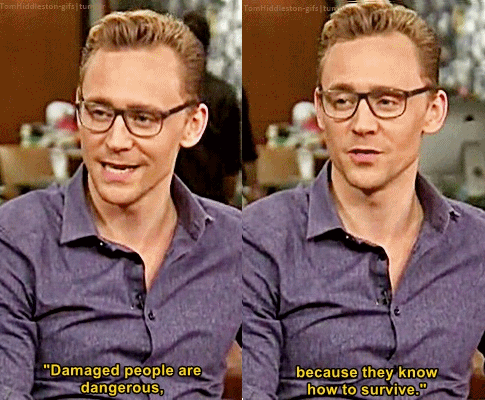
Tom Hiddleston is talking about Loki here, I think, but the concept is captivating, and it applies to Nicki and Armand:
Nicki seemed to be one of the only canon characters that explicitly had a mental illness, and that was during a time on tumblr that ppl were being more open about having mental illness and identifying with fictional characters who also had mental illness.
We are drawn to characters who have traits like ourselves, and/or those that survive, and overcome obstacles when they are faced with challenges like our own.
I think Nicki also represented some of the disillusionment ppl were feeling about the world at large at the time.
It might be that Armand has taken on more of that role, some fans also headcanon that Armand has mental illness(es) and he can also represent fans who feel disillusioned about the world at large, since the world has been so cruel to him.
More on all that later*, so I can address the other part of your statement now.
He (1) cut off Nicolas’s hands, (2) killed Claudia, and (3) kills suicidal people. (I’m not trying to shame anyone, I just want to understand why.)
^Ok, I’m going to address each of these things, since you want to understand. I’ll take it at face value that you’re not trying to shame anyone for liking a fictional character who does those things.
Whether you want to agree with my explanations is entirely up to you. If you judge him by human, real-world standards, yes, each of these things is maniacal and horrible. So my explanations are for FICTION.
NO CUTS WE LONGPOST LIKE MEN.
^I have to stop doing that I’m going to get in trouble.
First off, I would like to point out that I don’t think canon indicates that he takes pleasure in any of those things individually, except for the normal pleasure of that last one, vampires love feeding, there’s no getting around that 😉
(1) He cut off Nicolas’s hands,
This seems like fairly standard vampire punishment from a coven master. @damnitarmand, an Armand RPer, responded very well to this question, I’ll reblog it momentarily.
Armand may have been trying to help Nicki in the ways he knew how. Armand had been a coven master for hundreds of years, dealt with madness from many ages of vampires, maybe this was something that helped in other cases. It could be seen as cruel from our mortal standards, but maybe that was considered a reasonable form of treatment for vampires.
Eleni writes to Lestat in TVL:
“[Nicolas] must be watched constantly so that he does not enlarge our ranks. His dining habits are extremely sloppy. And on occasion he says most shocking things to strangers, which fortunately they are too sensible to believe.“ In other words, he tried to make other vampires. And he didn’t hunt in stealth. “In the main it is Our Oldest Friend [Armand, obviously] who is relied upon to restrain him. And that he does with the most caustic threats. But I must say that these do not have an enduring effect upon our Violinist.”
“…I tell you these things not to haunt you but to let you know that we do our utmost to protect this child who should never have been Born to Darkness. He is overwhelmed by his powers, dazzled and maddened by his vision. We have seen it all and its sorry finish before.”
^So clearly, Armand does everything he can before punishing him so viscerally, and Nicolas really was getting out of control. Eleni even notes that Nicolas is not taking to vampirism very well and would never have been turned by the coven, they’ve had hundreds of years to learn about who can handle it and who can’t, and they have their own system of psychological care, such as it is.
When Armand does take his hands, yes, it’s bc
Armand
has been pushed to being “maddened by the excesses” of Nicki! Not maddened for nothing. There is no indication that Armand takes pleasure in it. Further proof that it’s a standard punishment is when Eleni explains to Lestat that it’s temporary:
“It has come to the worst, as I feared. Our Oldest Friend, maddened by the excesses of Our Violinist, finally imprisoned him in your old residence. And though his violin was given him in his cell, his hands were taken away. But understand that with us, such appendages can always be restored.”
^So for all of the above, I don’t consider Armand’s cutting off of Nicki’s hands as a crime but as a merciful thing that’s standard procedure, albeit probably a last resort, for restoring vampire sanity.
(2) killed Claudia,
^Armand tried to get Claudia a new adult vampire companion when he pressured Louis into turning Madeleine. Armand even admits to Louis that he himself takes the responsibility for Madeleine:
“ `But if it’s any consolation to you … surely you realize I had a
hand in it.’
” [Armand said]
`That I did it to be free of Claudia, to be free to come to you …
yes, I realize that. But the ultimate responsibility lies with me!’ [Louis] said.
“`No. I mean, directly. I made you do it! I was near you the night you did it. I exerted my strongest power to persuade you to do it. Didn’t you know this?’ Woe.
I bowed my head.
‘I would have made this woman a vampire,’ [Armand] said softly. `But I thought it best you have a hand in it. Otherwise you would not give Claudia up. You must know you wanted it…
“ `I loathe what I did!’ I said. ” `Then loathe me, not yourself.’
^To me, Armand’s plan was to have Madeleine take Claudia off of Louis’ hands, so that Louis could still communicate with Claudia but not be responsible for her anymore.
I do think that the theatre vampires, led by Santiago, had other plans in mind, and that Armand had to cut his losses and let them kill Claudia since they were bloodthirsty for it. It’s exciting to kill vampires, as Santiago has said. Armand probably knew also, as a coven master, that it was a crime to turn a child anyway, and that she would have died at some point anyway (she might have even taken her own life).
(3) and kills suicidal people.
^In canon, yes, it’s described as Armand calling to those who wanted to die. Whether they could have been saved by actual medical care, or psychological therapy, I don’t think that’s addressed in canon. So here you might have an actual crime, of him killing innocent ppl who are consenting to death but not really capable of consenting to death.
This is his approach to the dilemma of being a vampire and needing to kill ppl on a regular basis, there’s a few options for doing it in canon:
Take lots of Little Drinks, if you’re capable of that, and not kill anyone,but spend like 3x the amount of time every night having to find that many more ppl to feed from. For awhile, it seemed like Louis wasn’t capable of this, since he gets so caught up in the swoon that he can’t stop. He might be able to now, tho.
Kill evildoers – bc “they deserve it anyway!” and you’re “protecting the innocents!”, but you still have to struggle to find the ones that deserve the death penalty, do drug dealers deserve to die for selling pot? In TOBT, Lestat kills someone who’s a serial elderly rapist/murderer, one would think that evildoer is evil enough to deserve the death penalty, but everyone is entitled to a defense attorney under U.S. law.
Kill indiscriminately, anyone who crosses your path, and don’t judge, bc they’re in the wrong place at the wrong time – Louis’ method bc he won’t judge evilness, lacking the Mind Gift but also, he doesn’t think he should be making that choice.
Kill innocent ppl – not very nice but some vampires do that. Claudia did.
Kill ppl who want to die as a form of assisted suicide; they are consenting to death – Armand is doing this, at least mentioning it in TVL and again in TVA. Medically assisted suicide is a very controversial thing but it is legal in some countries, and it reduces the prolonged suffering of terminally ill ppl. From wiki: “The three most frequently mentioned end‐of‐life concerns reported by Oregon residents who took advantage of the Death With Dignity Act in 2015 were: decreasing ability to participate in activities that made life enjoyable (96.2%), loss of autonomy (92.4%), and loss of dignity (75.4%).”
Armand’s killing method described in TVL:
[Armand] had perfected the act of
killing beyond the abilities of all the Children of Darkness that he knew. He
had learned to summon those who truly wished to die. He had but to stand near
the dwellings of mortals and call silently to see his victim appear. Old,
young, wretched, diseased, the ugly or the beautiful, it did not matter because
he did not choose. Dazzling visions he gave, if they should want to receive,
but he did not move towards them nor even close his arms around them.
Drawn inexorably towards him, it was they who embraced him. And when their warm
living flesh touched him, when he opened his lips and felt the blood spill, he
knew the only surcease from misery that he could know. It seemed to him in the
best of these moments that his way was profoundly spiritual, uncontaminated by
the appetites and confusions that made up the world, despite the carnal rapture
of the kill. In that act the spiritual and the carnal came together, and it was
the spiritual, he was convinced, that survived. Holy Communion it seemed to
him, the Blood of the Children of Christ serving only to bring the essence of life
itself into his understanding for the split second in which death occurred.
I think Armand’s assisted-suicides were mostly emotionally-driven, I don’t think canon goes into much further detail about it. I would think that Armand is killing ppl who are truly beyond saving, and the time period in which he’s doing it is not one that handled mental healthcare the way we do now. So at that time, that was probably not considered a crime, but a mercy killing.
Currently, his decision to kill “those who wish to die” (and possibly, he influences that on them), yes, he might be killing innocent ppl who might have had a chance at living otherwise.
Armand in TVA, more modern-era, is now killing an evildoer/drug addict:
Now I had to have blood. There was no time for the old game, the game of drawing out those who wanted to die, those who truly craved my embrace, those in love already with the far country of death of which they knew nothing.
…The next [victim] was a common desperate youth, full of festering sores, who had killed twice before for the heroin he needed so badly as I needed the doomed blood inside him.”
We don’t have as much information on whether he’s more of a “kill the suicidal” or “kill the evildoer” in current canon. In the TVA example above, the victim has killed “for the heroin,” so he’s an evildoer anyway.
*SO WHY DO PPL LIKE ARMAND??? O____O
Why do ppl like peanut butter? Or not like it? Some ppl are allergic to peanut butter. There are so many reasons to like a character!
We’re drawn to characters for any number of reasons!
I think this current crop of tumblr VC fans is talking about Armand more bc he is also a victim of CSA, has undergone an enormous amount of trauma in canon, and survived it, even becoming a coven master in the cult that brainwashed him for centuries. It’s inspiring to see a character carry the weight of all that damage and seem to overcome it and, even, become strong and confident, and even happy, at least sometimes. There’s no denying there’s a lot of sass in Armand.
Maybe fandom wants to embrace him and comfort him and give him all the happiness they would want themselves to have. It’s easier to project it onto a fictional character, and see it reflected back when you imagine him, in fanart or fanfic.
Imagining Armand enjoying himself, exploring technology with Daniel or playing videogames and elbowing Lestat to try to mess him up on coven game night, all of his past is still inside him but he’s trying to make the best of things, trying to have a family, such as it is, trying to find his purpose in life. Isn’t that what we’re all looking for? A home. And I think we like to see characters like ourselves find home and feel wanted, at least some of the time.
Dude! Just write some stuff. 😀 😀 This is a teeny little sleepy fandom and it is so thirsty for more content, just do it! You can do it! We all want you to write fic!!!!!!
…Fanfiction is awesome to flex your writing muscles a bit and get some practice in, and it’s helpful because it invites attention and feedback. It’s also easy to apply flash fiction or drabbles to fanfic because we don’t need exposition and backstory. Like, yeah! WE GET IT, WE KNOW! Quit dicking around and just jump into the story, we already want it! This is so valuable when it comes to just getting WRITING done and you really don’t even need a plot. You can elaborate on the teeniest mental images, headcanons, goofy or angsty situations, and that’s all it has to be! No one expects it to win a Pulitzer, it’s okay if it isn’t perfect!
In fact!!!!!!!!!! It shouldn’t be perfect! And you are not going to get better if you do not start somewhere!
I still get really nervous when I post fics and I doubt my abilities BASICALLY CONSTANTLY ALL THE TIME LOL but good and bad feedback are imperative to honing your craft and learning your strengths and finding things to fix. PLUS LIKE, it can really help to motivate you if you get some people on your side who like what you’re doing! Like I am consistently sappy and overwhelmed by the response to my fics and it’s what keeps me writing. 🙂 🙂 🙂 🙂
Anyway idk man, here’s an ungraceful dismount to my post lmfao but, listen!
Write! Do it! Share it with us we are thirsty.
^*APPLAUDS* Rules are made to be broken. Write the way you want! I had a teacher who told me that to begin a sentence with “And” was blasphemy, illegal. punishable by DEATH practically, but I know Anne Rice does it OFTEN, in published fiction, so that teacher was wrong. Maybe she was just trying to start us off with the rules so we could then break them. Probably that.
Even though I write fanfic myself, I have my own tastes about it. Writing fic is an art in itself, you’re creating smtg, like sculpture or cooking, and as such it’s very subjective. There are courses taught on writing in schools at all levels, books written about writing, so while I can’t give you a thorough and objective answer in a short blog post… I can give you this much and NO CUTS WE LONGPOST LIKE MEN.
For me, writing is about 1 or more of these basic setups, sometimes combined and interwoven:
(a) presenting a problem and exploring it,
(a) presenting a problem, exploring it, and (b) offering a solution,
(a) presenting a problem, exploring it, (b) offering what the author feels is a BAD solution and (c.) showing the consequences of that bad solution.
^That’s all you really need. Everything else is in service to that. Even the fluffiest fanfic has some issue, even if that issue is just, “What shirt am I going to wear tonight?” Mundane, probably, but hey, it’s still a decision that needs to be made! 😉
~My-own-taste-based advice on writing fanfic~
Fluff tastes better with at least a dash of angst, Angst tastes better with at least a dash of fluff, etc. A friend of mine took a cooking class and was told that salt brings out the flavor in other ingredients. I definitely think that corresponds with fic. I’m not saying to use every ingredient at your disposal, but in an angsty scene, can you toss in one character trying to placate the other by doing smtg fluffy, idk, bringing them flowers?
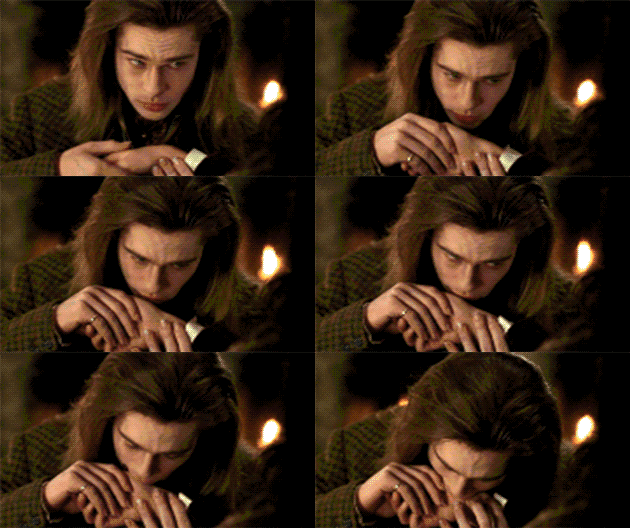
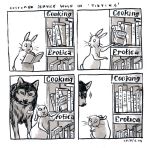
^X A flower offering might get rejected by the recipient in the scene (or it could provide ammunition!), but just the act of doing that can enhance the scene by so much. I MEAN LOOK AT THIS PICTURE. Is there not a rich story here??
Use epithets sparingly. PLEASE just use their names if you don’t want to use their gender pronouns. I can’t tell you how far it kicks me out of a fic when I see “the elder vampire” or “the brunette” so many times in close proximity bc it fixates the reader on those characteristics, which generally have nothing to do with the scene itself. YES I KNOW SHE’S OLDER/YES I KNOW HER HAIR IS BROWN. SO WHAT?? Even when it’s two characters of the same gender in a scene alone together, your reader can usually figure out by context which “he” you mean when you write: “he reached up and touched his shoulder” One way to do it is by leading with one of the characters in the para, so it’s clear who’s doing the actions in it, ’[Name 1] tentatively went in for a hug. He reached up and touched his shoulder.’ In the next para, the other character can take over the action. ’[Name 2] batted the offending hand away. “Don’t touch me!”’
“Said” is not a curse word. Go ahead anduse other words for “said,” but too many ‘“Oh!” she cried’ ‘“Oh!” she moaned’ also kicks me out of a fic bc I become more aware of the writer sitting there trying to impress me. “Said” is just a notification that it’s a spoken word, let me breeze past it, it’s okay, really. Don’t let your “said” substitutes do so much of the work that the words of dialogue should be shouldering.
Purple prose when it matters. A fic with all dialogue and little descriptive details can read like a report. If you’re going for that, good! But purple prose adds texture and helps immerse the reader. Readers don’t need it in every para and every line of dialogue, it tends to slow down the action. It can be used to great effect, maybe describing the interior of a room gives a nice pregnant pause in the dialogue to increase the tension. Just don’t drown the reader with it unless you’re doing it for a reason.
To return to my earlier point, What is the purpose of your fic? Even if you’re just aiming for the fluffiest fic, I feel like it gives it a little extra substance if there’s some underlying thing/moment you’re exploring.
I did a fic about Louis, Lestat, and Claudia getting ready for Halloween, but I also included some exploration of Claudia getting upset and missing her mother, and that led to her being informed that Louis and Lestat also missed their own mothers.It’s one of those defining but subtle moments in everyone’s life, when you realize your parents were also children with parents of their own. So the fic was not just about the premise “dressing up for Halloween,” but what other things that could stir up, and what we can reveal about the characters whether or not it was explicitly given to us in canon. In this instance, we didn’t get this in canon, this was in the interstices of canon.
Anon, start slow, dip your toe in, look at fic you love and try to figure out what makes it so good for you! Don’t be afraid to fail.
I’ve collected some somewhat more objective things in my #on writingtag, so you might try there, but again, those are things that I probably agree with, too 😉












 I-want-my-IWTV
