Canonically, we have Word of God from the author re: birthdays for 3 of them:
Lestat’s birthday is November 7, the birthday of Anne Rice’s late husband Stan (whom she partially modeled Lestat after).
Louis’ birthday is October 4, which is Anne’s birthday.
Claudia mentions her birthday in her diary (in QOTD) as beingSeptember 21, but she’s not sure if that’s really her birthday and her dads won’t explain it further (it’s probably the day she was turned, given the context of the diary entry). That’s Michele Rice’s birthday, Anne’s late daughter.
So that means (according to astrology-zodiac-signs.com, idk if it’s authoritative):
Lestat’s a Scorpio – the most lusty/sexual sign, brave, passionate, stubborn, violent, jealous, secretive, resentful, manipulative ✓YEP
Louis is a Libra – the scales, justice, contemplative, Cooperative,diplomatic, gracious, fair-minded, social, Indecisive, avoids confrontations, will carry a grudge, self-pity ✓YEP
Claudia is a Virgo – a virgin, strong, practical, detail-oriented ✓YEP
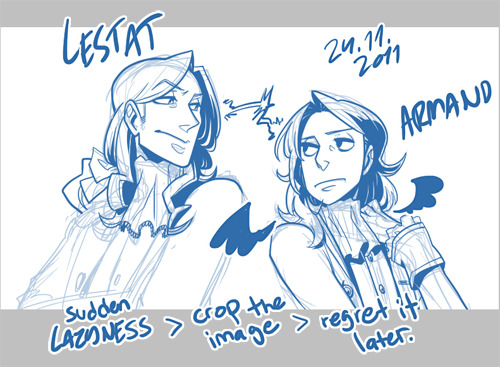
There’s fanon that Armand’s birthday is Nov. 11 (@auburnandamberangelposted about it last yr, but I think it’s a fanon thing as well), and I like that it would be that close to Lestat’s on the calendar, another source of contention between them, that they’d share the same zodiac sign >;}
Armand WOULD HATE following Lestat on the calendar, like, c’mon, Lestat would throw a HUGE BALL for himself (you KNOW he would), and then like 4 days later, Armand wants to have a big party… and everyone is like… ~Meh we just HAD one~… (They all went home already)(poor Armsy ;A;)
So Louis suggests to Lestat that he share! And have a bday party for both of them in between, on like 11/9. And Lestat is all pouty like “WHY SHOULD I SHARE WHEN MINES FIRST?? 11/9 WILL BE TOO LATE FOR MINE”
So, erm, I didn’t read the HP books, only saw some (maybe all, by now) of the movies ;A; So I’m not qualified to have an opinion or even qualified to properly summarize/sort other ppl’s opinions on this.
However! I’ve been asked about this before tho so check these answers out:
^I STILL think Claudia would end up in the same house as Lestat, continuing the tradition like the Malfoy line does, but I could be wrong on that. The sorting hat would be taking a LONG time w/ Claudia, tho.
Anyone is invited to sort our beloved characters! Do the thing (ノ^ヮ^)ノ*:・゚✧
Oh definitely! And I think you’re right that Armand and Louis would have had their own little moments throughout the time they were together, the art, inventions, social progress, etc. of the early-mid 20th century… there would have been highlights for them, they would have taken little mementos or made records of these times* :,)
I think there’s a reason AR chose to have Lestat effectively sleep through that time period
(”sleep” isn’t quite right, as he was more or less conscious but he was basically in his own little bubble, hiding from the world, buried in comic books). There’s no way Lestat wouldn’t have gained notoriety of some kind if he’d been his usual, confident, glittery-murder-machine self! I think she wanted to skip to the era that fashion and art and all that had really reached a peak that it had been steadily growing towards, and then she would be able to slam it at Lestat in the avalanche that he expresses it is in TVL.
I mean, (skipping over the 1940′s bc WWII, and the world beginning to rebuild itself from war**) the fashion of the 50′s would have been very appealing, the music, the inventions, the art…
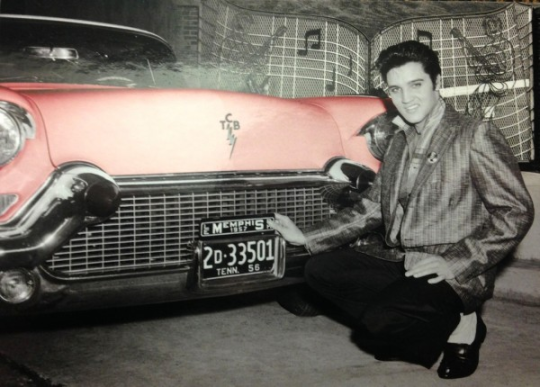
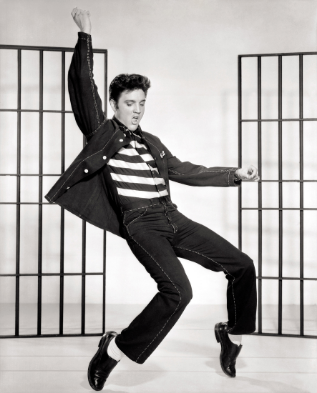
^Lestat would have LOVED Elvis’ music, and his iconic pink Cadillac, for sure. Aesthetically, that car was so organic (while also having a touch of space-age smoothness!) and sensuous curves, and the color being so unashamedly bright and joyful following such dark times re: WWII, it was a triumph of the human spirit. I pick this car as iconic of the ‘50′s bc I think it was part of the zeitgeist of that time and had international influence.
^And Elvis’ outfits (which got progressively more glamorous ok Lestat would have copied inspired ALL THOSE LOOKS)
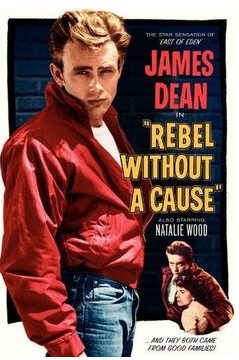
^And then of course James Dean and the Bad Boy/Greaser appeal ;D
Lestat being underground through all this kind of reminds me of the whole god-of-the-grove thing that Marius described the druids imposed on their captive vampires, that the periods during which a vampire rests underground, malnourished, absorbing the world above in a dream-like state, are as natural and cyclical as having autumn & winter precede the vitality of spring & summer. When Lestat rose up in the mid-80s the world was a more vibrant place in many ways than when he’d gone to ground to hibernate, and he was ready to take it all in and join it.
A few more thoughts on all this under the cut, cut for length.
**I had to skip over the 40′s bc I think AR had Lestat out of the picture then for the general policy that she doesn’t address current political conflict in VC.
War is an abstract in the books and I don’t blame her for choosing not to have any of her vampires visibly suiting up for human wars. It would be a complicated thing to tackle, to say the least. How do you explain to your superiors that you have to sleep all day and can fight all night?! How do you choose which side to fight on when you’re providing such an unfair advantage in your preternatural abilities?
That’s partly what the whole confrontation with Akasha in QOTD was about, the VC vampires stating that they have no right to participate in mortal conflicts since they aren’t mortal anymore, and I have to agree on that. Daybreakers had vampire soldiers and idk if that really worked out all that well, I’d have to watch it again to have a proper opinion but I remember it feeling very cringey the whole time I was watching it 😛
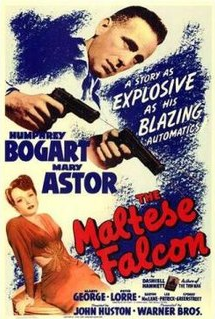
^AR acknowledges that Lestat was reading comics from the 1940′s, and I’m sure he had his fave actors like Cary Grant and Humphrey Bogart, and fave actresses (you KNOW HE LOVED JOAN CRAWFORD AND BETTE DAVIS LIKE C’MON). And it seemed like those comics helped to get his spark of lust for life back, he wanted to be the Good Guy he saw in those comics. I’m not well-read on those, but from what I understand about them, the Good Guy made mistakes, and was not necessarily all that civilized all the time, but he tried to be good, and usually succeeded. And he looked good doing it 😉
*Louis/Armand for 100 years: This was probably somewhat like what Armand later did with learning about the world with/through Daniel, but I think Armand held back with Louis for many reasons, partly bc it seemed like Louis/Armand was so fragile. Armand learned that holding back like that can weaken an already tenuous connection (what good did all that holding back really do for either of them?) so I think that’s why we see Armand being more outwardly curious/open-minded with Daniel; the reward for revealing yourself is that you give a person more reason to stay with you, as much as it is the risk of giving them more reason to leave you, but that’s partly how you strengthen the relationship ❤
Hmmm… I haven’t seen him act in anything so idk how he is as an actor, I watched the trailer for one of his upcoming movies, Lean on Pete, he plays a 15 yr old in that movie.
^These pics are from 2017, so they’re pretty recent. I think Charlie has an unconventional look, very unique features, with the wide nose, full lips, a prominent forehead and a soft jawline. Re: the mouth, specifically, Lestat describes his mouth as “well shaped but just a little too big for my face. It can look very mean, or extremely generous, my mouth.” Maybe Charlie’s would match that description?
The nose doesn’t match as Lestat has “a fairly short narrow nose”. Now, Tom Cruise wasn’t the right height and he did an amazing job, so sometimes talent outweighs physical deficiencies. But in Tom’s case, they could give him heels, an easier thing to adjust. Tom ALSO had a prominent nose, definitely not short or narrow. And it didn’t stop him from doing an acting job that earned him the glowing praise from Anne Rice herself, who had been very against his casting.
I don’t know if you find Charlie attractive physically, Anon, but there is a recent trend in casting unconventionally attractive actors. While I think the title is a little unnecessarily click-baity, in the article “MILLENNIAL’S GUIDE TO FILM: THE AGE OF THE UGLY ACTOR” Marina B. writes:
Sometimes there aren’t really words to explain why we find someone intriguing, they just have that je ne sais quoi that pretty boy actors can’t achieve. I feel like Adam Driver has that something special, and I’m not alone. Scorsese can back me up on this one. Scorsese can be quoted giving some serious admiration for Driver that he discovered when casting for Silence:
“I love the way he moves, his sense of himself on camera… he also has that remarkable baritone voice. He’s talented, of course, and very, very brave.” -Martin Scorsese
We also have growing antagonists. Caleb Landry Jones is for sure the go-to gross, delinquent star in film lately. He played the crazy brother in both Get Out and American Made. He goes absolutely ape shit with the roles he’s given; there is no amount of crazy that he isn’t willing to take on for a character.
^All that aside, I think Charlie Plummer looks a little too young to play Lestat yet, in both his face and his body. Lestat was a hunter in life, and had to have some muscle for that. We could get a trainer for our eventual actor for Lestat, tho!
Anon, while I always had Lestat in mind as being a conventionally attractive “pretty boy,” you might be onto something. A screen test would be the real determining factor 😉
Oh man, that is a lot to ask, and you’re correct in that I have not consumed a wide range of vampire media, especially in terms of historical/geographical/etc.
“A cliché or cliche is an expression, idea, or element of an artistic work which has become overused to the point of losing its original meaning or effect, even to the point of being trite or irritating, especially when at some earlier time it was considered meaningful or novel.”
Vampire fiction is so varied and has so many different rules compared to its first inception that I think it’s pretty free of ideas/elements that have “become overused to the point of losing their original meaning or effect, even to the point of being trite or irritating.”
One cliché is the “I vaaant to suck your blooood!” line that a vampire might say to a victim, originating in vampire movies from decades ago, but it’s more of a comical thing now. It can also be modified slightly to increase the comedy:
I will say that some of my fave vampire media takes existing clichés and/or rules/conventions about vampires, and interprets it in a different way or ignores it completely.
I think it’s more important to consider existing conventions/rules, and how your vampires will operate within them, if at all. I have some stuff mixed into my #vampire physiology tag, but not a complete list.
A few conventions/rules are already widely varied in different vampire media:
Vampires can’t walk around in sunlight –
In most vampire media, vampires exposing themselves to sunlight will get them severely burned or killed immediately.
In Byzantium, I think they can walk around in sunlight with no problems at all.
In Twilight, the vampires are physically able to do so, but they’re dazzling in the sunlight, so they stand out as non-human when they do (and that’s bad bc revealing themselves as non-human could risk harm from mortals).
Vampires require blood to survive, but they are immortal, so “survive” is more like, “a healthy vampire is one that is feeding on a regular basis, but it’s not a requirement.” – I can’t think of an example of vampires that die from not drinking blood regularly… but I think the What We Do in the Shadows and Only Lovers Left Alive vampires will rapidly weaken if they don’t feed often.
Vampires don’t have reflections in mirrors – the Bram Stoker’s Dracula (1992), What We Do in the Shadows, and
Only Lovers Left Alive
vampires
don’t have reflections, but the Interview with the Vampire ones definitely do.
Vampires have to be invited into their victim’s home – Only seen this being an issue in the two adaptations of Let the Right One In.
Vampires are harmed by crosses/crucifixes – Saw this as an issue in the What We Do in the Shadows vampires, that it frightens Deacon that he might be in close proximity to a cross, but it’s unclear what would happen if he touched it. In Fright Night, a vampire touching a cross ignites it in flames but it doesn’t seem to stop him from continuing to attack.
So what I’m saying is that you can explore different conventions/rules of vampires and then pick and choose which you’ll incorporate into your vampires, or invent whole new rules!
UPDATE: Got an anon message adding to the this post, here’s their info: (I reformatted their answer into nicer formatting than asks allow)
Regarding sunlight: In the original Dracula novel, sunlight actually didn’t hurt vampires, but it neutralized their powers. Dracula couldn’t transform while the sun was up, except at dawn, exact noon, and sunset, but as I recall, he still had his superhuman strength/speed/etc and was able to flee our team of heroes.
Regarding needing blood but being immortal: In Dracula and some other media, the vampires not only weaken, but age if they don’t feed. In the novel, Dracula looks like an old man when Harker first meets him, but turns young as he feeds regularly.
Regarding crucifixes: I’ve seen a instances with twists on this relating to faith. In one, the crucifix was harmless because the person using it had weak faith in God. In another, crosses and such only hurt the vampire if the vampire feared them, and faith was considered truly frightening. Two of the vampires went to church regularly to keep up their human guise, and one of them holds a cross in his hand with no issue, but a younger vampire is too scared of a cross to pick it up.
This is a tough question for many reasons. It’s hard to know what speaks to you about Vampire Fiction, it may be something different than what speaks to me. I think you should watch the movie again and choose a scene that you love!
As far as the “how that fiction portraits male and/or female characteristics,” I’m not sure what your professor is specifically looking for in that regard. Many of the VC vampires do not necessarily conform to gender stereotypes in the way that they act or present themselves. In the real world, gender presentation can vary widely historically and geographically.*
One example that comes to mind, for me, is Lestat’s turning of Claudia.
Lestat says in the book: “I am like a mother… I want a child!”Are men not equally capable of having that desire? Is it a female characteristic specifically? I don’t know the answer. But this is an example of a scene in which using the book would be better than the movie, because this line was not in the movie.
BTW, this line comes at the end of the often-quoted “Evil is a point of view” monologue, where Lestat talks about the vampires being like God. God creates life, and Lestat wants to do so, too. Is God necessarily female in this regard? I don’t know that either.
In the movie, Louis only tries to stop Lestat in one small, feeble attempt, by catching his hand before it starts, and Lestat places some of the blame on Louis by asking him, “Do you want her to die, then?” Movie!Louis seems to accept some of the blame by allowing Lestat to proceed in ‘giving Claudia another life,’ and we see Louis watch like a nervous father might watch his wife giving birth, with equal parts wonder and horror at the obvious pain involved.
In the movie, his wife had died in childbirth, was he present for that?
Does that then give Louis the male characteristics? This scene happened in a slightly different (but significantly so) way in the book, which I’m not going into since this is already a longish post.
Another example is when Louis carries Yvette out of the plantation house.
^In this scene, it’s evocative of the traditional image of a man carrying his wife across the threshold, away from her friends and/or family, into the home they will share together. Louis is doing it in reverse. He’s carrying her out of the house, bc he has killed her, and is now returning her to her friends and/or family. Later in the movie, Santiago tries to convince a mortal woman to become Death’s Bride. Yvette was one, for sure.
So I would say that Louis has the traditionally male characteristics here.
There is so much more to both of these scenes, in my opinion, but I think I’ll stop here bc I don’t know if you are also supposed to do analysis and I wouldn’t want to do your analysis for you! I hope that’s okay with you, and I hope this answer helped inspire you to choose a scene that speaks to you.
Oh man, that is a lot to ask, and you’re correct in that I have not consumed a wide range of vampire media, especially in terms of historical/geographical/etc.
“A cliché or cliche is an expression, idea, or element of an artistic work which has become overused to the point of losing its original meaning or effect, even to the point of being trite or irritating, especially when at some earlier time it was considered meaningful or novel.”
Vampire fiction is so varied and has so many different rules compared to its first inception that I think it’s pretty free of ideas/elements that have “become overused to the point of losing their original meaning or effect, even to the point of being trite or irritating.”
One cliché is the “I vaaant to suck your blooood!” line that a vampire might say to a victim, originating in vampire movies from decades ago, but it’s more of a comical thing now. It can also be modified slightly to increase the comedy:
I will say that some of my fave vampire media takes existing clichés and/or rules/conventions about vampires, and interprets it in a different way or ignores it completely.
I think it’s more important to consider existing conventions/rules, and how your vampires will operate within them, if at all. I have some stuff mixed into my #vampire physiology tag, but not a complete list.
A few conventions/rules are already widely varied in different vampire media:
Vampires can’t walk around in sunlight –
In most vampire media, vampires exposing themselves to sunlight will get them severely burned or killed immediately.
In Byzantium, I think they can walk around in sunlight with no problems at all.
In Twilight, the vampires are physically able to do so, but they’re dazzling in the sunlight, so they stand out as non-human when they do (and that’s bad bc revealing themselves as non-human could risk harm from mortals).
Vampires require blood to survive, but they are immortal, so “survive” is more like, “a healthy vampire is one that is feeding on a regular basis, but it’s not a requirement.” – I can’t think of an example of vampires that die from not drinking blood regularly… but I think the What We Do in the Shadows and Only Lovers Left Alive vampires will rapidly weaken if they don’t feed often.
Vampires don’t have reflections in mirrors – the Bram Stoker’s Dracula (1992), What We Do in the Shadows, and
Only Lovers Left Alive
vampires
don’t have reflections, but the Interview with the Vampire ones definitely do.
Vampires have to be invited into their victim’s home – Only seen this being an issue in the two adaptations of Let the Right One In.
Vampires are harmed by crosses/crucifixes – Saw this as an issue in the What We Do in the Shadows vampires, that it frightens Deacon that he might be in close proximity to a cross, but it’s unclear what would happen if he touched it. In Fright Night, a vampire touching a cross ignites it in flames but it doesn’t seem to stop him from continuing to attack.
So what I’m saying is that you can explore different conventions/rules of vampires and then pick and choose which you’ll incorporate into your vampires, or invent whole new rules!







 I-want-my-IWTV