preparing for reading this fic like it’s a romantic evening in, I’m making a special meal in the actual oven and I’m gonna wear my favourite outfit (my pyjamas) and dim the lights and put on music I might even pour a glass of wine
someone’s getting laid this evening and it’s my favourite fictional character
Anything bad that’s happened to me, I try to put it in my work, and afterward, I feel lighter. It’s like spring cleaning. I
think that’s what all artists do—it’s a way to communicate their
feelings, a way to use their heart and get things out.
First off, darkfic as an umbrella term encompasses a lot of subjects and ‘dark’ topics, abuse being only one of many. It may be therapeutic for people who’ve endured abuse, but it can also be helpful for people who’ve struggled with other forms of trauma, or with mental illness, or other negative things. Depictions of intense, dark experiences can serve as a catharsis by being a direct analog for one’s own experiences, but they can also function more indirectly as a parallel, or a metaphor. Someone who has not been assaulted, but who has struggled with mental illness, may find a story about an assault victim resonating with them as they can identify with the fear and lack of control. And someone who has never been through a specific traumatic experience, but has a lot of fear of it and cultural anxiety around it, may feel bolstered by stories of characters surviving and recovering from that experience.
So for many people, with many different experiences, there can be a direct, therapeutic/comforting benefit to darkfic.
But darkfic doesn’t need to be therapeutic.
There are, of course, other kinds of benefits. Someone who has never been abused might read a story featuring abuse (and clearly tagged for it) and because of it, identify potential warning signs in a real life relationship down the road and know to get out early before things get worse. Or, they might develop a better understanding of what abuse victims go through and as a result, have more empathy for real-life survivors they encounter.
But it’s also 100% ok to like darkfic purely for entertainment value! It is, after all, fiction.
Dark stories challenge us – and we can really enjoy that challenge. They take us to extremes of emotion and the human experience. They plumb the depths of the human id. Even someone with the most charmed life still lives in a world where bad things happen, and even the sweetest, naive person has the capacity for darkness in them. Darkfic lets all of us explore those in relative safety. It makes us feel, and can thrill and horrify us as much as any thriller or horror movie. It can make us consider our own darkness, and be more aware of it. And it can take us to a place so much worse than our reality, that when we resurface into our mundane lives, there’s a sense of relief; we’ve escaped from our escapism, and our hum-drum lives seem so much better and more manageable by comparison.
Plenty of people create dark content who aren’t abuse survivors. There are books with very dark themes that are written by, edited by, published by, and consumed and made popular by people who have not been abused, but which may prove a lifeline for a survivor – one that might not have existed if the entire genre was limited to only people with lived experience. And by accepting that anyone can produce or consume dark content, we allow survivors the protection of anonymity, by not forcing anyone to disclose and reveal their trauma in order to justify liking a work without being harassed and shamed for it. Creating an exclusive club of heavily-scrutinized creators and readers who have to be ‘this traumatized to ride’ helps no one. Hell, trying to pass moral judgement on anyone by scrutinizing the potential reasons they may have for enjoying certain kinds of fictional reading material, rather than looking at their actions toward real breathing human beings, is utterly inane. Especially when fiction – including, and sometimes especially dark fiction – can be used to expand our horizons beyond our own lived experiences make us more thoughtful, empathetic people on the whole.
I think there are many ways to make a character’s death really sad, and bc we can all have different feelings about a given character, any individual reader will be very sad about the death, when another reader might be totally indifferent (or even glad!). I’ve only written fanfic myself, and I know what makes me sad when I read/write character death, that’s about as informed as I am on the topic, DISCLAIMER: I’m not a professional writer and this is not professional advice.
💀 Some things that come to mind re: making a character’s death really sad: 💀
How they die,
How preventable their death was,
How other characters feel their loss and/or the loss of their potential,
And how much that character meant to the reader/audience, did they like the character?
I don’t know what specifically you’re doing in the Memnoch timeline… I won’t use any examples of deaths from that book in case of spoilers (Idk sometimes I’m more respectful about spoiling ppl than other times *shrugs*)
In IWTV, it was a very sad death when Claudia died. It’s portrayed differently in the book(s) and the movie, but I’m just going to address it re: the points above generally and drawing from both.
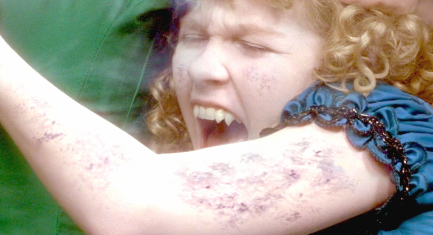
1. She died by sunlight exposure and it seemed extremely painful.
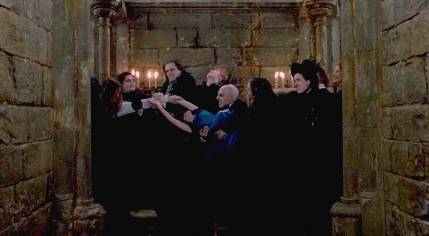
Louis would not have seen it, so he can’t describe the moment of her death in the book, but it’s shown in the movie. Leading up to the death, the tension builds and builds, all these moments where Louis, Claudia and Madeleine are hoping for Armand (or some other deux ex machina) to swoop in and save them all. It doesn’t happen. Probably one of the last shreds of hope they had was when the troupe pull Louis and Claudia apart, from that point on, he can no longer protect her ;A;
As it was so painfully underscored in Claudia’s Story, the last name Claudia hears Louis call for is “Armand,” bc calling her name won’t do them any good. But to her, it feels like a final betrayal, that he’s calling for Armand bc he cares more about him ;A;
Claudia and Madeleine get locked in the well, and when Claudia sees the sunlight approaching, she’s already starting to cry, trying to wake Madeleine to try to figure out a way out… there is none and then they can only brace themselves bc there IS NO ESCAPE ;A;!! The acceptance of their own deaths is part of the tragedy.
It’s a pretty universally nightmarish situation, even though sunlight is not fatal for ppl (most, anyway), but we can all relate to the experience. It’s like being pushed onto subway tracks and not being able to escape in time ;A;
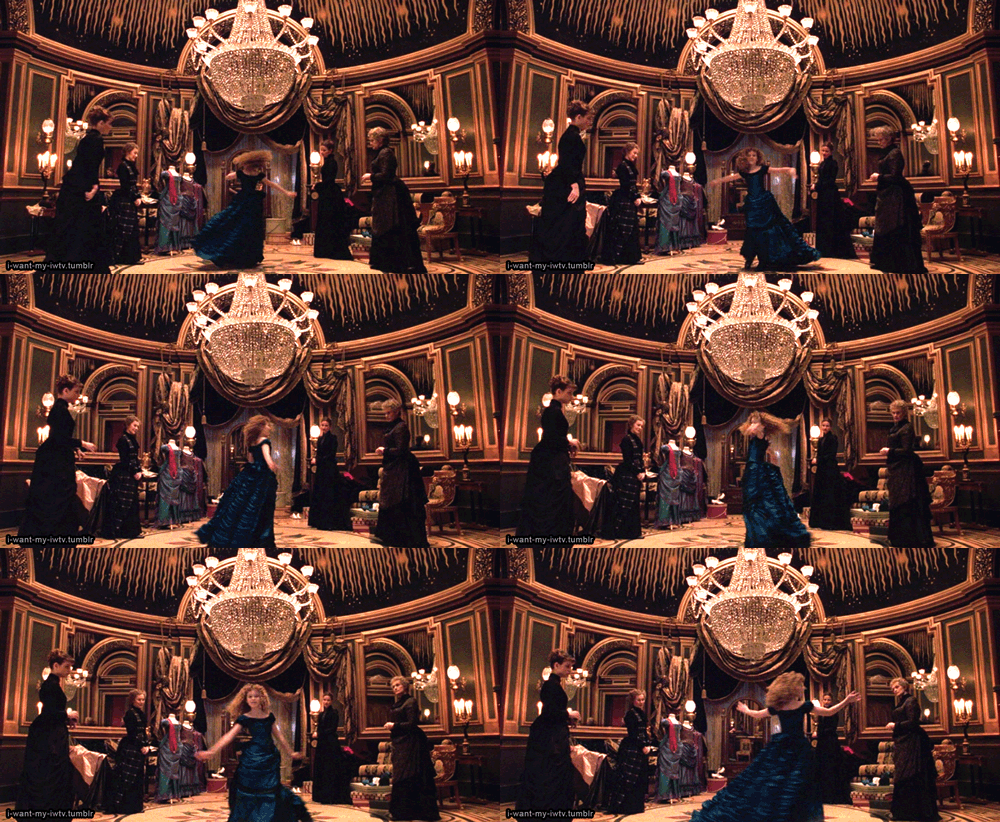
2. Her death was a failure in diplomacy, basically. The Theatre des Vampires, led by Santiago, held a kangaroo court (although they may have felt that they were within their rights) in which they found Claudia guilty of attempted murder of her maker, and decided to punish her with the death penalty.
Louis tried to protect her from it as best he could, he tried to make a deal to save her life, but failed. In the book:
“ `Listen to me, Lestat,’ I began now. `You let her go, you free her… and I will… I’ll return to you,’ I said, the words sounding hollow, metallic.
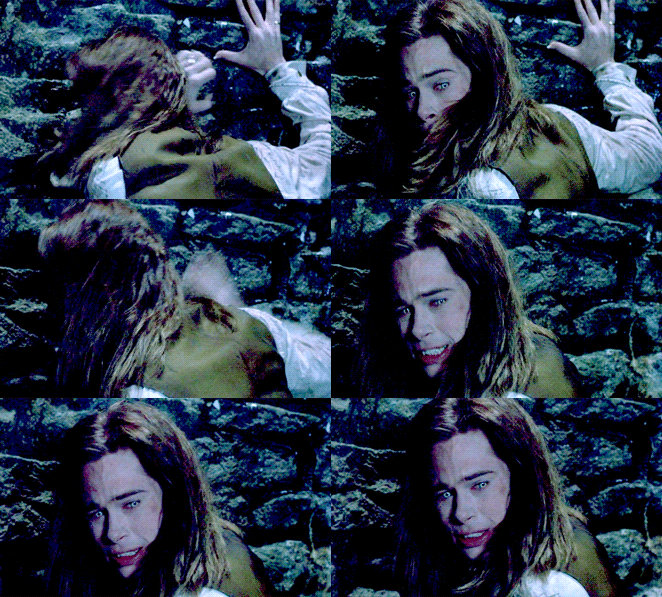
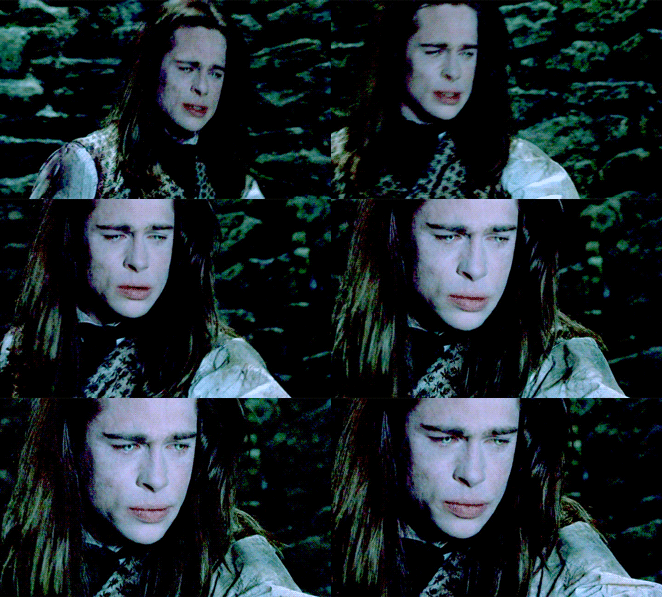
3. It kills a part of Louis when Claudia dies. His immediate reaction is extremely sad (not even factoring in the revenge he takes after).
I have a more thorough commentary on this scene here. It’s in this moment that Louis has lost the most precious person, the one who’s told him what to do, someone he could worship and follow, someone who metered out his doses of happiness with her approval. In the movie, he calls her “my child,” Armand tries to correct him: “Your lover,” and Louis compromises with “My beloved.”
In the book, the next night, Louis finds Lestat clutching Claudia’s bloody dress and sobbing over her death, too. Even though he was the very person who testified against her! Even he could not prevent their “justice.”
“And then I saw the thing in [Lestat’s] hands. I knew what it was. And in an instant I’d ripped it from him and was staring at it, at the fragile silken thing that it was – Claudia’s. His hand rose to his lips, his face turned away. And the soft, subdued sobs broke from him as he sat back while I stared at him, while I stared at the dress. My fingers moved slowly over the tears in it, the stains of blood; my hands closing, trembling as I crushed it against my chest.
Louis was expecting Claudia to go on and live with Madeleine, that he would still be in touch with her and see her occasionally. So that potential continued relationship was destroyed, too ;A;
4. What did Claudia mean to the audience/reader…
I know I sympathized with her and very much enjoyed her overall, and I like to think that other readers/viewers agreed, and don’t totally blame her for her actions against Lestat… after all, she was a victim herself. Lestat doesn’t blame her when he speaks of her in canon. We saw the love they both had for her ❤
Is that enough to convince the readers/audience to care enough for her that her death is sad for them? All those factors help!
~💀I hope that helps, Anon! Now make us cry!💀~
OKAY LIKE HI HELLO, I realize I haven’t killed anyone in my fics in a while but my never-gonna-be-fucking-finished novel is about death and grief and was closely based on my own grief process following the deaths of two of my friends in the span of three months so. Here’s what I want to say !!!
The points @i-want-my-iwtv are all super true, but I also want to say that to write an effective death scene or to be affected by a literary death you have to try to empathize with what death really feels like IRL. So, for me? Grieving hinged (and hinges, lbr, it never really goes away) on three things:
The immensity of the concept that you will never see the person again.
That as time goes by it’s not just “missing” them because you won’t see them again but that it’s been longer and longer and longer since the last time you saw them and you miss them the way you can even miss the living that you haven’t seen in a while.
The ruined potential of everything this person had to offer the world.
This is all pretty personal and grief is super emotionally complicated so obviously different people have different experiences and I AM SO EXCITED THAT AS CREATIVE HUMANS WE ALL HAVE WAYS TO EXPRESS WHAT WE INDIVIDUALLY WANT TO SAY ABOUT IT, that’s super special and I think it helps heal people a lot. But to me that’s kinda like how I narrow it down personally.
So when it comes to a story I think it’s going to depend on the POV of the text itself and also if the grief is more directed at other characters or at us as the reader.
Things to consider:
Are you trying to make us sad for US, for our own sake, because we will missing having the character around in canon? Are we attached to them?
Are you trying to make us sad for the survivor(s) of the death who we have grown to love?
In IWTV specially I think the movie does more of a job of letting us care about Claudia as her own person because see her with a bit of a wider frame, vs. the book I think heavily weighs on us caring about Louis and feeling empathy of his loss.
So if you want to make the character’s death “really sad” I think we have to first decide who we’re feeling sad for and go from there. Are we having to survive without them as a reader or are we just empathizing with someone like Louis, that we care about and feel sorry for?
EITHER WAY an important thing to note, whichever approach you take, is that we need to understand the value of this person and what they had to offer and why someone should miss them. If you’re trying to make your reader sad for the character I think it’s important to make sure they are valuable and liked and that we will care that they are gone. I think in the IWTV novel that Claudia is sort of cold and savage and by the time they’re in Paris she’s pretty cruel to Louis, so it’s natural for me not to feel personally affected by her loss, but as a reader I know that Louis is crushed because it’s the loss of his daughter. So even if the character is cold/cruel/unlikable/etc we can still hurt for someone who cares about them anyway.
So.
IDK!
@i-want-my-iwtv had super good points but I also just wanted to add that. Grief and death are messy and horrible and I think the emotional depth and sense of loss makes all the difference.
I think there are many ways to make a character’s death really sad, and bc we can all have different feelings about a given character, any individual reader will be very sad about the death, when another reader might be totally indifferent (or even glad!). I’ve only written fanfic myself, and I know what makes me sad when I read/write character death, that’s about as informed as I am on the topic, DISCLAIMER: I’m not a professional writer and this is not professional advice.
💀 Some things that come to mind re: making a character’s death really sad: 💀
How they die,
How preventable their death was,
How other characters feel their loss and/or the loss of their potential,
And how much that character meant to the reader/audience, did they like the character?
I don’t know what specifically you’re doing in the Memnoch timeline… I won’t use any examples of deaths from that book in case of spoilers (Idk sometimes I’m more respectful about spoiling ppl than other times *shrugs*)
In IWTV, it was a very sad death when Claudia died. It’s portrayed differently in the book(s) and the movie, but I’m just going to address it re: the points above generally and drawing from both.
1. She died by sunlight exposure and it seemed extremely painful.
Louis would not have seen it, so he can’t describe the moment of her death in the book, but it’s shown in the movie. Leading up to the death, the tension builds and builds, all these moments where Louis, Claudia and Madeleine are hoping for Armand (or some other deux ex machina) to swoop in and save them all. It doesn’t happen. Probably one of the last shreds of hope they had was when the troupe pull Louis and Claudia apart, from that point on, he can no longer protect her ;A;
As it was so painfully underscored in Claudia’s Story, the last name Claudia hears Louis call for is “Armand,” bc calling her name won’t do them any good. But to her, it feels like a final betrayal, that he’s calling for Armand bc he cares more about him ;A;
Claudia and Madeleine get locked in the well, and when Claudia sees the sunlight approaching, she’s already starting to cry, trying to wake Madeleine to try to figure out a way out… there is none and then they can only brace themselves bc there IS NO ESCAPE ;A;!! The acceptance of their own deaths is part of the tragedy.
It’s a pretty universally nightmarish situation, even though sunlight is not fatal for ppl (most, anyway), but we can all relate to the experience. It’s like being pushed onto subway tracks and not being able to escape in time ;A;
2. Her death was a failure in diplomacy, basically. The Theatre des Vampires, led by Santiago, held a kangaroo court (although they may have felt that they were within their rights) in which they found Claudia guilty of attempted murder of her maker, and decided to punish her with the death penalty.
Louis tried to protect her from it as best he could, he tried to make a deal to save her life, but failed. In the book:
“ `Listen to me, Lestat,’ I began now. `You let her go, you free her… and I will… I’ll return to you,’ I said, the words sounding hollow, metallic.
3. It kills a part of Louis when Claudia dies. His immediate reaction is extremely sad (not even factoring in the revenge he takes after).
I have a more thorough commentary on this scene here. It’s in this moment that Louis has lost the most precious person, the one who’s told him what to do, someone he could worship and follow, someone who metered out his doses of happiness with her approval. In the movie, he calls her “my child,” Armand tries to correct him: “Your lover,” and Louis compromises with “My beloved.”
In the book, the next night, Louis finds Lestat clutching Claudia’s bloody dress and sobbing over her death, too. Even though he was the very person who testified against her! Even he could not prevent their “justice.”
“And then I saw the thing in [Lestat’s] hands. I knew what it was. And in an instant I’d ripped it from him and was staring at it, at the fragile silken thing that it was – Claudia’s. His hand rose to his lips, his face turned away. And the soft, subdued sobs broke from him as he sat back while I stared at him, while I stared at the dress. My fingers moved slowly over the tears in it, the stains of blood; my hands closing, trembling as I crushed it against my chest.
Louis was expecting Claudia to go on and live with Madeleine, that he would still be in touch with her and see her occasionally. So that potential continued relationship was destroyed, too ;A;
4. What did Claudia mean to the audience/reader…
I know I sympathized with her and very much enjoyed her overall, and I like to think that other readers/viewers agreed, and don’t totally blame her for her actions against Lestat… after all, she was a victim herself. Lestat doesn’t blame her when he speaks of her in canon. We saw the love they both had for her ❤
Is that enough to convince the readers/audience to care enough for her that her death is sad for them? All those factors help!
Oh man, that is a lot to ask, and you’re correct in that I have not consumed a wide range of vampire media, especially in terms of historical/geographical/etc.
“A cliché or cliche is an expression, idea, or element of an artistic work which has become overused to the point of losing its original meaning or effect, even to the point of being trite or irritating, especially when at some earlier time it was considered meaningful or novel.”
Vampire fiction is so varied and has so many different rules compared to its first inception that I think it’s pretty free of ideas/elements that have “become overused to the point of losing their original meaning or effect, even to the point of being trite or irritating.”
One cliché is the “I vaaant to suck your blooood!” line that a vampire might say to a victim, originating in vampire movies from decades ago, but it’s more of a comical thing now. It can also be modified slightly to increase the comedy:
I will say that some of my fave vampire media takes existing clichés and/or rules/conventions about vampires, and interprets it in a different way or ignores it completely.
I think it’s more important to consider existing conventions/rules, and how your vampires will operate within them, if at all. I have some stuff mixed into my #vampire physiology tag, but not a complete list.
A few conventions/rules are already widely varied in different vampire media:
Vampires can’t walk around in sunlight –
In most vampire media, vampires exposing themselves to sunlight will get them severely burned or killed immediately.
In Byzantium, I think they can walk around in sunlight with no problems at all.
In Twilight, the vampires are physically able to do so, but they’re dazzling in the sunlight, so they stand out as non-human when they do (and that’s bad bc revealing themselves as non-human could risk harm from mortals).
Vampires require blood to survive, but they are immortal, so “survive” is more like, “a healthy vampire is one that is feeding on a regular basis, but it’s not a requirement.” – I can’t think of an example of vampires that die from not drinking blood regularly… but I think the What We Do in the Shadows and Only Lovers Left Alive vampires will rapidly weaken if they don’t feed often.
Vampires don’t have reflections in mirrors – the Bram Stoker’s Dracula (1992), What We Do in the Shadows, and
Only Lovers Left Alive
vampires
don’t have reflections, but the Interview with the Vampire ones definitely do.
Vampires have to be invited into their victim’s home – Only seen this being an issue in the two adaptations of Let the Right One In.
Vampires are harmed by crosses/crucifixes – Saw this as an issue in the What We Do in the Shadows vampires, that it frightens Deacon that he might be in close proximity to a cross, but it’s unclear what would happen if he touched it. In Fright Night, a vampire touching a cross ignites it in flames but it doesn’t seem to stop him from continuing to attack.
So what I’m saying is that you can explore different conventions/rules of vampires and then pick and choose which you’ll incorporate into your vampires, or invent whole new rules!
I wanted to share my progress story of the past sixteen years because I know how hard it is to not give up, because I know how much crap you have to produce to finally start producing something slightly less crappy. Because I know it’s hard to look at all that gorgeous art on the internet and not be discouraged.
I’m still learning, I’m still not happy with what I can do. I may never be. But it doesn’t matter.
You have time, you can do this. Just don’t give up.
I used to think tension and conflict were the same thing. I mean don’t they go together?
Well, a lot of the time they do, but it’s entirely possible to have one
without the other. They often go hand-in-hand, but they aren’t the same
thing. Conflict doesn’t necessarily equal tension, and tension doesn’t
equal conflict.
Lately I’ve been editing stories that seem to have so much conflict and
no tension! I don’t care about the conflicts. I don’t care about the
characters. Because there is no tension.
Tension isn’t the conflict.
A couple of months ago, I wrote this post on Mastering Stylistic Tension. In the comments, Becca Puglisi said:
I learned a long time ago that while conflict and tension are often
considered to be synonymous, they’re different. Tension is key for
winding up the character’s—and therefore the reader’s-emotions.
I admit that for some reason I read it as “Tension is the key for
winding up,” and my mind filled with an actual image of a key winding
something up. Tension winds up. Conflict is problems that collide.
Tension doesn’t need problems to collide, tension is often the promise or potential for
problems colliding. My oldest brother pointed out that there are action
movies that have conflict after conflict, but no tension. They are a
spectacle–blasts, explosions, fire. Then, he went on to say, there are
movies like Jaws that have scenes that work largely off tension.
I said in my Mastering Stylistic Tension post, “In some ways, it’s not the conflict itself that draws readers in, it’s the promise of conflicts,” which is often the tension.
Tension invests us personally in the story. We feel it. It’s
anticipation, it’s hope or dread for what will happen. It’s a tangible subtext or undercurrent for what could happen.
Tension is defined as a straining or stretching; intense suppressed emotions.
Conflict means “to come to a collision;” to fight or contend.
So tension may suggest a conflict, but it is not the conflict itself.
Conflict may be an object, but tension is the key winding it up.
Sometimes writers try so hard to put in so much conflict to make their
stories interesting when what their story needs is tension for the
conflicts they already have.
I’ll give an example from my own experience.
Last year I was working on a sequence of flashbacks for my novel. While
not the main purpose of the flashbacks, it was important that I
illustrate a romantic relationship in them, because the relationship
itself is important to a main character and what happens in the present
timeline. I was stuck trying to figure out how to communicate the
uniqueness and complexity of the relationship in such a short space. In
an old, old version of this story, I had planned to use a lot of
romantic gestures to convey the relationship, but in working on these
flashbacks, I realized that the romance and the conflict it brought
(which deals with “forbidden love”) wasn’t as powerful as the tension it could have.
I scrapped the idea of the characters touching and kissing, and instead focused on their powerful desires to touch and kiss when they weren’t allowed or able to; I gave one of
the characters a particular reason and a personal commitment to not give
the other affection.
The scene immediately became more interesting. The tension was palpable,
their desires electric, but because they could not give into their
desires, the tension couldn’t release, regardless of how much they or
the audience wanted it to.
The conflict is forbidden love, but the tension is held in the drawn out moments of a desire that can’t be manifested.
This is one of the reasons that sexual tension can be so powerful in
stories. It’s not the colliding problems that come with being with that
person, it’s the subtext and undercurrent of wanting to be with that
person, but not being with them. Once the couple is together, that
tension ends.
Likewise, some of the best dialogue comes from tension, not straight-up
conflict. It comes from subtext, from what’s not being directly said.
Once the dialogue becomes direct, the tension ends and the problems
collide in conflict. Tension often comes before direct conflict. And if
that isn’t happening much in your story, it should.
As Mindy Kaling once explained, sometimes the best tension comes from
the characters trying to avoid conflict, from them trying to stop it
from bubbling out into the open. The closer the conflict gets to the
open and the harder a character tries to stop it, the stronger the
tension gets. It winds up, tighter and tighter. We as an audience
anticipate its release.
That’s what draws a reader into the story.
So make sure that your story has tension and conflict, and not just one
or the other. If you have a story with a bunch of conflict, but your
readers aren’t interested, you may need more tension. If you only have
tension and no conflict, the reader may end the story feeling cheated.
Use both.














 I-want-my-IWTV
